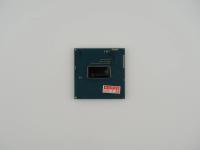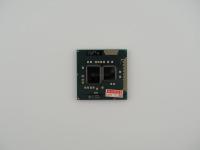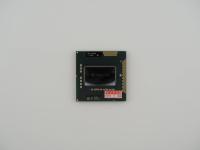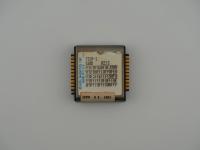

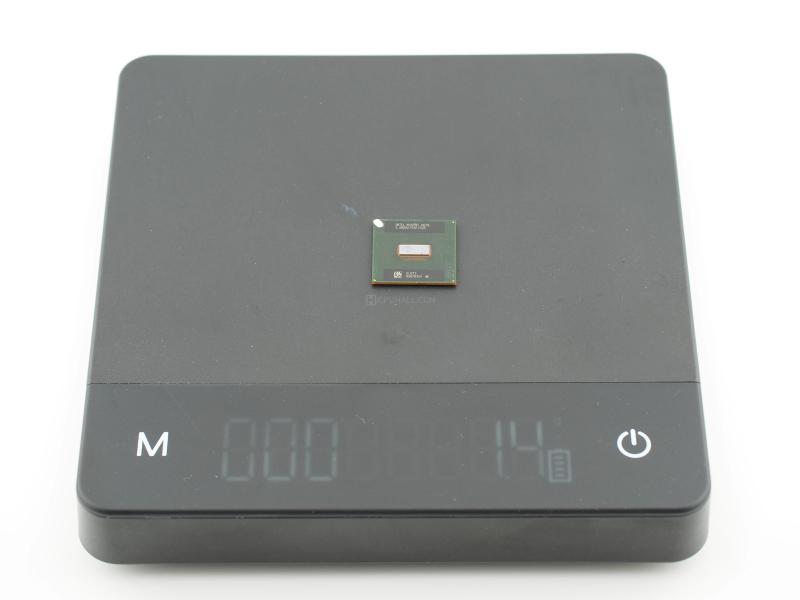
Unlike the massive ceramic behemoths or gold-plated mainframe slices in my collection, this little square of green organic substrate is a featherweight. Tossing it on the scale confirms it weighs exactly 1.4 grams. Measuring roughly 22 by 22 millimeters, it is a prime example of high-volume, low-margin mobile silicon.
There is nothing exotic about the materials here. We are looking at a standard flip-chip ball grid array layout with a tiny, bare silicon die right in the center. Flipping it over reveals a dense, almost fully populated grid of solder balls waiting to be permanently reflowed onto a cheap motherboard.
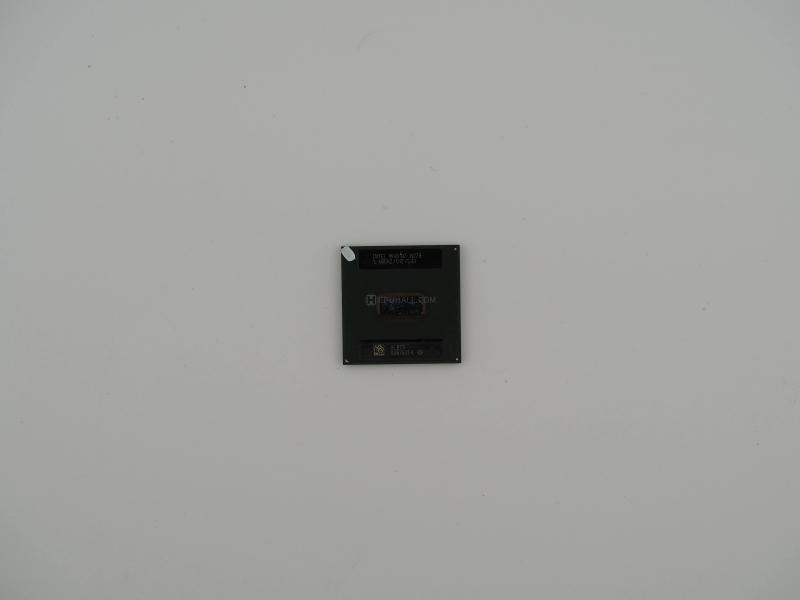
The laser etching on the dark die surface is remarkably crisp, allowing us to perfectly identify this artifact. The transcriptions are as follows:
Top Left Package Text:INTEL (M) (C) '07 N270
1. 60GHZ / 512 / 533
Bottom Die S-Spec Text:SLB73
Q007B354 (e1)
The micro-contrast of the engraving shows virtually no wear, meaning this chip likely sat in a tray or was salvaged from an unpowered board rather than surviving a brutal desoldering process.
To understand the engineering of the Intel Atom N270, we have to talk about taking a massive step backward to move forward. Built on Intel's 45nm fabrication node, the Diamondville architecture deliberately threw away years of complex processor evolution.
At the time, Intel's Core 2 Duo line was dominating the world with sophisticated out-of-order execution engines. But those engines ran hot and consumed power. For the Atom, Intel reverted to an in-order execution architecture. This meant the processor processed instructions exactly in the order they were received. If a piece of data was delayed in memory, the whole pipeline stalled out. To hide this brutal latency penalty, Intel bolted on Hyper-Threading, allowing the chip to juggle two threads at once. While one thread was stalled waiting for memory, the other could push forward.
The most impressive metric of this artifact is not its 1.60 GHz clockspeed or its meager 512 KB of L2 cache. It is the Thermal Design Power. The N270 boasts a TDP of just 2.5 Watts. This allowed manufacturers to build laptops without fans, relying entirely on passive cooling to dissipate the tiny amount of heat generated by the core. It communicated with the rest of the system via a rather archaic 533 MHz Front Side Bus.
This specific unit represents a very weird, highly specific era in computing history. The era of the "Netbook."
Around 2008, the world was hit by a financial crisis, and suddenly, nobody wanted to spend a thousand dollars on a laptop. Enter devices like the Asus Eee PC and the Acer Aspire One. These were tiny, cramped, plastic clamshells that cost roughly two to three hundred dollars. And powering almost every single one of them was the Intel Atom N270. Intel practically flooded the global market with these chips, selling them at rock-bottom prices just to ensure ARM processors could not get a foothold in the emerging mobile computing space.
There is a myth that netbooks were actually good computers. They were not. The in-order architecture of the Atom was notoriously sluggish. Users quickly realized that while the N270 was fine for opening a basic text document, it would absolutely choke on rich web pages, Flash video, or any kind of multi-tasking. It was a processor built for a very narrow window in time, right before smartphones and true tablets made the entire netbook form factor completely obsolete. Having this in the museum is a reminder of that chaotic, brief gold rush of the cheap mini-laptop.
Identifying this artifact requires no guesswork. The markings are loud and clear. The SLB73 S-Spec is the definitive code for the retail stepping of the mobile Atom N270.
The (C) '07 copyright date points to the initial masking and design finalization, while the release of the chip officially occurred in the second quarter of 2008. The Q007 batch code gives us a window into its manufacturing timeline, indicating it was produced right as the netbook boom was reaching its peak volume.
There are no mysteries or Cold War secrets etched into this silicon. It is a mass-market workhorse, built to incredibly tight cost constraints. Its presence in the collection serves as a perfect foil to the multi-million dollar mainframe modules sitting on the shelf next to it.