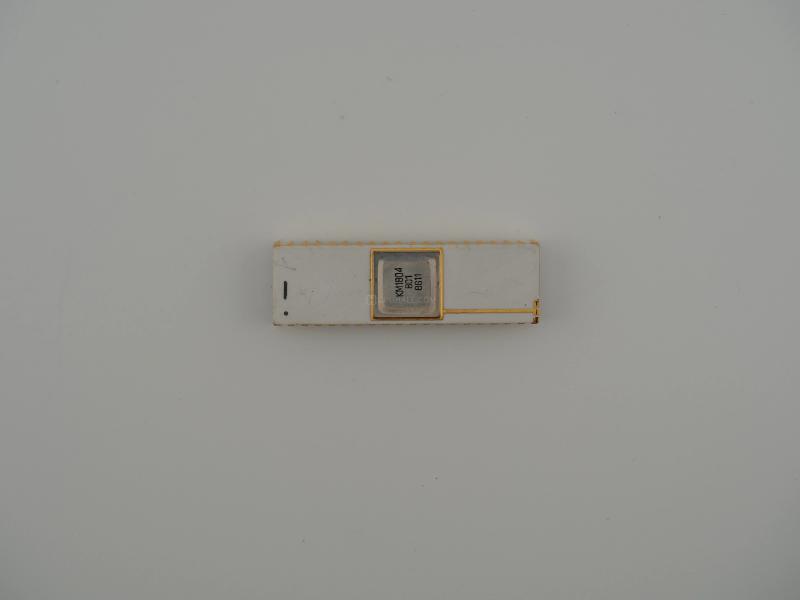

Looking closely at the top of this artifact, the markings are stamped in crisp black ink directly onto the bare ceramic, just below a stunning, square gold cap that protects the silicon die. There is a distinct, thick gold trace running laterally from the center cap all the way to the right edge of the package, terminating at a specific pin. This is a beautiful artifact of vintage packaging where grounding or testing points were explicitly routed over the surface.
Top Markings:КМ1804
ВС1
8611
Bottom Markings:1391
U5
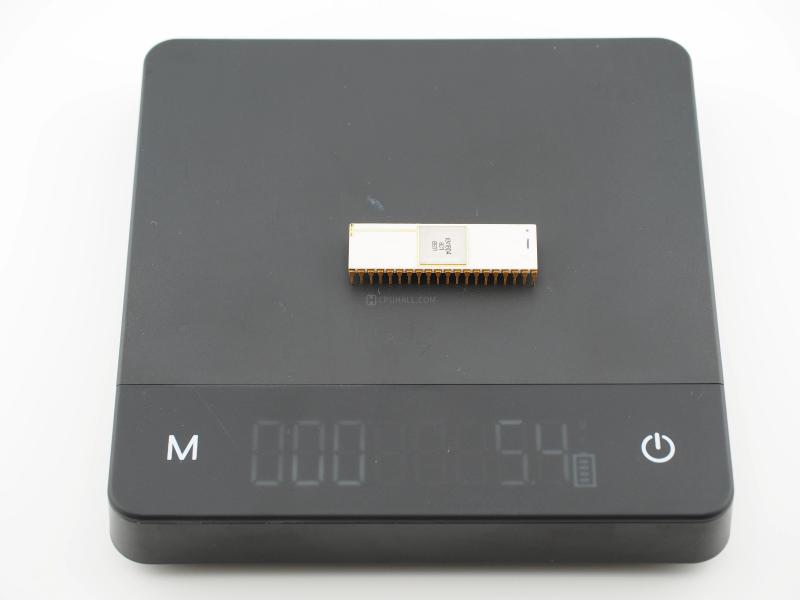
The Cyrillic lettering translates directly to the Latin "KM1804VS1". The printing is spartan and utilitarian. There is a black alignment bar and a dot on the left side indicating Pin 1, but the surface is otherwise completely devoid of any consumer branding. Turning the chip over, the stark white ceramic continues, interrupted only by the mysterious factory codes 1391 and U5. The side-brazed pins are generously plated in gold, a hallmark of aerospace and military-grade hardware designed to resist corrosion in harsh environments.
This artifact is a 4-bit microprocessor slice, an exact silicon-level clone of the legendary AMD Am2901. To understand the engineering here, we have to look back at how computing worked before the dominance of single-chip microprocessors. Instead of cramming an entire CPU instruction set onto a single piece of silicon, bit-slice technology allowed computer architects to build modular processors.
The KM1804VS1 acts as a fundamental building block. It contains a high-speed Arithmetic Logic Unit (ALU) and sixteen 4-bit registers. If an engineer wanted to build a 16-bit processor for a radar system or a minicomputer, they would literally wire four of these chips side by side. If they needed a 32-bit system, they used eight. This horizontal partitioning meant that the data paths and control logic could be scaled to any word length required by the application.
Under the gold cap, this chip relies on bipolar Low-Power Schottky TTL technology. Unlike the slower MOS chips of the 1970s and 1980s, bipolar TTL was blindingly fast, allowing the Am2900 series to operate at speeds that eclipsed standard microprocessors of the era. Because it is a bit-slice component, it does not have a traditional fixed clockspeed. Its performance depended entirely on the microcode sequencer and the surrounding hardware it was integrated into, making it a highly flexible and extremely powerful tool for custom computing.
The history of the 1804 series is deeply intertwined with Cold War geopolitics. During the 1970s and 1980s, the Soviet Ministry of Electronic Industry operated under strict directives to achieve computing parity with the West. Because of heavy embargoes on high-technology exports, the USSR turned to meticulous reverse engineering.
There is a common, slightly dismissive myth that Soviet engineers were incapable of designing their own architectures. The reality is far more pragmatic. The Soviet military apparatus needed absolute reliability and, more importantly, software compatibility with Western systems. Creating a custom architecture would mean writing compilers, operating systems, and diagnostic tools from scratch. By cloning the AMD Am2900 family, Soviet engineers gained instant access to a proven, highly modular ecosystem.
The Am2900 series was the ultimate "Lego set" for computer design. In the United States, it powered everything from arcade games to the data sequencers on the Voyager space probes. In the USSR, the 1804 series became the backbone of military computing, custom mainframes, and robust industrial controllers. Holding this clone is like holding a mirrored reflection of Western computing history, manufactured behind the Iron Curtain.
Identifying Soviet silicon is always a forensic exercise. Based on my research and observation of the surface codes, we can decode the exact provenance of this artifact.
The prefix K indicates that this was intended for general commercial or industrial use, while the M stands for metal-ceramic packaging. The 1804 designates the specific integrated circuit family assigned to the Am2900 clones. The VS1 (written in Cyrillic as ВС1) identifies the specific function of the chip within that family, which is the 4-bit ALU slice. The date code 8611 places the manufacturing of this specific unit in the 11th week of 1986.
What makes this specific unit fascinating is what is missing. There is no manufacturer logo anywhere on the package. Typically, major Soviet semiconductor plants like Angstrem or Exiton would stamp their distinct logos on the ceramic. The absolute lack of a factory mark on this chip suggests it was either part of a clandestine state-directed production run where plant identification was scrubbed, or it was an early batch where the packaging process skipped the final branding step. The mysterious 1391 and U5 on the back are likely internal batch or inspector codes, but without the original factory databooks, those numbers remain a beautiful mystery of the Soviet electronic state.