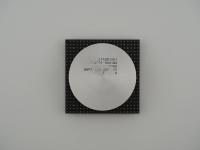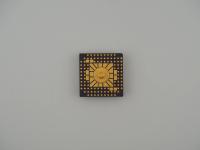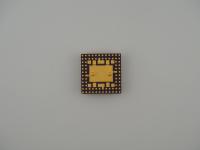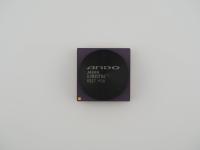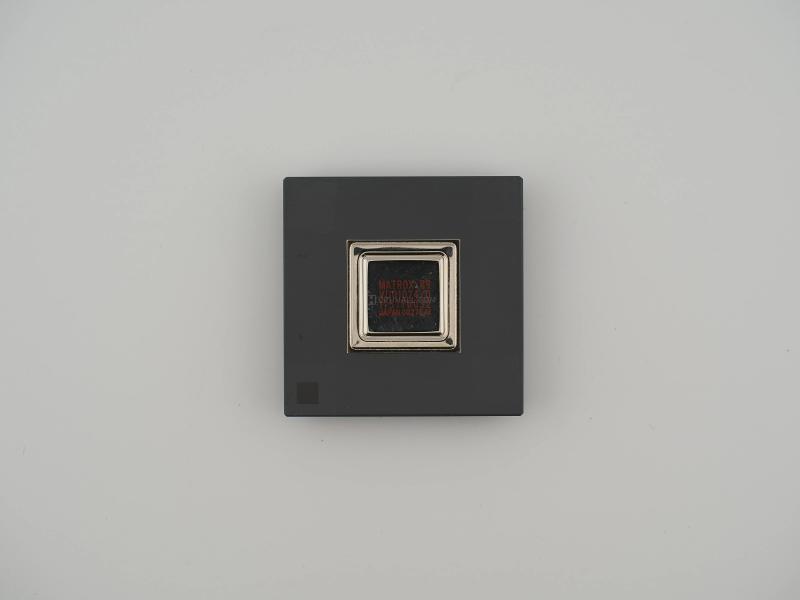

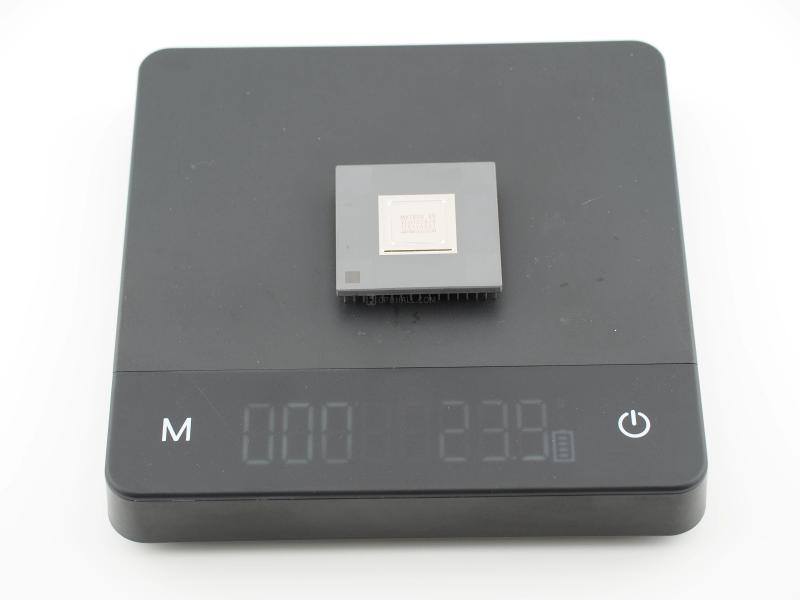
Hitting the scale at exactly 23.9 grams, it possesses a satisfying, armor-like heft that modern organic substrates simply cannot replicate. The contrast between the bright metal cap and the dark grey ceramic substrate is visually striking.
Here is the exact surface transcription:
MATROX 89
VD01024/0
1151Y0032
JAPAN 0027EAI
Flipping the chip over reveals a beautiful 200-pin array. The pins are arranged in a strict 15 by 15 grid, with a perfectly hollow 5 by 5 center. The brazing on the pins is immaculate, showing zero signs of bend or aggressive insertion wear. It is a textbook Ceramic Pin Grid Array package, built for serious I/O and thermal stability.
When we talk about hardware from the year 2000, consumer graphics chips were rapidly moving toward cheaper plastic ball-grid arrays or flip-chip designs to cut costs. Matrox, however, chose a robust CPGA package for this specific piece of silicon. This decision points directly to the chip's operational environment. It was designed to run hot, demanding continuous, uninterrupted performance where thermal throttling was not an option.
The raised metallic cap acts as an integrated heat spreader. This was necessary to quickly move thermal loads away from the fragile silicon die underneath. In the context of high-end video editing or industrial display processing, dropped frames or graphical artifacts caused by heat soak were unacceptable. The 200 pins provided the necessary bandwidth to interface with massive banks of onboard memory and directly communicate with the PCI bus architecture of the era. While we do not have the exact transistor count, the die size hidden beneath that cap represents a significant investment in custom logic.
While the gaming world in the late nineties was completely consumed by the 3D accelerator wars between 3dfx, Nvidia, and ATI, Matrox was playing an entirely different, much more lucrative game. They owned the professional non-linear editing (NLE) and broadcast market. If you were working in a television studio or doing serious video production, your workstation likely had a massive Matrox card dominating its internals.
Chips like this VD01024/0 were the unsung heroes of the broadcast industry. They were the custom "heavy metal" ASICs that allowed editors to render real-time transitions, handle hardware-accelerated MPEG-2 encoding, and push multiple video streams simultaneously without bringing the host CPU to its knees. There is a common myth that Matrox simply lost the 3D graphics war because their engineering fell behind. The reality is that they pivoted to where the margins were highest. They poured their R&D into proprietary silicon like this to dominate the professional sector.
Identifying proprietary ASICs is always a thrilling challenge. These chips were never sold individually at retail. They were soldered directly onto high-end expansion boards that cost thousands of dollars.
The VD in the part number VD01024/0 most likely stands for Video Decoder or Video Device. The date code 0027EAI is the golden key here. It tells us this chip rolled off the fabrication line in the 27th week of the year 2000. This perfectly aligns with the release window of Matrox's legendary RT2000 and DigiSuite line of video editing platforms.
The JAPAN designation is also highly revealing. Matrox did not own their own foundries. For their most complex, high-yield custom silicon, they historically partnered with Japanese manufacturing giants like NEC or Toshiba. I strongly suspect one of these two fabricators produced this die based on Matrox's logic design. Finding a public datasheet for this specific part number is nearly impossible because it was strictly internal IP. However, the physical evidence of the robust CPGA package, the timeline, and the nomenclature all point to a high-end video processing engine that once lived on a massive, expensive professional PCI card.