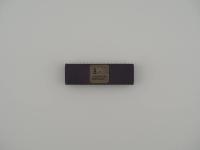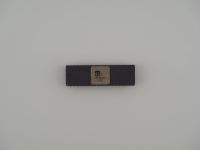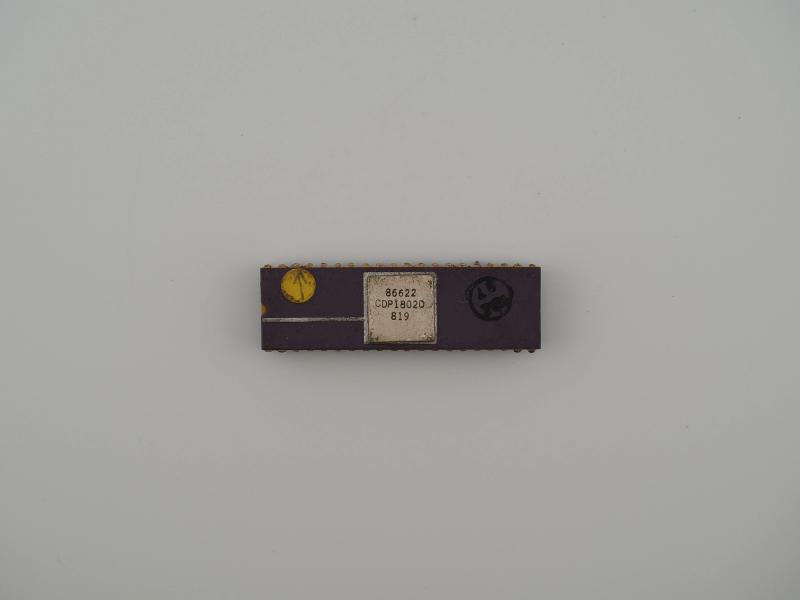

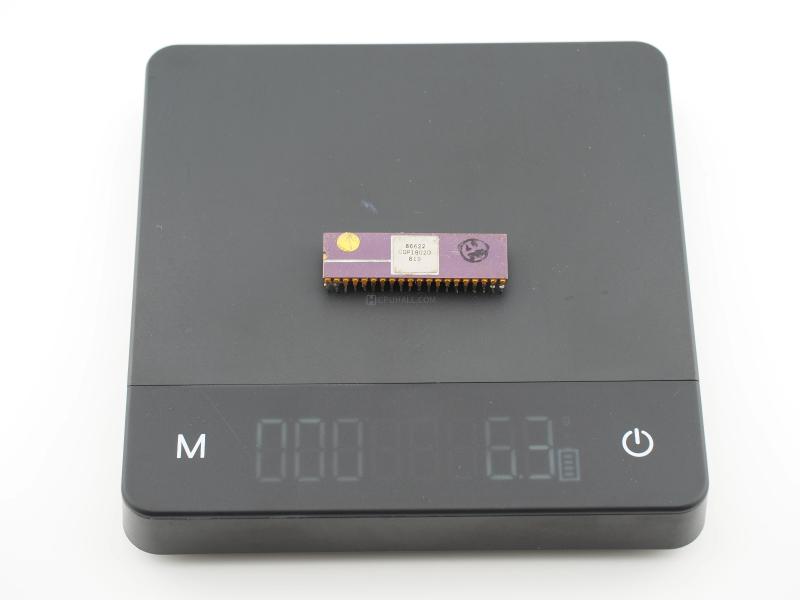
Holding this specific unit immediately grounds you in the reality of cold war era computing. The 6.3 grams of mass register on the scale with a dense, substantial feel that modern silicon simply lacks. The package is a stunning deep purple alumina ceramic, a material choice that practically screams high-reliability aerospace engineering. Looking closely at the top, a beautifully brazed silver metal cap protects the die cavity.
I can clearly read the laser-etched markings on the cap:
86622
CDP1802D
819
To the left of the cap is a classic yellow dot sticker with an arrow indicating pin 1 orientation. To the right, there is a circular black ink stamp, slightly faded and smudged by time, which looks like a quality assurance or military inspection mark.
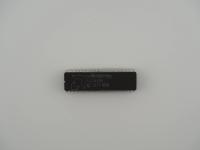
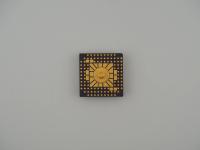
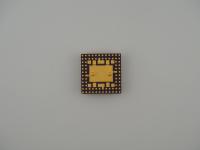
Flipping the artifact over, the underside of the purple ceramic features faint silver stamping that reads:
XWZED0000
The gold-plated pins are side-brazed directly into the ceramic substrate. This is a very expensive manufacturing technique designed to survive extreme thermal shock. The pins themselves show localized dark oxidation and slight solder residue, indicating this chip was socketed and likely saw active field use before it ended up in my collection.
Diving into the architecture of the RCA 1802 reveals a fundamental shift in how engineers approached processor design in the 1970s. While Intel and Zilog were pushing power-hungry NMOS logic to gain raw speed, RCA built the 1802 entirely on CMOS (Complementary Metal-Oxide-Semiconductor) technology.
Because it uses CMOS, the 1802 features a fully static core. This means there is no minimum clock frequency requirement to keep the internal registers refreshed. You can literally drop the clock speed down to zero Hertz, completely pausing the processor, and it will draw almost zero power while perfectly retaining its internal state. Once the clock resumes, it picks right back up.
Internally, it features an incredibly orthogonal instruction set and a generous array of sixteen 16-bit registers. This was massive for an 8-bit chip of its era. The D suffix in its part number denotes the side-brazed ceramic dual inline package, ensuring the delicate silicon die remains hermetically sealed against moisture, dust, and corrosive environments.
The lore of the COSMAC 1802 is literally out of this world. It is the undisputed king of early spaceflight computing.
Because CMOS logic requires less power, it naturally runs much cooler than NMOS. But more importantly, the specific fabrication techniques RCA used gave the 1802 an inherent resistance to cosmic radiation and single-event upsets. NASA engineers quickly recognized this potential. The 1802 became the primary microprocessor for the Galileo spacecraft, managing critical systems as it voyaged to Jupiter. It also powered numerous amateur radio satellites and military aerospace projects.
Back on Earth, it gained a cult following among hobbyists. The COSMAC ELF was a legendary do-it-yourself computer featured in Popular Electronics magazine, teaching thousands of enthusiasts how to toggle hex codes directly into memory. It is a fantastic historical irony that while other companies fought bloody wars over the desktop PC market, RCA quietly locked down the vacuum of deep space.
Decoding the physical evidence on this chip points directly to late 1970s or early 1980s industrial production.
The CDP prefix is RCA's standard identifier for commercial and industrial digital components. The 1802 designates the legendary COSMAC architecture. The D suffix is the critical identifier for the physical package, confirming it as a ceramic side-brazed DIP rather than the much cheaper and common E suffix plastic packages.
The numbers 819 at the bottom of the metal cap almost certainly represent the date code. In the standard industry format of Year/Week, this points to the 19th week of either 1978 or 1981. Given the widespread use of the 1802 during that exact window, 1981 is a highly probable manufacturing date. The top number, 86622, is likely a specific manufacturing lot code or a contract tracking number. The XWZED0000 stamp on the bottom is an internal factory tracking code, commonly seen on side-brazed ceramics from this era to track the specific substrate batches.
While I do not have the exact mission log for this specific unit, the robust packaging and QA inspection stamps strongly suggest it was pulled from high-end industrial machinery, avionics, or early telecom switching equipment. It stands as a brilliant example of computing history where absolute reliability was prioritized over pure computational speed.