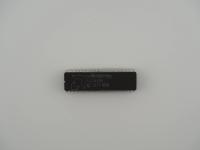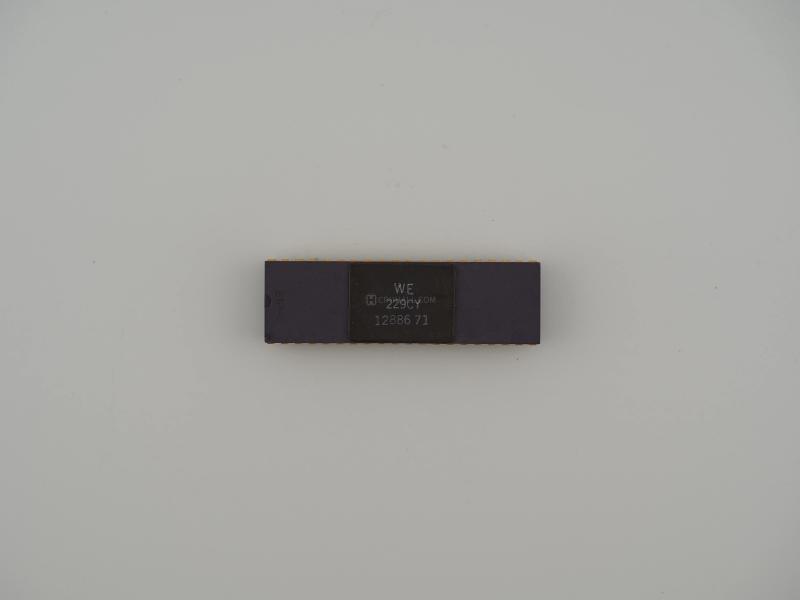

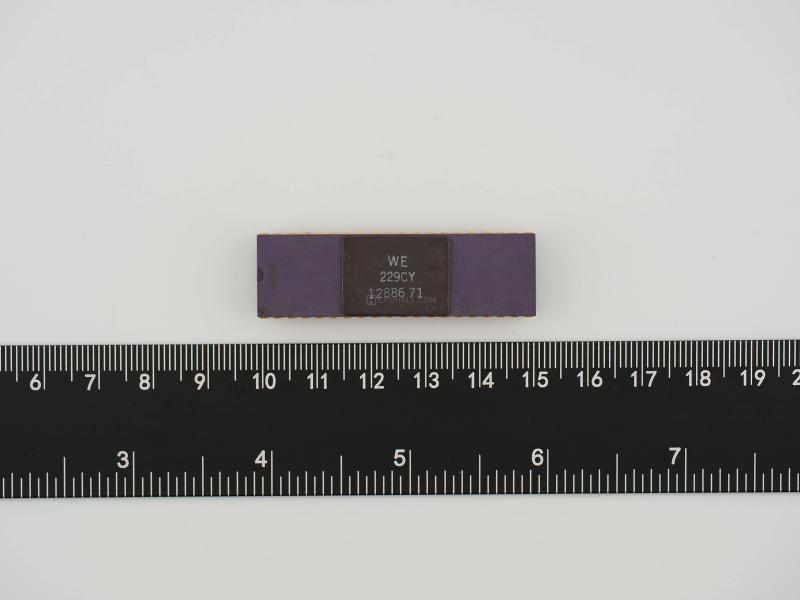
When I place this specific unit on the scale, it registers a solid 7.2 grams. The package is a gorgeous purple ceramic, a hallmark of mid-to-late 20th-century industrial and military-grade silicon. The top face features a dark, slightly textured ceramic lid that contrasts beautifully with the bright gold of the side-brazed pins.
The surface text is laser-etched directly onto the lid, crisp and legible:
WE
229CY
12886 71
On the extreme left edge of the ceramic substrate, there is also a faint, debossed E12- marking. The gold brazing on the side of the 40-pin Dual In-line Package (DIP-40) is immaculate.
From a mechanical standpoint, side-brazed ceramic DIPs were the absolute gold standard for high-reliability applications before the industry shifted en masse to cheaper plastic molds and surface-mount technologies. The manufacturing process involved firing multiple layers of ceramic with internal metal traces, then brazing the external gold-plated pins to the exposed contacts on the sides. Finally, the silicon die was seated inside the cavity, wire-bonded, and hermetically sealed with that dark top lid.
This packaging style is incredibly robust. The ceramic provides excellent thermal dissipation compared to plastic, which was essential for densely packed telecommunications racks running continuously without active cooling. While I do not have a die shot to count the microscopic transistors, a DIP-40 package from this era typically housed complex logic. This ranged from 8-bit microprocessors to specialized peripheral controllers and early custom digital signal processors. The sheer number of pins indicates it needed to interface with a wide parallel data bus or handle numerous discrete input and output lines.
The "WE" logo immediately identifies this as a product of Western Electric, the legendary manufacturing arm of AT&T. To understand the significance of this chip, one must understand that Western Electric was basically a shadow Silicon Valley operating in parallel to companies like Intel and Motorola. Because AT&T held a legal monopoly on the American telephone network for decades, they built practically everything in-house. They demanded absolute, uncompromised reliability. A telecom switch was expected to have mere minutes of downtime over a span of several decades.
Western Electric produced incredible custom silicon to meet these extreme demands, including the famous BELLMAC series of microprocessors. They strictly did not sell these chips on the open consumer market. If you found a Western Electric chip in the wild back in the day, it was because it had been salvaged from a decommissioned Bell System telephone exchange or a commercial PBX system. The lore surrounding these chips is deeply steeped in the history of the Cold War and the sheer engineering brute force of the Ma Bell monopoly.
The exact functional schematic of the WE 229CY is shrouded in the typical mystery that surrounds proprietary telecom logic. When researching these parts, one rarely finds a standard consumer datasheet floating around the internet. Instead, these chips were documented in massive, proprietary internal Bell System manuals that were often shredded when equipment was scrapped.
Let us break down the numbering to establish a timeline. The 12886 marking is almost certainly a date code. In the realm of vintage ICs, this format frequently maps to a Julian date or a specific plant and week combination. My working theory based on similar artifacts is that 1 signifies the fabrication plant (possibly the famous Allentown, Pennsylvania facility), 28 stands for the 28th week of the year, and 86 denotes the year 1986. The 71 trailing below could be a batch identifier or a specific quality control inspector mark.
While I cannot definitively confirm the internal architecture without an authentic Bell System service manual, the DIP-40 package from 1986 strongly suggests this is a complex state machine, an interface controller, or a custom microcontroller designed for a specific central office line card. It lacks the massive footprint of a central routing processor, but it clearly possessed enough logic to require a full 40-pin interface. The mystery is ultimately part of the appeal. It stands as a physical artifact of a closed, highly secretive technological ecosystem that once connected the entire world.