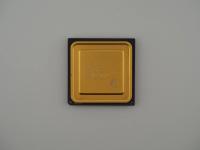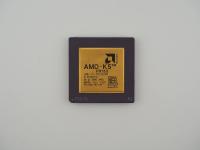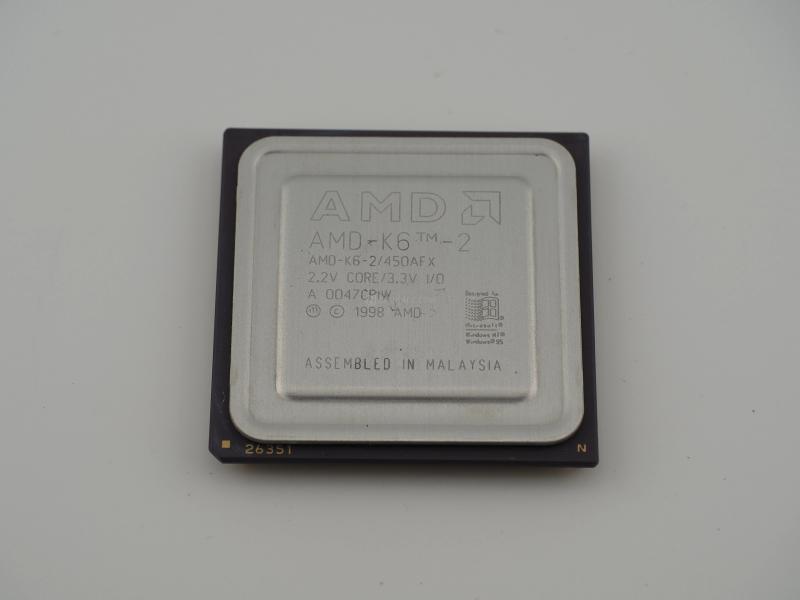

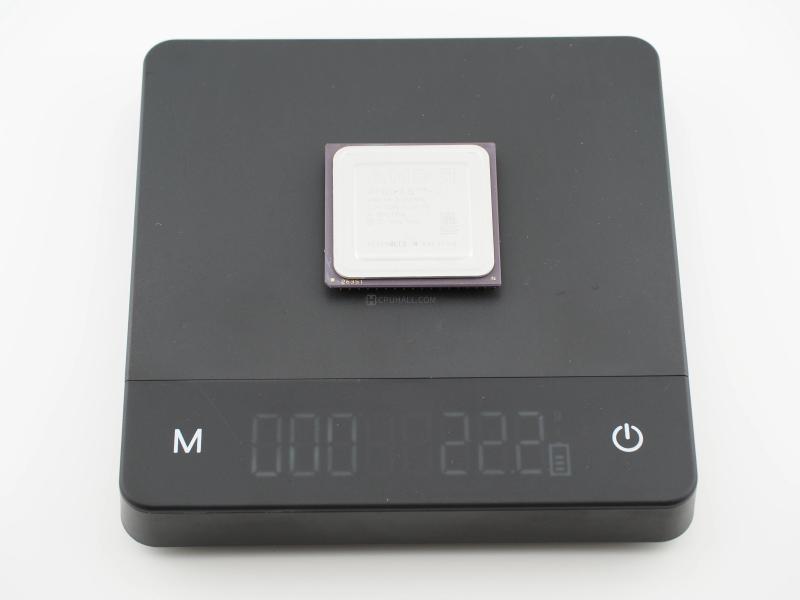
The physical density of the Ceramic Pin Grid Array package immediately stands out. It has a solid, utilitarian heft that modern fiberglass substrates simply lack. The top of the chip features a stamped aluminum heat spreader designed to protect the bare die from the crushing force of heavy aftermarket heatsink clips.
The laser etching is beautifully preserved against the slightly frosted, micro-porous texture of the aluminum cap. Down in the bottom corners, we have a small gold square indicating pin 1, alongside the factory batch markings 26351 and N.
Here is the exact transcription of the top spreader:
AMD
AMD-K6(TM)-2
AMD-K6-2/450AFX
2.2V CORE/3.3V I/O
A 0047CPIW
(M) (C) 1998 AMD
Designed for Microsoft Windows NT Windows 95
ASSEMBLED IN MALAYSIA
Flipping this artifact over reveals the 321 gold-plated pins of the Socket 7 interface. I immediately noticed a paper inventory or warranty sticker adhered directly to the center of the pin grid. It features the letters LTXH, several Chinese characters, and hand-marked dates indicating 01 and 12. This is a classic hallmark of the Asian gray market or a regional system builder's warranty seal. The pins themselves look pristine with no bent leads or obvious oxidation.
Diving into the silicon, the AMD K6-2 is a masterclass in squeezing every last drop of potential out of an aging platform. This specific piece of silicon is built on a 0.25 micron fabrication node and houses approximately 9.3 million transistors.
The engineering magic of this chip lies in its front side bus and voltage requirements. The AFX suffix in the part number tells us exactly how this chip was meant to be driven. The A denotes the 321-pin CPGA package. The F indicates a core voltage requirement of 2.2V, while the I/O voltage remains at the standard 3.3V to interface with Socket 7 motherboards. Finally, the X specifies a maximum operating case temperature of a rather toasty 65 degrees Celsius.
To hit that 450 MHz clockspeed, this processor relied on the Super Socket 7 platform, pushing the front side bus up to 100 MHz and applying a 4.5x multiplier. Because the L2 cache was located on the motherboard rather than on the CPU die itself, pairing this chip with a high-quality motherboard featuring fast SRAM was absolutely critical to extracting its full performance.
This is the chip that made Intel sweat. In the late 90s, Intel wanted everyone to abandon Socket 7 and migrate to their proprietary Slot 1 architecture for the Pentium II. AMD refused to play that game. Instead, they took the aging Socket 7 standard, cranked the bus speed to 100 MHz, and created the "Super Socket 7" ecosystem.
The defining legacy of the K6-2 is the introduction of 3DNow!. Intel had MMX, which was great for integer math and 2D media, but AMD recognized that the future of PC gaming lay in floating-point geometry calculations for 3D graphics. 3DNow! was a set of 21 new SIMD instructions specifically designed to accelerate floating-point math. When game developers like id Software patched titles like Quake II to support 3DNow!, the budget-friendly K6-2 could suddenly trade blows with Intel processors that cost twice as much. It cemented AMD's reputation as the gamer's choice for value.
The laser etchings are entirely unambiguous. While the copyright date clearly states 1998, a close reading of the date code 0047CPIW reveals the true manufacturing date of this specific unit. It was fabbed in the 47th week of the year 2000.
This late manufacturing date, combined with the Chinese vendor sticker on the bottom, paints a clear picture. By late 2000, the K6-2 was being phased out of high-end Western markets in favor of the newer Athlon line. However, these chips remained incredibly popular for low-cost system builders and internet cafe machines in Asian markets. The sticker is almost certainly a vendor warranty seal from that second life, proving this little piece of silicon was still out there doing the heavy lifting well into the new millennium.