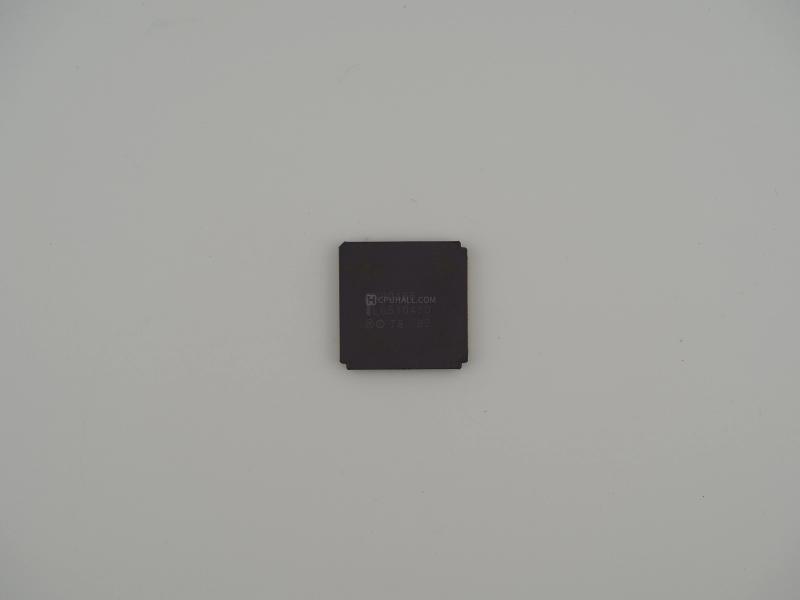

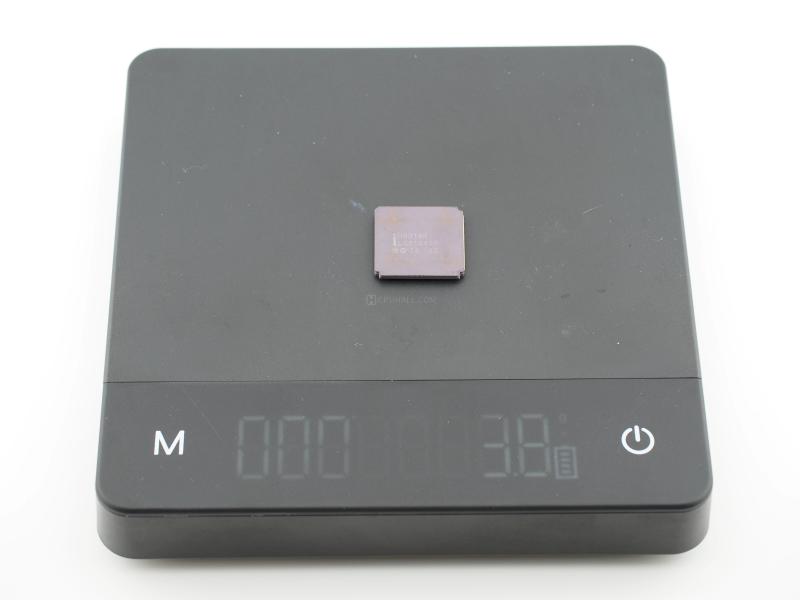
Holding this piece, the very first thing I notice is the stark, almost brutalist contrast between the top and the bottom of the package. Placing it on the scale, it weighs in at a precise 3.8 grams. The top surface is a matte, dark purplish grey ceramic, completely flat and devoid of any flashy branding. The identification is handled by a faint, low contrast laser etching that requires a bit of light angling to read perfectly:
i R80186
L6510430
(m) (c) '78, '82
Flipping this artifact over reveals the true heavy metal appeal of early 1980s silicon. We are greeted by a brilliant, perfectly square gold cap covering the die cavity, surrounded by the gold plated traces leading out to the 68 castellations around the edge of the ceramic substrate. The bottom lid is stamped with crisp black ink:
MALAY
8650 AV
This specific unit is in remarkable condition. The gold contacts along the perimeter of the Leadless Chip Carrier show no signs of harsh socket wear or solder flow, indicating it might have spent its entire life safely stored away rather than deployed in the field. The texture of the ceramic is cool and dense, a hallmark of aerospace grade packaging from that era.
The Intel 80186 is a masterclass in early silicon integration. Before this chip came along, building an x86 system required the CPU and a massive cluster of support chips scattered across the motherboard. You needed a clock generator, a local bus controller, an interrupt controller, timers, and DMA controllers. The 80186 took all of those discrete, power hungry components and shoved them onto a single piece of silicon alongside an enhanced 8086 core.
This specific package is a CLCC 68 (Ceramic Leadless Chip Carrier). Unlike a standard Pin Grid Array or a Dual Inline Package, this form factor has no pins to bend. Instead, it relies on 68 gold plated castellations around the edges. You either had to reflow solder this directly to a printed circuit board or use a highly specialized, high pressure socket to make contact. The lack of a speed suffix on the R80186 marking typically indicates the standard base clock of 8 MHz, though some early batches defaulted to 6 MHz. The internal architecture was still a true 16 bit processor, but it included new instructions (like PUSHA and POPA) that made assembly programming significantly less painful compared to the original 8086.
The 80186 is the missing link of the PC world. If you look at the lineage of desktop computers, everyone knows the 8088, the 20286, the 386, and the 486. The 186 is famously absent from the IBM PC compatible bloodline.
The lore here is fascinating. Intel designed the 80186 to be the ultimate PC processor, but they integrated the DMA and interrupt controllers directly on the die. When IBM was designing the PC AT, they wanted to use their own specific external chips to maintain strict backwards compatibility with the original IBM PC. The integrated hardware on the 186 clashed hard with IBM's architecture. Because IBM ruled the world, the 186 was completely sidelined in the desktop market.
However, failure in the desktop space turned into total domination in the embedded space. Because it was essentially a "motherboard on a chip," the 80186 became the absolute king of embedded controllers. It lived inside hard drive controllers, network cards, industrial robots, and telecom switches for over two decades. It is the unsung workhorse of the 1980s and 1990s enterprise infrastructure.
The identification of this piece is absolute. The R prefix in the part number R80186 is Intel's specific internal code for the Ceramic Leadless Chip Carrier package during this era, distinguishing it from the C (Ceramic DIP) or A (PGA) packages.
The copyright dates '78, '82 reflect the microcode for the original 8086 architecture (1978) and the release of the 80186 integration (1982). The bottom stamp 8650 is a classic four digit date code, confirming this specific unit was manufactured in the 50th week of 1986 at Intel's fabrication and assembly plant in Malaysia. The L6510430 is the batch and lot tracking number. Everything about this artifact aligns perfectly with standard Intel production runs for mid 1980s embedded processors. It is a textbook example of high reliability ceramic packaging from the golden age of silicon.