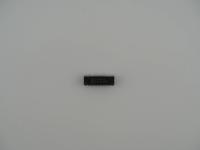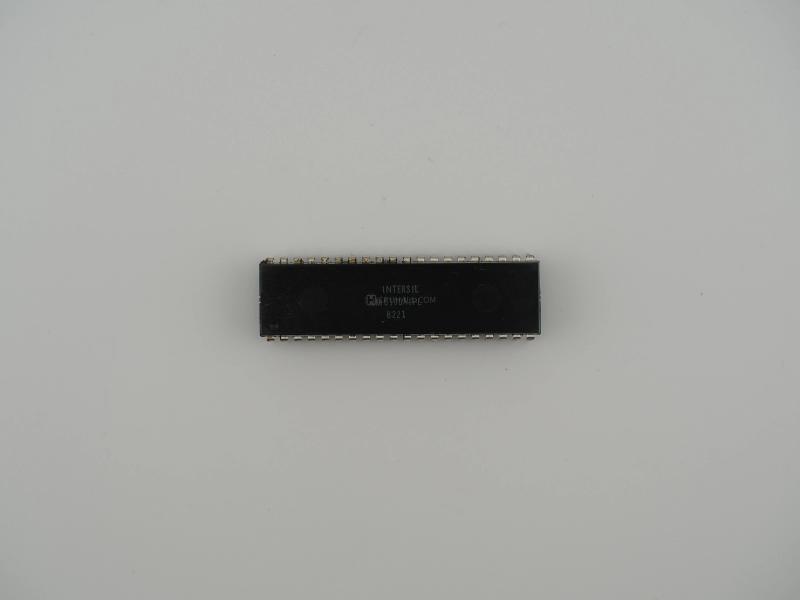

Holding this piece, the sheer density of computing history hits me. Visually, it is an unassuming block of black plastic, but the pristine white screen-printing tells a heavy story. Looking closely at the top surface, I can see the subtle matte texture of the epoxy resin and two perfectly circular mold marks flanking the manufacturer text. The text itself is crisp and bright, a rarity for commercial plastic chips that have been floating around since the early 1980s.
INTERSIL
IM6100AIPL
8221
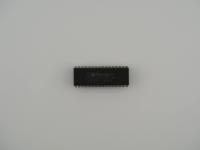
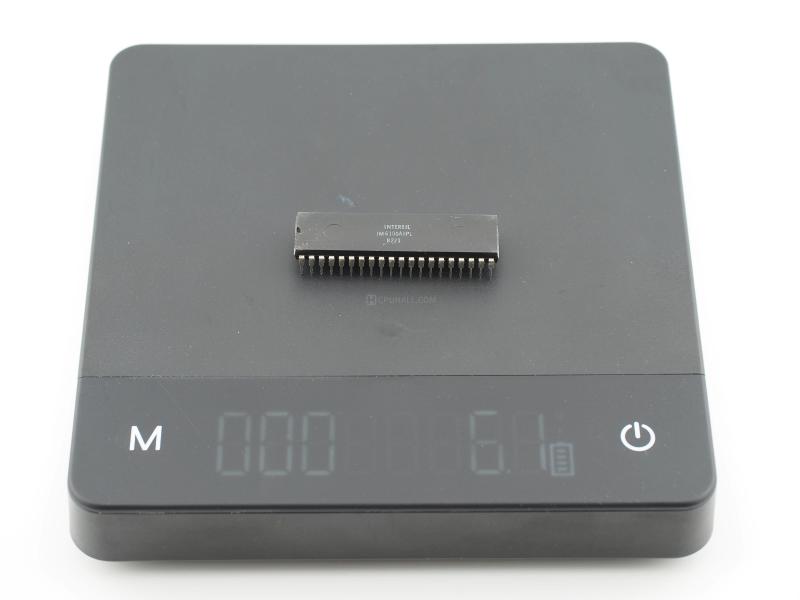
When I throw it on the scale, it weighs in at exactly 6.1 grams. Sizing it up against the ruler, it spans the standard two inches expected of a vintage 40-pin Dual Inline Package. Turning the artifact over, the underside reveals a slightly glossy finish with two inset circles containing an "S" and a "76", which are undoubtedly mold identifiers from the plastic injection process. The tin-plated pins are remarkably straight with only mild surface oxidation. It lacks the cold, heavy brilliance of a gold-capped ceramic package, but the utilitarian plastic carries a different kind of working-class charm.
Diving into the silicon inside this package is a trip into an alternative dimension of computing. We live in an 8-bit, 16-bit, and 64-bit world today. The IM6100 is a 12-bit microprocessor.
Intersil pulled off a monumental feat of engineering here. They took the entire instruction set of the legendary DEC PDP-8 minicomputer and squeezed it down into a single monolithic piece of silicon using their cutting-edge silicon-gate CMOS technology. CMOS was incredibly important at the time because it meant this chip sipped power compared to the power-hungry NMOS processors of the era.
Because it operates on a 12-bit word, the internal registers and the Program Counter are all 12 bits wide. This allows the processor to natively address exactly 4096 words of memory. The standard IM6100 ran at 4 MHz on a 5-volt rail. However, the specific artifact I have here is the "A" revision. The IM6100A was fabricated to handle up to 10 volts, allowing the clock speed to be cranked up to 8 MHz. Managing a 12-bit multiplexed data and address bus over a 40-pin package required some clever timing cycles, relying on external latches to separate the addresses from the data during memory operations.
This chip is literally a mainframe in your pocket. Digital Equipment Corporation (DEC) dominated the world with the PDP-8 minicomputer. It was the machine that built the 1960s and 1970s software industry. But DEC was initially slow to move their architectures onto single microprocessors. Intersil saw the gap, reverse-engineered the instruction set, and created the 6100. It was completely software compatible with the PDP-8/E.
The funny thing about the 6100 is that DEC actually ended up buying it. DEC used the Intersil 6100 in their VT78 intelligent terminal and their DECstation word processors. The low power draw made it an absolute darling for embedded systems, remote weather stations, and military applications. A common myth in retro circles is that the 8-bit byte was always the universal standard. Holding this 12-bit IC shatters that illusion. Octal math was king in the PDP-8 days, and this little plastic bug is a physical monument to that lost octal era.
Identifying this unit is straightforward, but the exact suffix codes require cracking open the old Intersil databooks. The IM prefix stands for Intersil Microprocessor. The 6100 signifies the PDP-8 clone family. The A is the high-speed, higher-voltage variant.
The IPL suffix tells us exactly how this chip was meant to be deployed. The I designates an Industrial temperature range, meaning it is guaranteed to operate from -40 degrees to +85 degrees Celsius, making it far more robust than standard commercial silicon. The P explicitly denotes the Plastic DIP package. The L is a bit of a historical ghost, but in Intersil's 1980s nomenclature, it often referred to a specific burn-in screening process or low-power binning.
Finally, the 8221 date code confirms this silicon was packaged in the 21st week of 1982. By 1982, the PDP-8 architecture was ancient by microcomputer standards, but its massive established software library kept these chips rolling off the fabrication lines for legacy military and industrial contracts well into the decade.