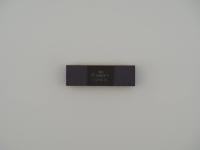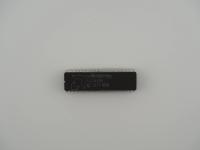

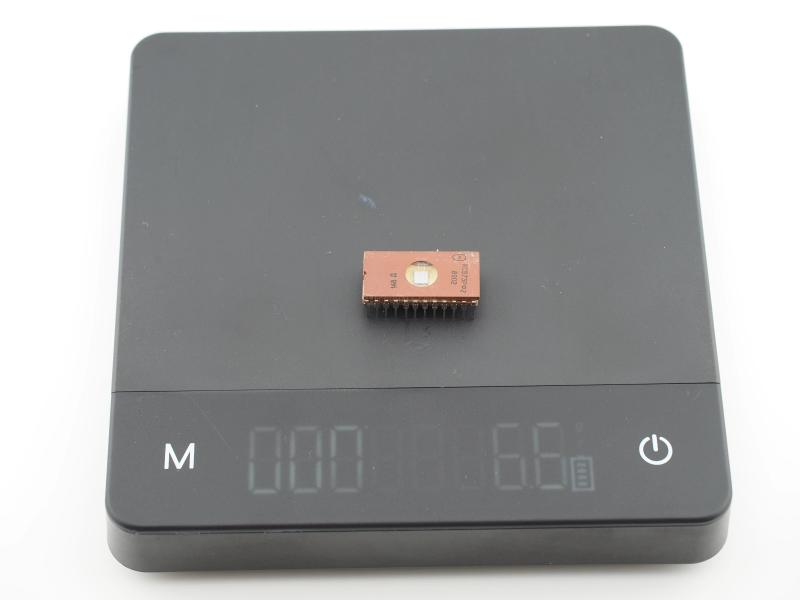
Placing it on the scale, it weighs exactly 6.6 grams. For a standard 24-pin memory chip, it feels more like a piece of military hardware than civilian electronics. The texture of the dark brown ceramic is incredibly distinct. It has a slightly rough, almost unrefined, porous feel compared to the smooth purple ceramics of early Western chips.
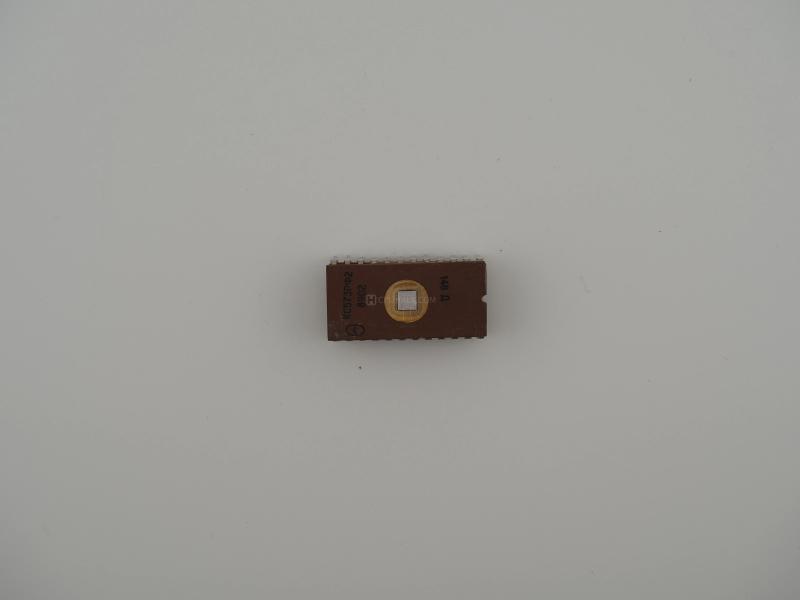
Looking closely at the top and sides, I can clearly see the 24 pins brazed directly onto the edges of the ceramic package. But the absolute focal point is the pristine circular quartz window. Peering straight down into it, the silicon die sits perfectly centered inside a recessed gold cavity. The fine gold bonding wires radiating outward to the lead frame catch the light beautifully.
Here are the transcribed surface texts:
Logo: [Vertical oval with Cyrillic 'Э']
Model: КС573РФ2
Date Code: 8902
Back/Bottom: 148 Д
The contrast of the black ink stamped over the brown ceramic remains sharp, despite some minor surface scuffs and wear indicative of its age.
Diving into the technical weeds, this chip is a 16-kilobit (2 Kilobytes) Ultraviolet-Erasable Programmable Read-Only Memory (UV-EPROM). It is a direct Soviet reverse-engineered clone of the Intel 2716. The architecture here relies on floating-gate transistors. To write data to this chip, an engineer must use a relatively high programming voltage (typically 21V, or sometimes 25V for early or finicky Soviet variants) to force electrons into an insulated gate via avalanche injection. Because the gate is completely surrounded by oxide, the electrons become trapped, which physically registers a zero bit.
The beautiful quartz window is strictly functional. Normal glass blocks ultraviolet light, but quartz allows it to pass through. To erase the chip and reset all bits to ones, you expose the bare die to strong UV-C light (around 253.7 nm) for about 20 to 30 minutes. The UV photons give the trapped electrons enough energy to escape the floating gate. The thermal challenges were minimal during standard read operations, but programming and erasing were highly volatile processes that required exact voltages. A single voltage spike during programming could permanently fry the delicate silicon.
The 573 series is the undeniable backbone of late Soviet computing. While Western engineers were rapidly moving on to much higher capacities, Soviet semiconductor fabs were churning out the КС573РФ2 for nearly every domestic computing application imaginable. You will find these exact chips nestled inside the Agat (the famous Soviet Apple II clone), the Elektronika BK-0010, and countless industrial control systems.
There is a fantastic bit of hardware lore surrounding these UV-EPROMs. A common hardware myth is that leaving an EPROM exposed to standard room lighting will quickly erase it. In reality, fluorescent tubes do emit trace amounts of UV light, but it would take months or even years of continuous exposure to randomly flip a bit. Still, Soviet engineers and hobbyists would meticulously cover the window with thick paper, foil, or black paint to prevent data corruption. Finding this specific artifact without a sticker residue suggests it was either kept in dark storage, freshly wiped, or simply never deployed in a harsh environment. It is a brilliant piece of Cold War tech, directly mirroring Intel's triumph but manufactured entirely behind the Iron Curtain.
When researching the specific origins of this piece, the visual clues provide a definitive roadmap. The date code 8902 tells me this chip was fabricated in the second week of 1989. This places its birth right at the twilight of the Soviet Union. The prefix КС explicitly designates commercial grade in a glass-ceramic package. A К prefix alone would imply plastic, which obviously lacks the erasable window. The mysterious 148 Д stamped on the underside is a factory batch or inspector mark. Given the consistency of the printing and the lack of a diamond-stamped "Voenpriemka" military acceptance mark, I firmly believe this unit was manufactured for a high-end domestic consumer machine or a commercial logic board.