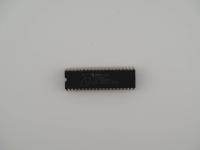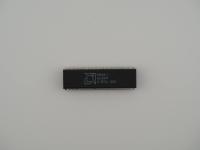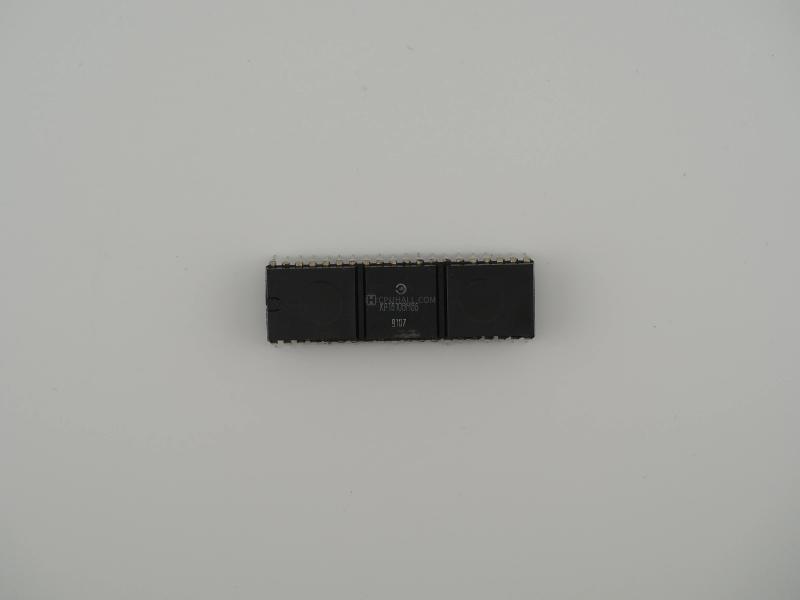

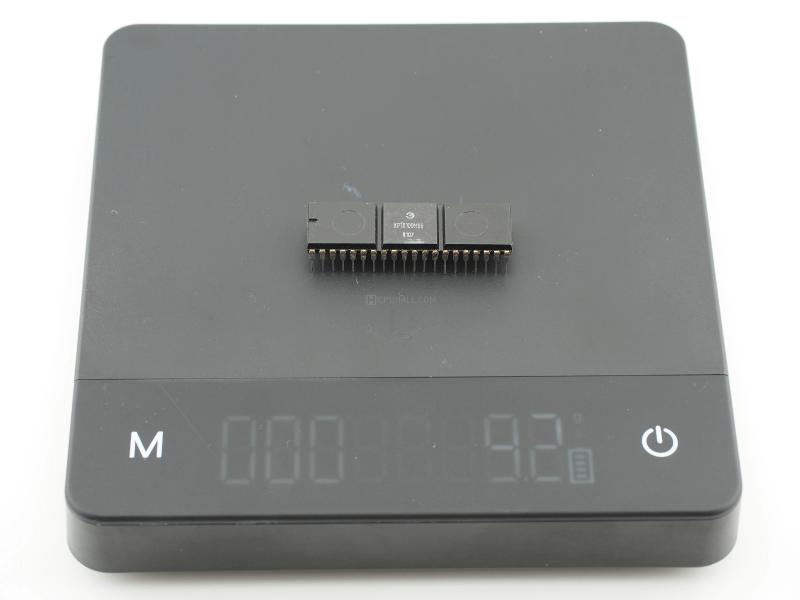
Weighing in at exactly 9.2 grams according to the scale, this specific unit is an exercise in function over form. The package is a standard DIP-40, but the black plastic encapsulation has a distinctively rough, slightly porous matte finish that feels remarkably different from the smoother epoxy resins favored by NEC, AMD, or Intel during the same era.
Looking closely at the macro shots, the top of the chip features a prominent double-indentation mold mark and crisp, white painted text.
(Logo: "Kvantor")
КР1810ВМ86
9107
On the reverse side, there is a very faint, almost ghostly secondary stamp reading 1097. The pins themselves tell a story of prior use. Examining the shoulders of the metal leads, especially near the plastic body, I can clearly see remnants of solder and slight oxidation. This artifact wasn't just sitting in a warehouse. It was actively deployed, soldered to a PCB, and later salvaged.
Beneath that gritty black plastic lies a perfect, reverse-engineered clone of the legendary Intel 8086 microprocessor. The Soviet designation system is highly logical once you know how to read it. The "К" designates a commercial or consumer grade component, while the "Р" specifies a plastic package. The "1810" points to the chip series (the Soviet equivalent of the Intel 8086 family), "ВМ" translates to microprocessor, and "86" is a completely unabashed nod to the original Intel architecture.
From an engineering standpoint, this chip operates identically to an Intel 8086. It is a 16-bit microprocessor built on an HMOS (High-performance N-channel Metal-Oxide-Semiconductor) process, packing roughly 29,000 transistors. It runs at a base clock of 5 MHz and requires a standard 5V power supply. The Soviet engineers didn't just emulate the instruction set. They physically decapped Western chips, photographed the silicon dies layer by layer, and painstakingly copied the gate layouts to ensure 100 percent hardware compatibility.
Because this is the plastic "КР" variant rather than the ceramic "КМ" version, thermal dissipation limits meant this chip was destined for ordinary civilian machines like the ES PEVM, Iskra, or various educational microcomputers rather than harsh military or aerospace environments.
The legacy of the KP1810BM86 is deeply intertwined with the geopolitical realities of the 1980s. The Soviet Union recognized that the Western world was rapidly standardizing on IBM PC compatible hardware. Rather than continuing to push isolated proprietary architectures, the state mandated the wholesale cloning of Intel microprocessors to keep their domestic computing industry relevant.
The date code 9107 on this specific unit places its manufacture in the 7th week of 1991. This makes the artifact an incredible historical bookend. It was pressed in a factory just months before the official dissolution of the Soviet Union in December 1991. You are looking at the absolute twilight of the Soviet microelectronics apparatus. By the time this chip was leaving the fab, the Western world was already heavily adopting the 80486, making this 5 MHz 8086 clone completely obsolete the moment it was cast in plastic.
A persistent myth in the hardware community is that Soviet clones were inherently buggy or unreliable. In reality, chips like the 1810BM86 were incredibly robust and highly faithful to their Intel counterparts. They ran standard MS-DOS (or the localized equivalent, ADOS) flawlessly.
Identifying this artifact is entirely straightforward due to the excellent legibility of the top surface text. The stylized logo is the hallmark of the Soviet electronic component manufacturer "Kvantor".
What makes this particular unit fascinating to me is its physical condition combined with its date code. The presence of solder on the pins means someone likely extracted this from an early 90s Eastern Bloc personal computer long after the architecture was obsolete. It is a survivor from a very specific, chaotic transition period in computing history.