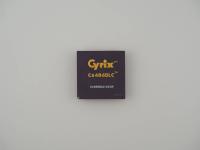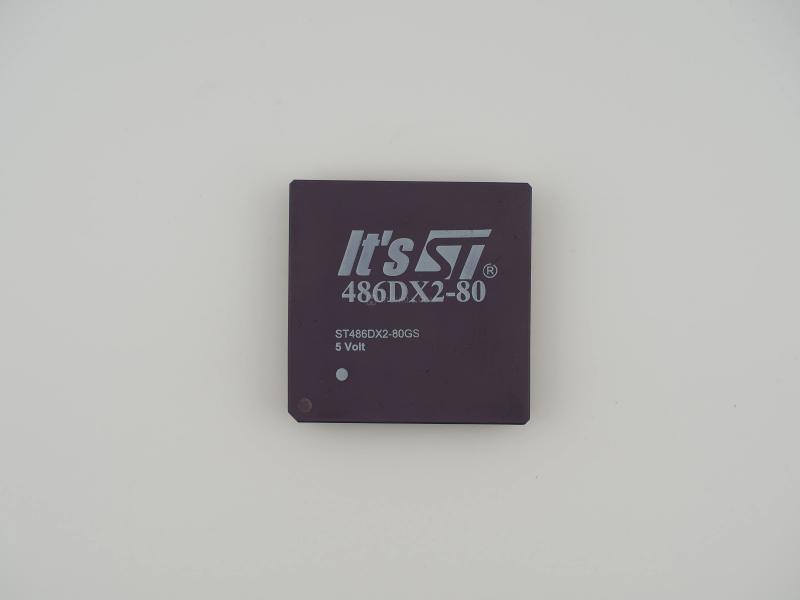

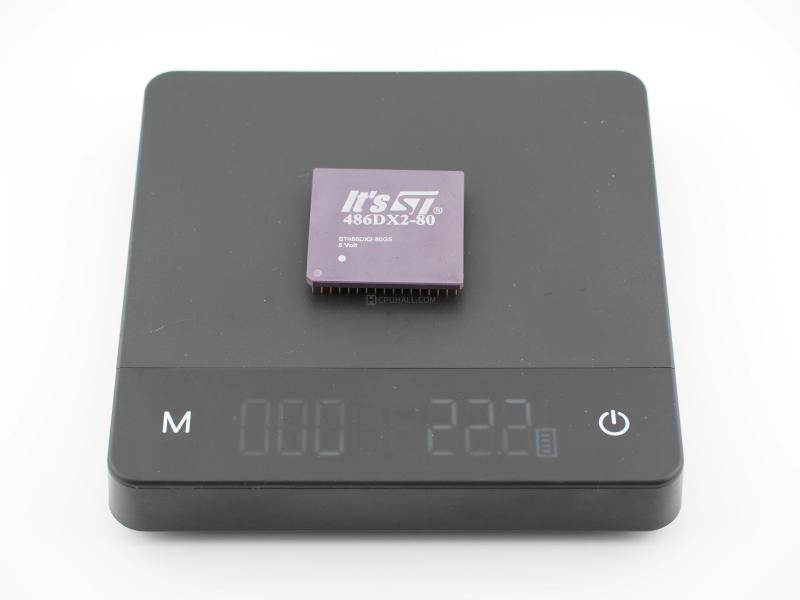
Tipping the scales at exactly 22.2 grams, this artifact utilizes a beautiful, deep purple ceramic package that feels incredibly dense. The top surface features crisp, silver screen-printed text that practically shouts its branding.
It's ST (R)
486DX2-80

ST486DX2-80GS
5 Volt
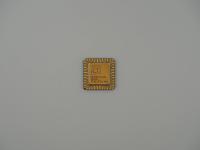
Flipping this chip over reveals the classic 168-pin arrangement of the 486 era, bathed in a rich gold plating that has survived the decades exceptionally well. The central block on the underside is where the real forensic clues hide. Etched directly into the dark material are the factory codes:
MD6J PABMDCB
P533779
PB78M6480
2XC
MADE IN
CANADA
Adding to the localized history of this specific unit is a fragile paper warranty sticker. It features traditional Chinese characters ("勿撕", warning against removal) and grid numbers for the year and month. The ink marks denote the year "98" and the month "3". This indicates the chip was likely sold or installed as a late-life budget upgrade in March 1998, long after the Pentium had taken over the high-end market.
Diving into the silicon itself, this processor is a fascinating byproduct of 1990s foundry agreements. Running at 80 MHz, this is a clock-doubled chip relying on a 40 MHz front-side bus. At the time, pushing a motherboard bus to 40 MHz was notorious for causing stability issues with certain ISA expansion cards and VESA Local Bus (VLB) controllers, but it yielded fantastic raw throughput for the era.
The "5 Volt" marking on the ceramic is a critical operational parameter. While later 486 processors shifted to a cooler 3.3V logic to save power and reduce heat, this specific die relies on the older 5V standard. This means it ran quite hot and absolutely required active cooling. A bare chip like this running a full load in a DOS gaming rig without a heatsink would halt the system in short order. It packs an integrated floating-point unit (math coprocessor) and an 8KB write-back L1 cache, aligning perfectly with the standard DX2 specifications of its generation.
The "It's ST" branding is a wonderful slice of 1990s marketing defiance. During this period, Intel was aggressively pushing their "Intel Inside" campaign. Competitors had to fight hard for consumer recognition. SGS-Thomson Microelectronics (now STMicroelectronics) released these chips to carve out their own space in the lucrative clone market.
But ST did not design this processor architecture. The underlying logic was engineered by Cyrix. Because Cyrix was a fabless semiconductor company, they had no physical manufacturing plants of their own. To get their brilliant x86 designs into silicon, Cyrix struck deals with major foundries like Texas Instruments, IBM, and SGS-Thomson. The agreement was simple: the foundries would manufacture the silicon for Cyrix, and in return, the foundries were granted the right to produce and sell a certain volume of those identical chips under their own brand names. Therefore, beneath the bold SGS-Thomson branding lies the beating heart of a Cyrix Cx486DX2.
The most compelling mystery on this artifact is the laser-etched "MADE IN CANADA" text on the bottom. SGS-Thomson is a European multinational, and Cyrix was based in Texas. Why Canada?
When researching the global semiconductor supply chain of the 1990s, the Canadian connection points directly to IBM. IBM operates a massive, historically significant semiconductor packaging and testing facility in Bromont, Quebec. Because IBM was also one of Cyrix's primary manufacturing partners (fabricating the Cyrix designs and selling them under the IBM Blue Lightning moniker), there was immense cross-pollination of resources.
Based on the physical evidence, I can confidently deduce the lifecycle of this specific artifact. The raw silicon wafer was either fabricated by SGS-Thomson in Europe or sourced through the shared Cyrix foundry network. Those raw wafers were then shipped to IBM's Bromont facility in Canada, where they were sliced, wire-bonded to the purple ceramic substrate, sealed, and pinned. Finally, it ended up in an Asian retail market, evident by the March 1998 warranty sticker, serving as a budget workhorse at the twilight of the 486 era.