
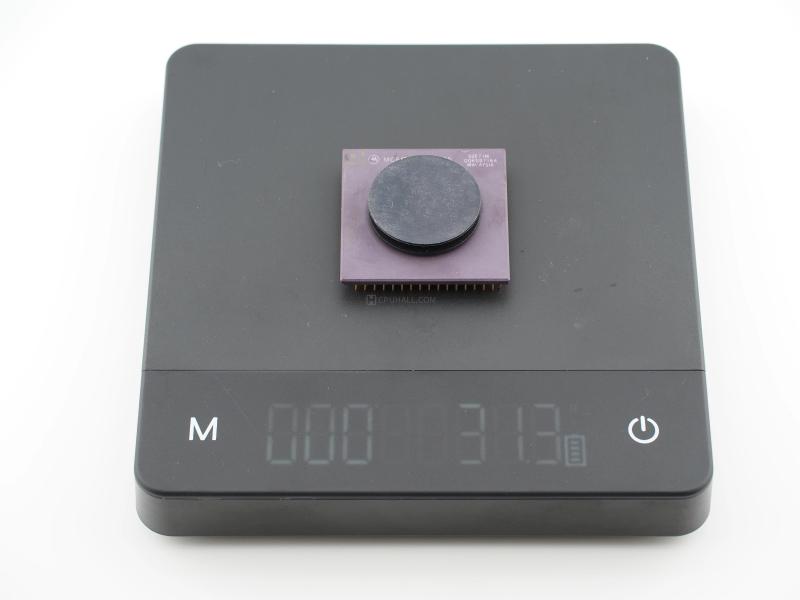
Weighing in at exactly 31.3 grams on the scale, this artifact possesses that unmistakable density characteristic of 1990s ceramic hardware.
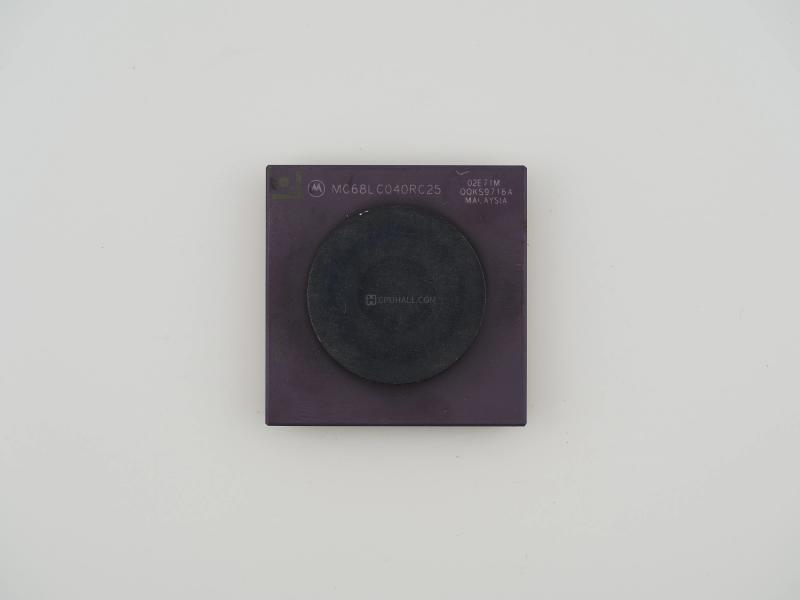
The top substrate is a gorgeous, deep purple ceramic. It provides a striking visual contrast to the stark black, circular heat spreader mounted squarely in the center. Analyzing the surface under good lighting reveals crisp, perfectly preserved laser etchings. The iconic Motorola "batwing" logo is cleanly struck on the left side.
Here is the exact surface transcription from this specific unit:
(M) MC68LC040RC25
02E71M
QQKS9716A
MALAYSIA
Flipping the chip over reveals a true treat for material enthusiasts. We have a gold-plated central die cavity pad surrounded by a staggered array of heavily gold-plated pins. The brazing on the base of each pin catches the light beautifully, indicating high-quality manufacturing standards that were typical of Motorola's Malaysian fabrication facilities during this era. There is virtually no pin oxidation or bending visible on this unit.
To understand the MC68LC040RC25, we have to look at the architectural compromises of the early 1990s. The base 68040 was a massive leap over the previous 68030, packing roughly 1.2 million transistors and integrating both a memory management unit (MMU) and a floating-point unit (FPU) directly on the die.
However, silicon was expensive. The "LC" in this model name stands for Low Cost. To improve yields and offer a cheaper part for budget-conscious system builders, Motorola created the LC variant. This specific chip retains the MMU but completely lacks the FPU.
Running at a clock speed of 25 MHz, this processor still delivered substantial integer performance. The full 68040 architecture was heavily pipelined and utilized dual 4KB caches (one for data, one for instructions). Even without the FPU, the integer core was formidable for its time. The physical package is a robust CPGA (Ceramic Pin Grid Array), designed to handle the thermal output of the architecture. The 68040 family was notoriously power-hungry and ran quite hot compared to its predecessors, making that black ceramic heat spreader on the top not just an aesthetic choice, but a strict thermal necessity.
The Motorola 68040 is legendary. It represents the final glorious peak of the m68k architecture in mainstream desktop computing before the massive industry shift to PowerPC.
The LC variant holds a somewhat controversial place in computing history. Apple used these specific chips extensively in their mid-range Macintosh line, such as the Mac LC 475 and the Quadra 605. Gamers and power users of the era quickly discovered the painful reality of the missing FPU when trying to run mathematically intensive applications or early 3D software.
A common piece of hardware lore from this era involves the "FPU lottery." Some users believed that certain LC chips were actually fully functional 68040s with the FPU simply disabled in microcode or intentionally crippled to meet market segmentation demands. While this practice is common today, early LC chips were often completely different silicon masks. Upgrading these systems usually meant physically pulling out this purple ceramic square and dropping in a vastly more expensive full RC variant.
In the Amiga scene, the 040 was heavily utilized in aftermarket accelerator cards. Enthusiasts pushed these chips to their absolute thermal limits to squeeze out every drop of demoscene performance.
Identifying the exact production run of this artifact is straightforward thanks to Motorola's consistent marking schema. The visual clues on the ceramic package tell a complete story.
The part number MC68LC040RC25 breaks down perfectly. "MC" denotes a fully qualified Motorola part. "68" is the architecture family. "LC" confirms the lack of an FPU. "040" is the processor generation. "RC" specifies the Ceramic Pin Grid Array package. Finally, "25" indicates the factory-rated speed of 25 MHz.
The most telling piece of data is the batch code 9716A. This date code confidently places the manufacturing of this specific unit at the 16th week of 1997. This is a fascinatingly late production date. By 1997, Apple had already transitioned completely to the PowerPC architecture. This implies that this specific chip was likely destined for the embedded market, industrial control systems, or late-stage replacement parts rather than a flagship consumer desktop. The MALAYSIA stamp aligns perfectly with Motorola's primary offshore assembly and testing facilities during the late 90s.