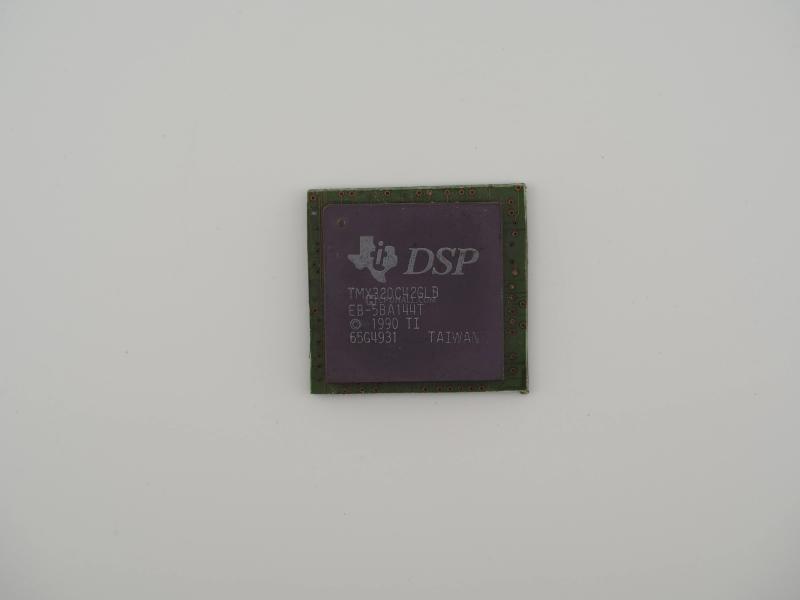

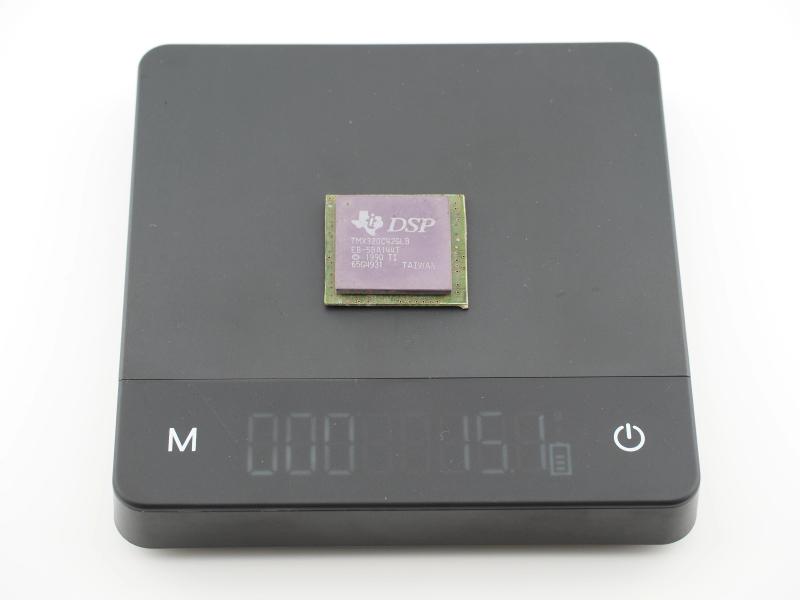
Placing it on the scale, it weighs in at exactly 15.1 grams. The ruler shows the outer dimensions of the substrate at a neat 35mm by 35mm. It has that classic matte, slightly chalky texture you only find on aerospace and high-end industrial silicon from the 1990s.
The laser etching on the ceramic is crisp and provides all the identifying clues we need. Here is the exact transcription:
Texas Instruments Logo (Map of Texas + ti) DSP
TMX320C42GLB
EB-5BA144T
(C) 1990 TI
65G4931    TAIWAN
Flipping this piece over reveals its true structural nature. Initially, the green fiberglass material looks like a small daughterboard or interposer. However, looking closely at the bottom, I can see a dense outer perimeter of gold contact pads forming a Land Grid Array. The center cavity of the bottom side houses an array of surface-mount capacitors and resistors (labeled 102 and 201), along with complex trace routing. There is also a black rectangular component on one edge of the bottom side. This entire unit is a single LGA package, utilizing the green PCB as the main substrate with the purple ceramic acting as a heavy-duty protective cap for the die underneath.
The Texas Instruments TMS320 family is absolute royalty in the Digital Signal Processing world. The C4x generation, introduced in the early 1990s, was designed specifically for parallel processing. These were floating-point DSPs built to crunch massive amounts of mathematical data in real time.
The "42" in the C42 designation usually indicates a specific variant within the C40 family tree. The standard C40 featured six high-speed parallel communication ports to link multiple DSPs together in a mesh topology. The C42 was typically a cost-reduced or application-specific version, often featuring fewer communication ports or altered memory interfaces to suit embedded applications where a full six-port mesh was unnecessary.
The packaging here is the real engineering marvel. Using an organic PCB substrate bonded to a heavy ceramic lid was a complex manufacturing choice. It allowed TI to place decoupling capacitors directly on the package bottom, right beneath the silicon die. This minimizes electrical noise and inductance, which is critical when you have a processor violently swinging its power draw as it executes intense floating-point math. The LGA footprint indicates this was meant to be surface-mounted or placed in a very specialized compression socket.
If you used a high-end modem, worked with military radar, or dealt with early 3D medical imaging in the 1990s, you were likely relying on the math being done by a TMS320 series chip. Texas Instruments practically owned the DSP market during this era. The C4x series specifically became legendary in the defense and aerospace sectors because you could just keep stringing them together. If one chip could not process the radar signal fast enough, you simply designed a board with four, eight, or sixteen of them talking to each other over their dedicated comm ports.
There is a running joke among vintage collectors that TI had a monopoly on the color purple. While other manufacturers used standard grey or white ceramics, TI frequently used these striking purple lids for their high-end DSPs and microcontrollers. It makes spotting a TI chip on a crowded surplus military board incredibly easy.
The most critical letter on this entire artifact is the "X" in TMX320C42GLB. Texas Instruments has a very strict internal naming convention for their silicon lifecycle. "TMS" is a fully qualified production part. "TMP" is a pre-production part. "TMX" denotes an experimental prototype or engineering sample.
This specific unit is a prototype. Given the 1990 copyright and the 65G4931 batch code (which likely points to a 1996 manufacturing date based on TI date code structures), this chip was likely seeded to an important industrial or defense client to test the C42 variant before mass production.
The "GLB" suffix confirms the package type. While standard C40s often shipped in massive Ceramic Pin Grid Arrays, this specific LGA-style organic substrate was likely built for a client with very strict clearance or vibration requirements. The combination of the experimental "TMX" tag and the unusual substrate makes this a highly specialized piece of DSP history.