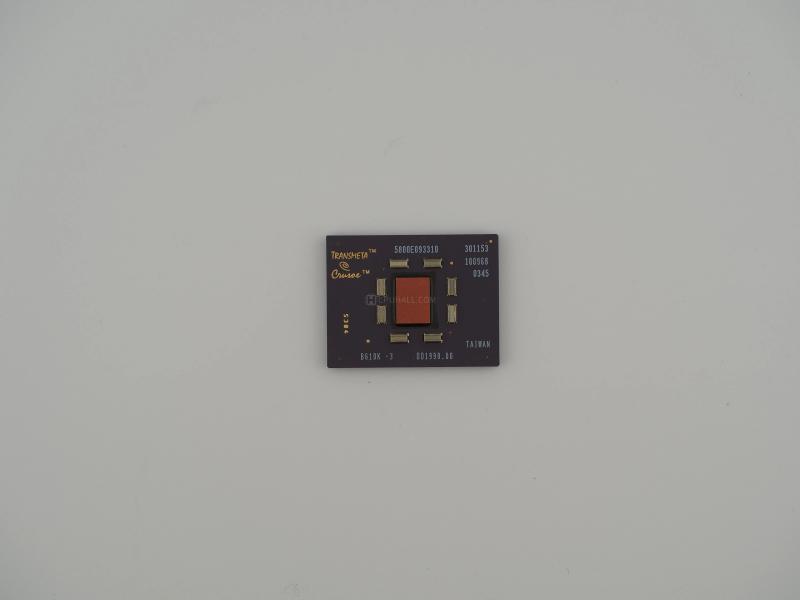

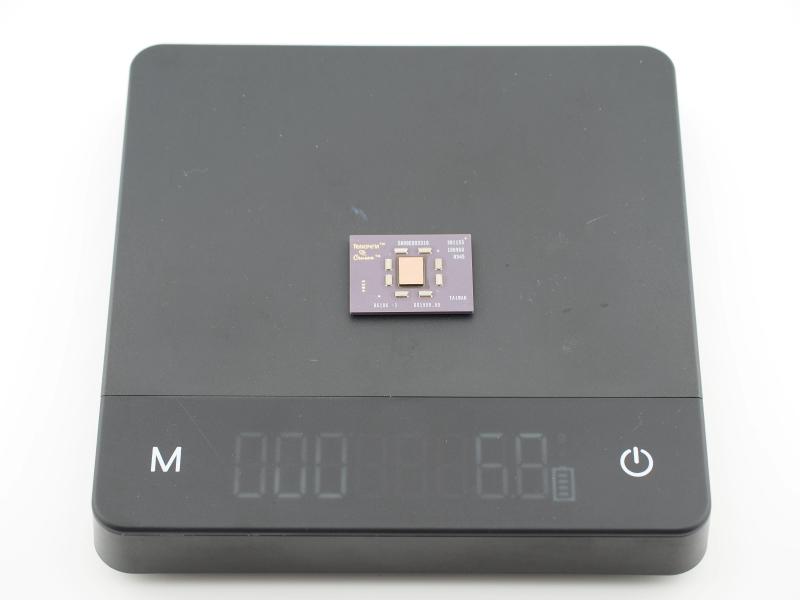
Holding this artifact on the scale, it weighs in at a mere 6.8 grams. It is a highly compact piece of silicon history. I immediately noticed the dark, almost plum-purple hue of the organic substrate, measuring exactly 21mm by 21mm according to the ruler shots. The front is dominated by a beautifully exposed rectangular die that catches the light with a distinct copper-toned reflection. Surrounding the central die is a symmetrical perimeter of eight surface-mount decoupling capacitors.
Transcribing the surface yields the following data:
TRANSMETA (TM)
(Swirl Logo) Crusoe (TM)
5800E093310     301153
                100968
                0345
S304
                TAIWAN
B610K -3   . DD1990.00
Flipping this piece over reveals a dense BGA (Ball Grid Array). The solder balls are perfectly intact, indicating this specific unit was likely never mounted to a motherboard or was professionally reballed. The visual contrast between the gold lettering and the dark substrate gives it a premium aesthetic that belies its troubled history.
The hardware inside this package is a radical departure from standard processors of its era. This is not a native x86 processor. Under the hood, the Transmeta Crusoe TM5800 is built on a VLIW (Very Long Instruction Word) architecture. Instead of complex hardware decoders parsing x86 instructions, Transmeta shifted the burden to a software layer called CMS (Code Morphing Software).
This translation layer sat between the operating system and the hardware. It took standard x86 instructions, translated them into VLIW instructions on the fly, and cached the results in a dedicated portion of system memory to speed up future executions. This allowed the hardware to be incredibly simple and utilize far fewer transistors than a comparable Intel Pentium III or Pentium M.
Fabricated by TSMC in Taiwan on a 130nm process, the TM5800 was designed for extreme power efficiency. The simple VLIW core meant the chip could operate at sub-watt levels during idle and consume only a few watts under load. The physical design reflects this. The lack of a bulky heat spreader and the small package size are direct results of the chip's ultra-low thermal footprint.
The hype surrounding Transmeta in the late 1990s and early 2000s was absolutely legendary. They operated in extreme stealth mode for years, famously employing Linux creator Linus Torvalds, which only fueled the intense speculation about what they were building. When they finally unveiled the Crusoe, they promised it would revolutionize mobile computing by offering x86 compatibility with a fraction of the power consumption of Intel or AMD processors.
However, the reality of the Crusoe was a masterclass in the trade-offs of software emulation. While the battery life on Crusoe-equipped laptops (like the Sony Vaio PictureBook) was stellar, the performance was wildly inconsistent. The Code Morphing Software introduced a noticeable latency overhead. While synthetic benchmarks often looked acceptable, the actual user experience was frequently described as "sluggish" or "stuttery" as the CMS worked frantically in the background to translate code.
Transmeta forced Intel to take the mobile market seriously, directly leading to the development of the highly successful Pentium M architecture. Intel ultimately crushed Transmeta in raw performance while matching their battery life, rendering the Crusoe obsolete.
Identifying this specific unit requires breaking down the part numbers. The primary string 5800E093310 is the key to unlocking its exact specifications. The 5800 definitively places it in the Crusoe TM5800 family. The subsequent 0933 is the target clock speed, verifying this chip operates at 933 MHz.
The string 0345 on the right side is a standard industry date code. This tells me the chip was manufactured in the 45th week of 2003. This timeline aligns perfectly with the mature phase of the TM5800's life cycle before Transmeta pivoted to their ill-fated Efficeon lineup. The TAIWAN stamp confirms my knowledge that Transmeta was a fabless semiconductor company, relying entirely on TSMC for their physical manufacturing.
While not the rarest chip in the world, finding an unmounted TM5800 in such flawless physical condition is a fantastic addition to the archive. It represents a fascinating, albeit failed, architectural gamble.