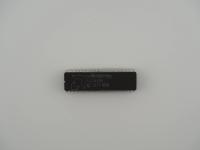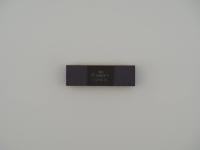

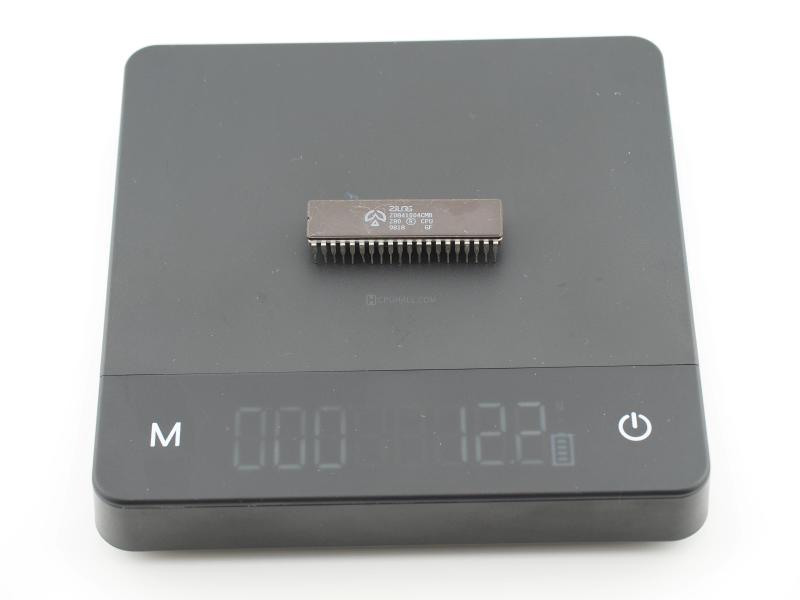
Placing this piece on the scale, it registers a satisfying 12.2 grams. Holding this specific unit, the cold, dark grey texture of the ceramic immediately stands out against the standard plastic packaging we normally see for 8-bit silicon. This is a classic Ceramic Dual In-line Package or Cerdip. The two halves of the ceramic shell are bonded together with a visible glass frit seal running along the side profile, sandwiching the lead frame perfectly in the middle.
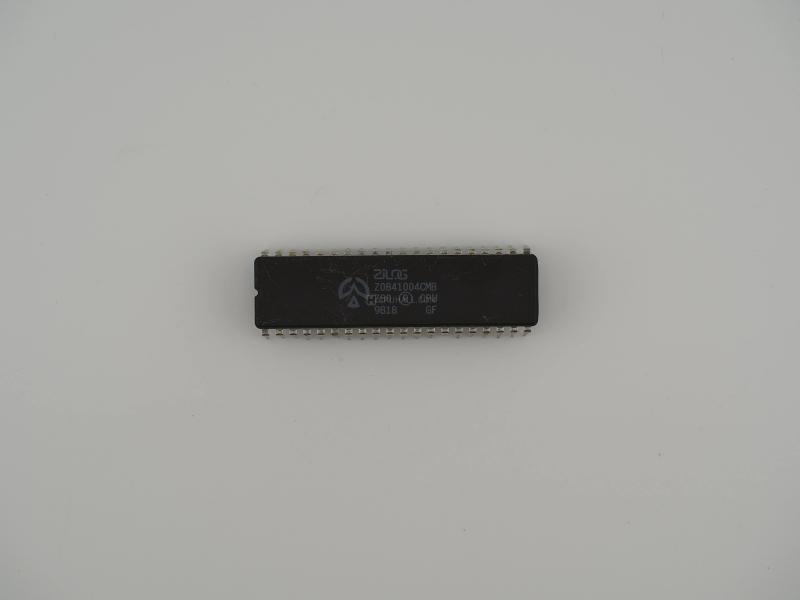
Inspecting the top surface, the white silkscreen provides a very clear history:
Zilog (Logo)
Z0840004CMB
Z80 (R) CPU
9818 GF
Flipping the artifact over reveals a crisp PHILIPPINES stamped into the bottom ceramic half. The Z0840004CMB part number is the real story here. While some might mistake the middle digits, careful inspection confirms this is the Z08400 base part, denoting the standard NMOS Z80 CPU. The 04 indicates a 4 MHz clock speed, which was the upgraded "A" tier speed from the original 2.5 MHz release. Finally, the CMB suffix is where this chip earns its stripes. C stands for the ceramic package, M denotes a military temperature operating range, and B signifies MIL-STD-883 Class B processing and screening. The 9818 date code tells me this specific silicon rolled off the fabrication line in the 18th week of 1998.
To understand the engineering of the Z80 is to understand the foundation of 1980s microcomputing. When Federico Faggin left Intel after designing the 4004 and the 8080, he wanted to build something fundamentally superior. He succeeded.
The Z80 was strictly backward compatible with the Intel 8080 instruction set but expanded it massively. It featured an 8-bit data bus and a 16-bit address bus capable of addressing 64 KB of memory directly. What makes this architecture brilliant is the integration of features that previously required expensive external support chips. Faggin added built-in DRAM refresh logic, which drastically lowered the cost and complexity of building a computer system around it.
Furthermore, the Z80 features an alternate register set. Programmers could simply swap the active register bank with a single command during an interrupt, entirely bypassing the slow process of pushing and popping registers to the stack. At 4 MHz, this NMOS design ran completely passively in its ceramic shell. The Cerdip package here is not just for aesthetic appeal. It offers superior thermal dissipation and hermetic sealing against moisture, an absolute requirement for the military and aerospace applications this chip was graded for.
It is almost impossible to overstate the historical prestige of the Z80. While the MOS Technology 6502 dominated the home console and affordable computer market in the US, the Z80 was the undisputed king of business machines, arcade cabinets, and the European microcomputer scene.
This is the brain of the ZX Spectrum, the Osborne 1, and the TRS-80. It was the driving force behind the CP/M operating system, which was the absolute standard for business computing before MS-DOS took over. If you walked into an arcade in the early 1980s, you were practically swimming in Z80s. Pac-Man used a Z80. Galaga used three of them. Even Nintendo utilized a custom variant of the Z80 for the legendary Game Boy.
There is a fun bit of lore regarding Zilog and Intel. Because Faggin and his team effectively cloned and expanded the 8080, Intel was furious. However, Zilog cleverly avoided copyright infringement by changing the assembly language mnemonics. While the binary machine code was the same for the original 8080 instructions, the human-readable text was different, preventing Intel from successfully suing them into oblivion.
What makes this exact piece fascinating is the juxtaposition of its release architecture and its manufacturing date. The Z80 was introduced to the world in 1976. This specific military-grade chip was minted in 1998. That is a twenty-two-year lifespan for a single microarchitecture, a completely unheard-of timeline in the modern semiconductor industry.
The CMB designation confirms this was not destined for a cheap desktop computer. It was procured for heavy duty industrial, aerospace, or defense applications. The military is notorious for locking down a design and refusing to change it once it is certified. They needed a rugged, perfectly understood, and totally predictable 8-bit processor, and the Z80 fit the bill perfectly for decades. Finding one in this pristine, unbent condition with such a late date code is a brilliant testament to the immortality of Federico Faggin's masterpiece.