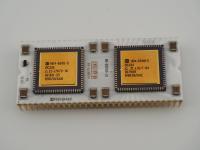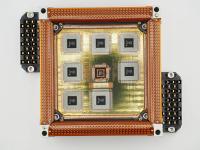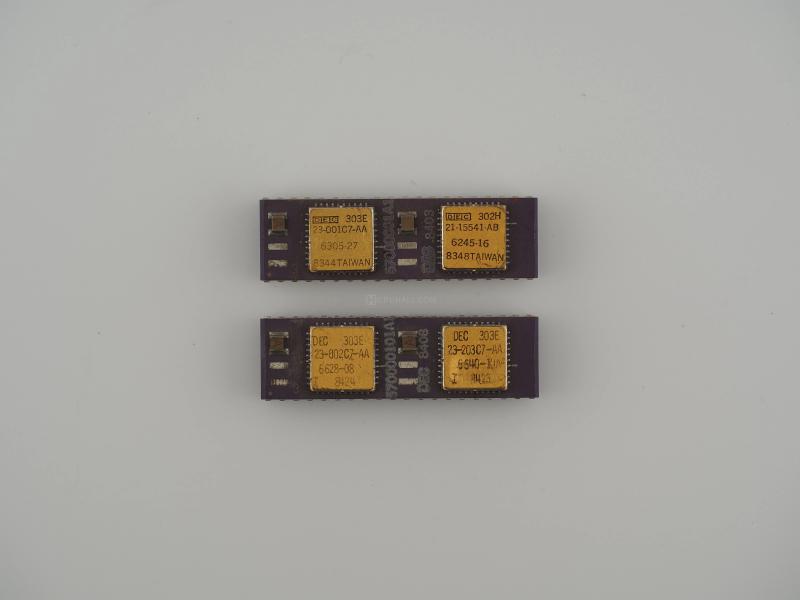

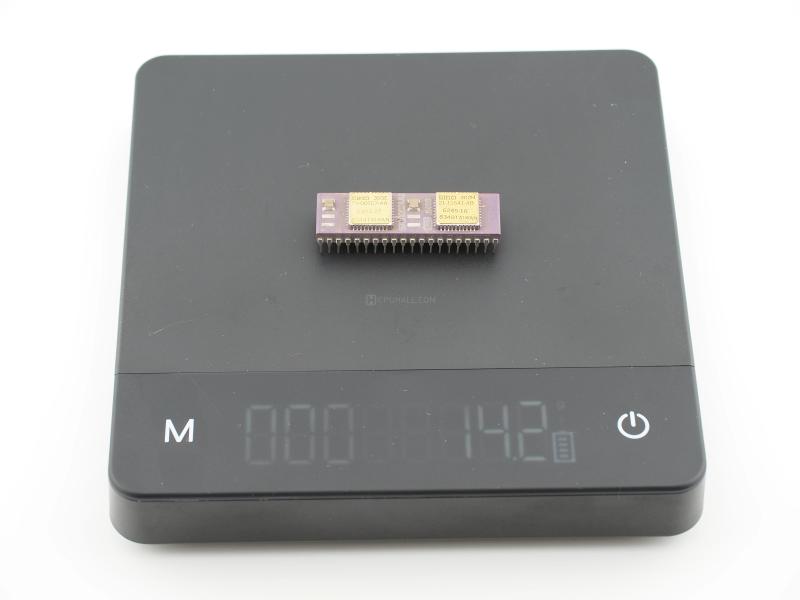
These artifacts are absolute masterclasses in late 1970s and early 1980s packaging logic. Holding these pieces, the first thing that strikes me is the sheer physical weight and the striking contrast of the materials. We are looking at deep plum-colored ceramic DIP-40 carriers, but instead of housing a single monolithic die underneath a lid, these carriers act as substrates for a Multi-Chip Module (MCM) design.
The gold caps themselves have that perfectly imperfect vintage luster, sealing the individual dies in their own leadless chip carriers (LCCs) which are then reflowed onto the main DIP package.
Here is the exact transcription of the surface text from the top artifact:
Left Cap:DEC 303E
23-001C7-AA
6305-27
8344 TAIWAN
Right Cap:DEC 302H
21-15541-AB
6245-16
8348 TAIWAN
Substrate (Center):57000001A1 DEC 8403
And the bottom artifact:
Left Cap:DEC 303E
23-002C7-AA
6628-08
I 8424
Right Cap:DEC 303E
23-203C7-AA
6640-10A
T 8423
Substrate (Center):57000101A1 DEC 8408
Both chips feature BP-01-A stamped on the bottom of the ceramic. The date codes reveal a fascinating assembly timeline. The individual dies were fabricated in late 1983 and early 1984 in Taiwan, while the final substrate assembly for both units happened in early 1984.
What we have here is the magnificent DEC F-11 chipset. In the late 1970s, transistor budgets were too tight to fit a complex instruction set architecture like the 16-bit PDP-11 onto a single piece of silicon. Digital Equipment Corporation solved this by dividing the processor into distinct functional blocks.
The architecture is built around the DC302 Data Chip and the DC303 Control Chip. The top module in the collection represents the core CPU. The right cap houses the DC302 Data Chip, which contains the arithmetic logic unit (ALU), the registers, and the core execution pathways. The left cap houses the DC303 Control Chip, which is essentially a dense microcode ROM that sequences the instructions for the data path.
This packaging is highly complex for the era. By creating standardized ceramic LCCs for the individual silicon dies, DEC could mix and match components on these 40-pin DIP carriers to create different SKUs without spinning entirely new monolithic chips. The tiny surface-mount capacitors brazed between the caps are bypass capacitors, placed as close to the dies as possible to ensure clean power delivery to the NMOS logic running at roughly 3.3 MHz.
Inside DEC, the F-11 project was famously code-named The Fonz. Introduced around 1979, this chipset was the beating heart of the PDP-11/23 minicomputer. It was a massive leap forward from the older LSI-11 (which required a much larger physical footprint) and brought true minicomputer power down to a desktop-sized enclosure.
The real magic of the F-11 architecture was its expandability, which brings us to the second artifact in the photographs. Because the instruction set was entirely microcoded in the DC303 chips, you could simply add more DC303 chips to the system bus to teach the CPU new tricks. The bottom chip in this set, sporting two identical DEC 303E caps, is not a standalone CPU. It is an expansion microcode module. System integrators would drop this second DIP-40 into a socket next to the main CPU to instantly hardware-accelerate floating-point operations (the KEF11-A option) or add commercial instruction sets. It is physical DLC from the 1980s.
I am incredibly confident in this identification based on the highly specific DEC 302 and DEC 303 nomenclature etched into the gold caps. The distinction between the base processor and the microcode expansion unit is perfectly laid out in the physical hardware presented here.
The 21-15541-AB part number on the DC302 Data Chip is a documented DEC internal part number for the core execution unit. Furthermore, the 23-xxx series part numbers on the DC303 caps perfectly align with DEC's internal numbering scheme for masked ROMs and microcode arrays. The presence of the 57000001A1 substrate number on the primary CPU and 57000101A1 on the expansion module confirms they were explicitly designed to be companion pieces on a KDF11 CPU board. Finding them together as a matched pair from early 1984 is a fantastic archival win.