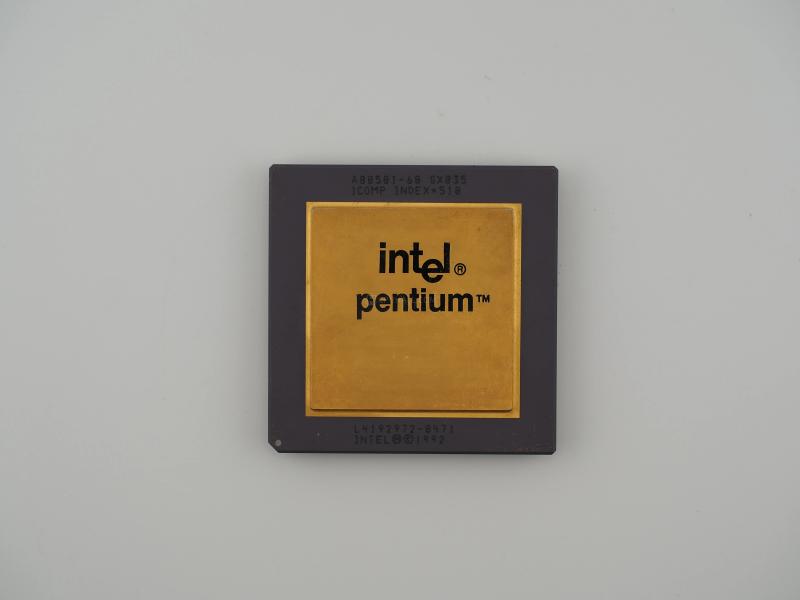

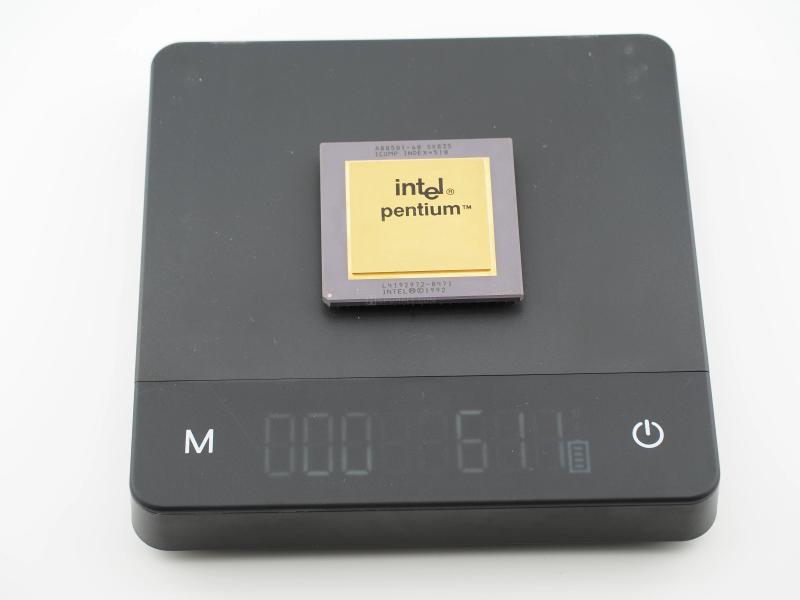
Placing this specific unit on my scale, it clocks in at a very solid 61.1 grams. This is heavy metal computing in its purest form. The foundation is a thick, dark grey ceramic substrate that feels cold and dense to the touch. Dominating the top is a massive, highly reflective gold-plated heat spreader that catches the light beautifully, bearing the classic lowercase Intel Pentium logo.
Flipping it over reveals a dense forest of gold-plated pins arranged in a staggered pattern, surrounding a secondary gold plate perfectly flush in the center of the ceramic belly.
Here is the exact surface text transcribed directly from this artifact:
Top Face (Above Spreader):A80501-60 SX835
ICOMP INDEX=510
Top Face (Gold Spreader):intel (R)
pentium (TM)
Top Face (Below Spreader):L4192972-0471
INTEL (M) (C) 1992
Bottom Face (Center Gold Plate):94094236AA
MALAY
E 422
INTEL (M) (C) 1992
The laser etchings on the ceramic have that distinct dot-matrix styling typical of early 90s Intel manufacturing. There is a slight patina building up on the gold spreader, and minor edge wear on the ceramic corners, indicating this chip saw actual service before retiring to the museum.
The P5 architecture was an absolute monster when it debuted. Intel packed 3.1 million transistors onto a 0.8-micron BiCMOS process, which was a massive leap from the 486 era. To feed this beast, Intel designed a superscalar architecture featuring two independent integer pipelines (the U and V pipes), allowing the processor to execute multiple instructions per clock cycle.
However, the raw power came with a literal cost in heat. This 60 MHz chip operates at a blistering 5 volts. The power draw was so significant that these early Socket 4 chips ran exceptionally hot. It necessitated that massive gold heat spreader just to keep the silicon from cooking itself to death. The Socket 4 platform itself was a short lived engineering stepping stone. It was large, hot, and required specialized motherboards before Intel quickly transitioned to the cooler, 3.3-volt Socket 5 and Socket 7 standards. The CPGA-273 form factor was an incredibly dense pin layout for 1993, requiring careful handling to avoid bending the delicate gold leads.
This is the chip that changed computer marketing forever. Intel abandoned the "586" naming convention because you cannot trademark a number. They hired a branding agency and gave the world "Pentium", a name that would dominate desktop computing for over a decade.
But the 60 MHz and 66 MHz Socket 4 chips carry a much darker, far more fascinating legacy. They are the prime suspects of the infamous FDIV bug. In 1994, Professor Thomas Nicely discovered that early Pentium chips returned incorrect results for certain floating point division operations. While Intel initially tried to downplay the severity, claiming it would only affect normal users once every 27,000 years, the enthusiast and scientific communities revolted. The backlash forced Intel into a massive, humiliating replacement program that cost the company nearly half a billion dollars.
These early 5V chips are also legendary for being somewhat temperamental. The heat they generated spawned an entire aftermarket industry of active CPU coolers, replacing the passive heatsinks that were standard during the 286 and 386 eras.
When I examine the SX835 S-Spec laser etched onto the ceramic face, the history of this exact artifact locks into place with absolute certainty. The S-Spec confirms this is a P5 generation chip utilizing the D1 stepping.
Crucially, the D1 stepping is fully confirmed to possess the hardware level FDIV bug. This makes the artifact an incredibly important piece of computing history. It is a physical embodiment of Intel's most infamous engineering oversight.
Furthermore, the batch code L419 tells me exactly when this silicon was born. The "L" indicates the manufacturing plant (likely Malaysia, matching the MALAY stamp on the bottom plate), the "4" indicates the year 1994, and "19" indicates the 19th week of that year. Even though the copyright year reads 1992, this specific chip rolled off the assembly line in early May of 1994. It went straight into the market right before the FDIV scandal broke wide open later that same year. Finding a surviving, working 5V Socket 4 chip is getting harder every year, but finding an original FDIV bug unit in such pristine aesthetic condition makes this a cornerstone piece for the collection.