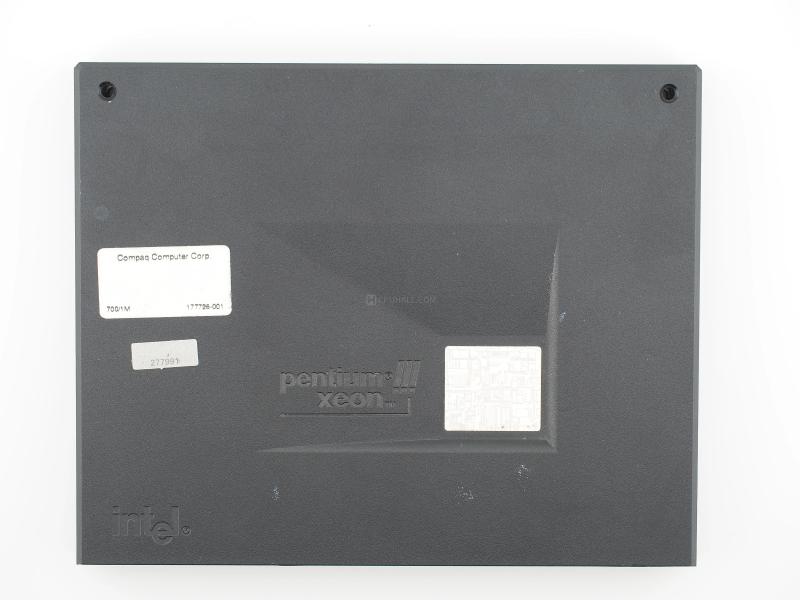

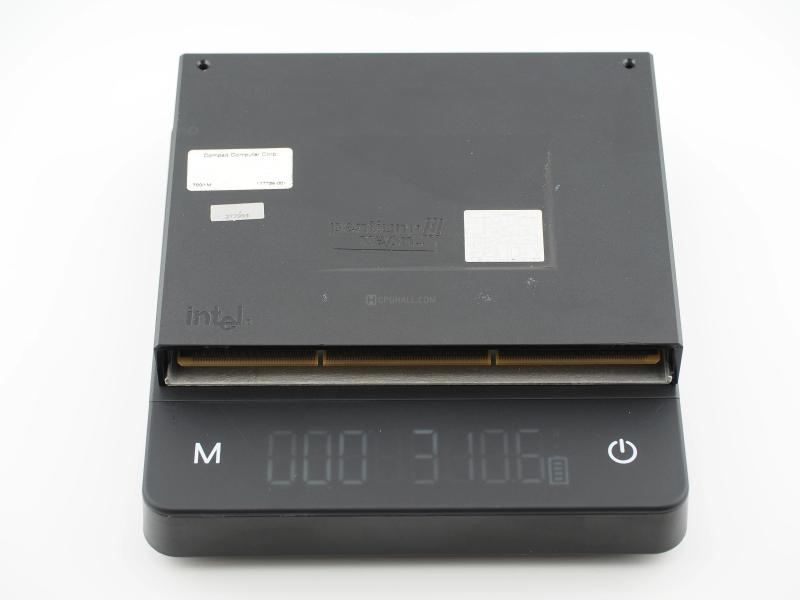
Holding this specific unit, the first thing that strikes me is the sheer, undeniable density of late-90s and early-2000s enterprise hardware. As the scale in the photograph proves, this cartridge weighs in at a hefty 310.6 grams. It is a solid brick of silicon, PCB, and aluminum. The front shroud is molded from a dense, matte black plastic that has a distinct industrial texture. Pressed into the plastic is the iconic pentium III xeon branding, accompanied by the classic intel logo with its registered trademark symbol. A holographic authenticity sticker sits flush on the right side, catching the light to reveal an intricate circuit board pattern designed to thwart counterfeiters.
This artifact bears the scars of an enterprise life. A white paper label proudly identifies it as a Compaq OEM pull:
Compaq Computer Corp. 700/1M 177726-001 277991
Flipping the cartridge over reveals the massive, raw aluminum thermal plate. This entire back surface was designed to interface directly with the colossal passive heatsinks found in multiprocessor server chassis. The white, crusty remnants of dried thermal paste still cling to the metal, telling the story of years spent clamped down in a rackmount server.
Looking closely at the top spine, we find the crucial laser-etched identifiers that reveal exactly what we have in the collection:
700/100/1M S2 2.8V 10510393-0097 Philippines i (m) (c) '99 SL49P
This is where the SL49P gets truly fascinating. This part number corresponds to a 700 MHz Pentium III Xeon featuring a massive 1MB of L2 cache and utilizing a 100 MHz Front Side Bus. The S2 denotes the Slot 2 interface, a 330-pin connector designed specifically for high-end, multi-processor (up to 8-way SMP) enterprise servers, distinguishing it heavily from the consumer Slot 1 interface.
Underneath the black plastic shroud lies the "Cascades" core. In the earlier Pentium II Xeon and early Pentium III Xeon (Tanner) models, Intel used separate custom SRAM chips located on the cartridge PCB to provide the L2 cache. However, this specific Cascades chip represents a monumental shift in manufacturing. Intel managed to integrate the massive 1MB L2 cache directly onto the silicon die using their Advanced Transfer Cache technology on a 180nm process. Because SRAM cells take up a vast amount of physical space, the resulting silicon die was absolutely gigantic. It was one of the largest and most expensive x86 dies Intel had ever successfully yielded at the time.
The edge etching explicitly states 2.8V. While the 180nm Coppermine and Cascades cores internally operated at much lower voltages (around 1.6V to 1.7V), the Slot 2 cartridge infrastructure and the integrated voltage regulator modules were designed to interface with the 2.8V standard established by the earlier "Drake" and "Tanner" generations. This ensured backward compatibility with existing high-end server motherboards that cost tens of thousands of dollars to replace.
The Slot 2 architecture was the epitome of heavy metal computing. In the year 2000, deploying a quad-processor or eight-processor server utilizing these 1MB and 2MB Cascades Xeons was an investment equivalent to buying a luxury car. These chips were the engines powering the dot-com boom, running massive databases, and serving the exploding internet infrastructure.
A common myth among vintage builders is that Slot 2 and Slot 1 are electrically similar enough to be easily adapted. While "Slotkets" existed to adapt Socket 370 processors to Slot 1, adapting Slot 2 was practically unheard of due to the complex multiprocessing logic, the massive physical footprint, and the strict voltage requirements of the Slot 2 specification. Slot 2 was an exclusive, walled garden of enterprise performance. This specific era marked the absolute zenith of the "cartridge" processor format. Shortly after the Cascades generation, Intel abandoned the massive SEC Cartridge entirely, pivoting to the Socket 603/604 flat packages for the NetBurst-based Xeon processors.
I am incredibly confident in the identification of this piece. The SL49P S-Spec is a well-documented stepping of the 180nm Cascades core. The visual cues align perfectly with the historical record. The Philippines origin mark indicates the final packaging and testing facility.
The presence of the Compaq sticker (177726-001) provides an excellent provenance trail. Compaq was one of Intel's biggest enterprise partners during this era. This processor was almost certainly original equipment in a heavy-duty Compaq ProLiant server, such as the ProLiant 8000 or ProLiant 8500 series, which were legendary for their 8-way Slot 2 processor boards. It survived the dot-com crash, years of 24/7 database crunching, and eventual decommissioning, only to find a final resting place right here in the museum.