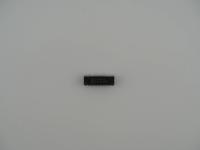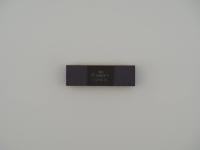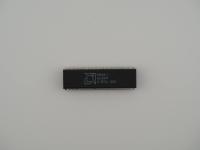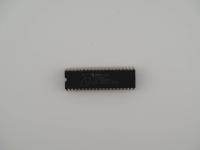

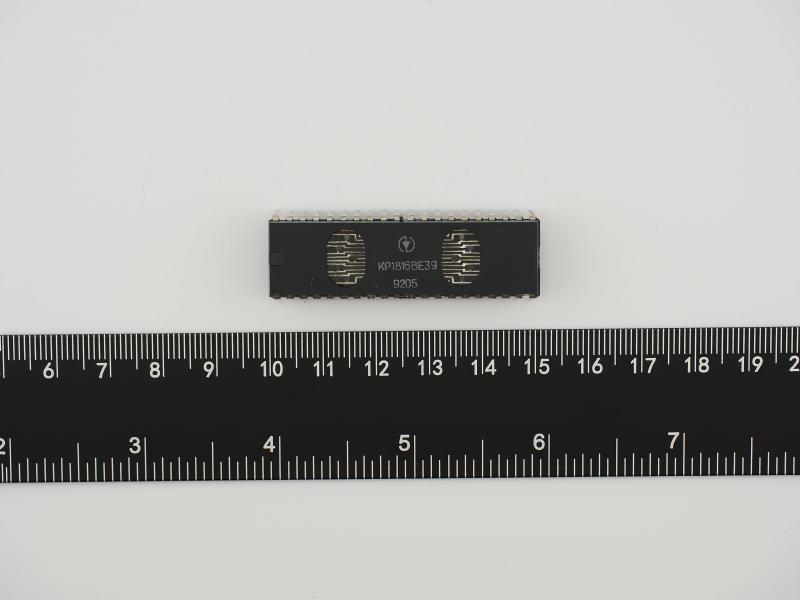
Holding this piece in my hand, the first thing that strikes me is the bizarre, almost skeletal packaging. This is a standard DIP-40 chip by dimension, but the physical execution is incredibly weird.
Plaintext
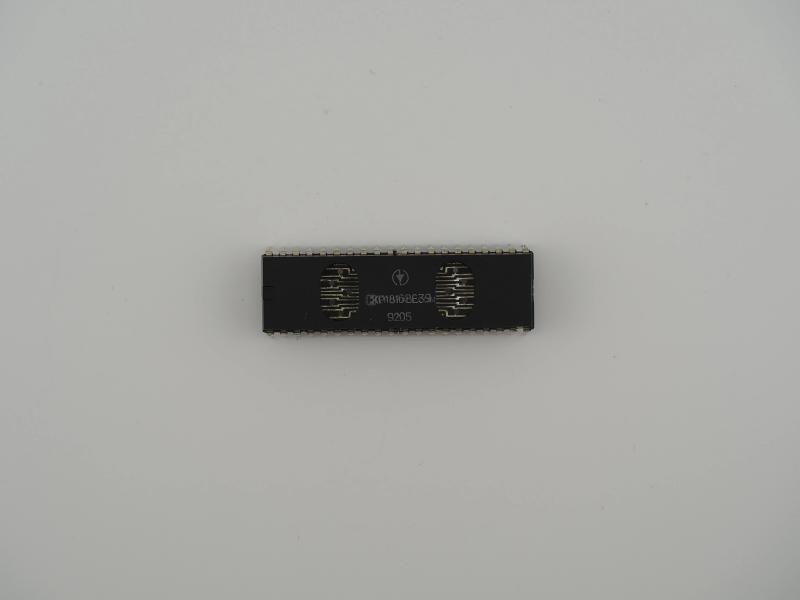
Part Number: КР1816ВЕ39 (KP1816BE39)
Date Code: 9205 (5th week of 1992)
Logo: Circle with a downward pointing arrow and a left-side semi-circle
Looking at the top of the black plastic housing, you immediately notice two perfectly circular, open cavities flanking the central text. These holes are not damage. They are precision molded cavities that completely expose the internal metal lead frame traces! The silicon die itself is hidden safely under the central block of plastic where the silver ink text is stamped.
When I flip this artifact over to inspect the bottom, things get even stranger. There are three similar mold indents on the underside. The left one is solid black plastic. The center cavity is solid black but features a molded number 28. The right cavity, however, is completely open and once again exposes the internal lead frame. The pins are standard tin-plated metal, showing a bit of the dull oxidation you expect from thirty year old hardware. The aesthetic is pure industrial grunge. It looks like a factory cutaway model, but it is a fully functional production unit.
Diving into the silicon, the КР1816ВЕ39 is a direct, unlicensed Soviet reverse-engineered clone of the legendary Intel 8039 microcontroller. The 8039 is a member of the MCS-48 family, specifically the version completely lacking internal ROM.
Because it lacks internal read-only memory, it requires an external program memory chip to function. It features an 8-bit CPU, a whopping 128 bytes of RAM, 27 I/O lines, and it runs at an 11 MHz clockspeed. This was fabricated using n-MOS (n-channel metal-oxide-semiconductor) technology and houses roughly 18,000 transistors. The DIP-40 package houses 40 pins. To save precious physical pins, the 8039 design multiplexes the low-order address bus with the data bus, a classic Intel trick from the late 1970s. This meant system designers had to use an external latch to capture the address during the ALE (Address Latch Enable) signal.
The most fascinating engineering aspect of this specific unit is the packaging anomaly. Usually, the КР prefix (signifying a commercial plastic package) means the chip is fully encapsulated in opaque epoxy. So why the open windows? In Soviet manufacturing, plastic molding presses sometimes utilized specific ejector pins or internal supports. However, given the date code of early 1992, I highly suspect this is an artifact of extreme economic shortages. The plastic epoxy might have been rationed or the molds degraded, resulting in these degassing holes being left completely unfilled and exposing the traces. The exposed traces in this package might have accidentally helped with thermal dissipation for the notoriously warm n-MOS silicon, though that was certainly not their intended purpose. It is a brilliant, terrifying example of doing more with less.
The MCS-48 architecture was a global juggernaut. It powered everything from early arcade cabinets to the keyboard of the original IBM PC. In the Soviet Union, the 1816 series was the absolute workhorse of embedded systems, industrial automation, and military hardware.
There is a persistent myth in the vintage hardware community that Soviet clones were just cheap, inferior copies. This is entirely unfair. While their packaging could be wildly inconsistent (as this exact artifact proves), the actual silicon engineering was a massive feat. NII-35 and other Soviet institutes had to adapt Intel's logic to completely different, often older, domestic fabrication nodes. They did not just copy the chip. They translated it into a completely different dialect of physics.
The true X-factor of this chip is its date code: 9205. The Soviet Union officially collapsed and ceased to exist on December 26, 1991. This chip rolled off the assembly line in the 5th week of 1992. It is literally a ghost chip. It was manufactured in a country that no longer existed, built by a chaotic, collapsing supply chain in the dark early days of the post-Soviet transition. During this period, centralized funding vanished overnight. Engineers were left working in factories that occasionally lacked heating, sometimes being paid in consumer goods rather than currency. The fact that this complex 8-bit microcontroller was successfully fabricated and packaged during that exact window of history makes it a legendary piece of lore.
Identifying Soviet silicon is always an adventure in forensic archaeology. The nomenclature is strict, and I can read it like a map. The prefix КР indicates a commercial plastic package. 1816 is the state registry series for MCS-48 clones. ВЕ stands for microcomputer, and 39 maps directly to the ROM-less Intel 8039 architecture.
The true mystery lies in the manufacturer logo. Stamped above the part number is a circle containing a downward pointing arrow, with a semi-circle attached to the left side of the arrow shaft. Major Soviet electronic plants like Kvazar in Kyiv or Mezon in Chișinău produced millions of these microcontrollers, but they used very different, well documented logos. This specific mark is highly obscure.
Based on my deep dives into Soviet integrated circuit registries, this logo likely belongs to a specialized military sub-contractor or a newly privatized fabrication plant attempting to forge a new identity in the 1992 chaos. While I cannot confirm the exact building this silicon was baked in, the physical evidence (the bizarre exposed lead frame and the post-collapse date code) points to a factory operating in severe survival mode. It is a stunning physical manifestation of geopolitical collapse captured in plastic and tin.