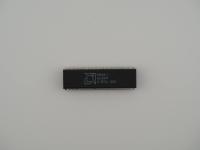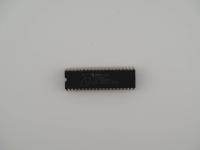

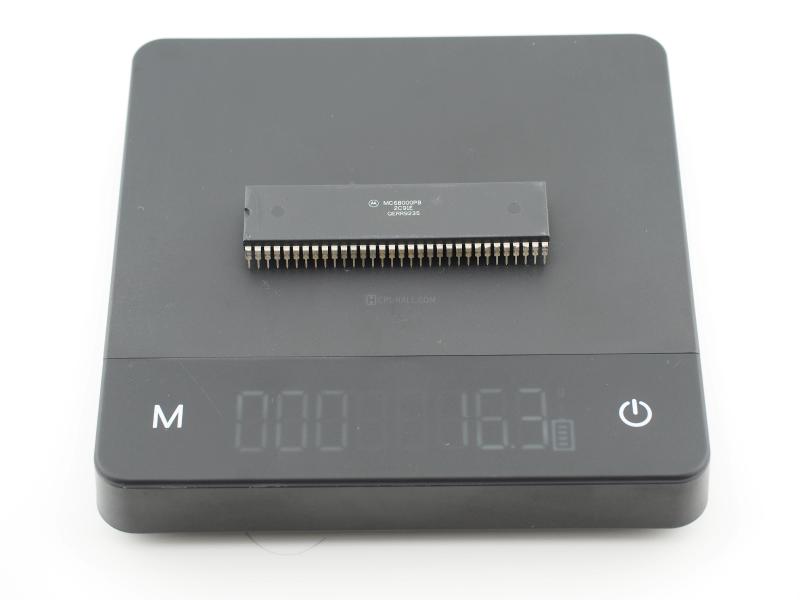
A 64-pin plastic package takes up an incredible amount of board space, and on the scale, it registers a chunky 16.3 grams. This is a massive slab of epoxy and copper lead frame.
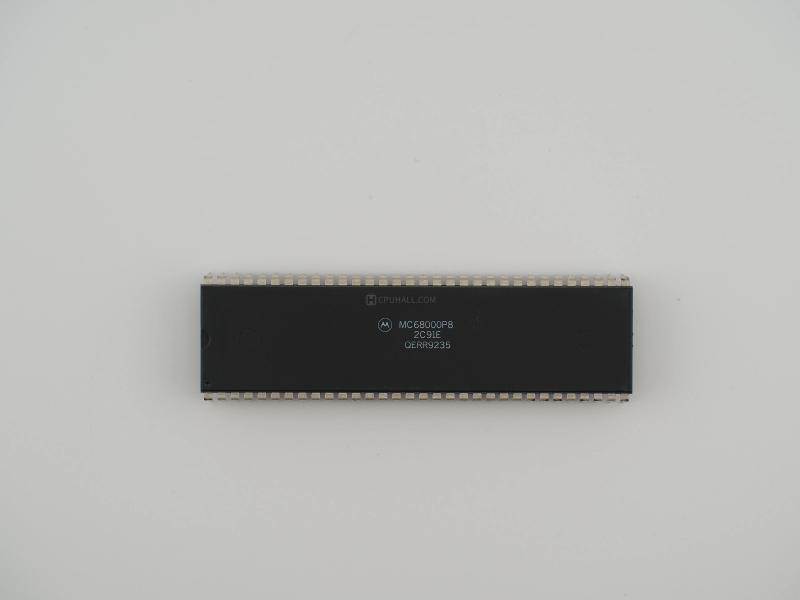
The laser-etched text really pops against the slightly textured, matte black plastic package. Here is the exact top transcription:
(M) MC68000P8
2C91E
QERR9235
Flipping the chip over, the underside reveals standard molding indents and a very faint set of white printed characters:
HHRRQ
The iconic Motorola "batwing" logo is proudly displayed on the top left. The physical condition is excellent. The 64 pins are completely straight with no visible solder residue or heavy oxidation, suggesting this artifact was either very carefully pulled from a socket or sat as New Old Stock for decades. There is no gold or heavy ceramic here. This is pure, utilitarian plastic packaging designed for mass production, identified by the "P" in the part number.
Underneath this plastic shell lies one of the most elegant architectures of the late 20th century. The MC68000 is famous for containing approximately 68,000 transistors. While strictly an architecture with a 16-bit arithmetic logic unit (ALU) and a 16-bit external data bus, it features 32-bit internal registers and a 32-bit internal address bus.
The primary reason this package requires a massive 64 pins is Motorola's design choice to use a non-multiplexed data and address bus. Unlike contemporary Intel processors that shared pins to save space and reduce costs, the 68000 dedicated distinct pins for its 16-bit data bus and 24-bit external address bus. This made the chip physically huge and slightly more expensive to implement on a motherboard, but it provided serious performance benefits and made hardware interfacing far simpler for engineers.
The "8" at the end of the part number denotes an 8 MHz clock speed constraint. While this seems glacial today, 8 MHz on a 68k was enough to drive entire graphical operating systems at a time when other architectures were still struggling with basic text modes.
It is nearly impossible to overstate the historical prestige of the Motorola 68000. If an architecture defines an era, the m68k defines the 16-bit revolution. This is the silicon that powered the original Apple Macintosh, the Commodore Amiga, the Atari ST, and countless arcade boards.
Programmers absolutely loved this chip. Unlike the x86 architecture with its infamous 64-kilobyte segment limits and convoluted memory models, the 68000 offered a beautiful, flat memory model capable of addressing 16 megabytes directly. It featured a highly orthogonal instruction set, meaning almost any instruction could operate on any register. It was a joy to write assembly for.
A common myth is that the 68000 is a "true" 32-bit processor. While it certainly laid the groundwork for full 32-bit successors like the 68020, this original die requires multiple clock cycles to process 32-bit math because data has to pass through the 16-bit ALU in chunks. Regardless of the semantics, it absolutely dominated the high-end desktop and workstation market throughout the 1980s.
While the MC68000 architecture launched in 1979, the surface markings on this artifact tell a much later story. By decoding the date code 9235, we know this specific piece of silicon rolled out of the factory in the 35th week of 1992.
By 1992, the 68000 was completely obsolete for high-end desktop computers. Apple and Commodore had long moved on to the 68030 and 68040. However, the architecture had found a massive second life in embedded systems, controllers, and most famously, the Sega Genesis (Mega Drive) video game console. Given the 8 MHz speed rating and the 1992 manufacturing date, it is highly probable this chip was destined for a console, a printer controller, or telecom equipment rather than a personal computer.
The string 2C91E indicates the specific mask revision of the silicon die, pointing to a very mature, highly refined manufacturing process with all original errata ironed out. The mysterious HHRRQ printed on the bottom is almost certainly a factory lot or assembly facility code, tracking the plastic encapsulation process.