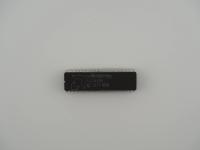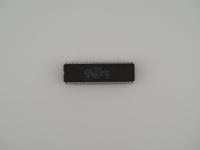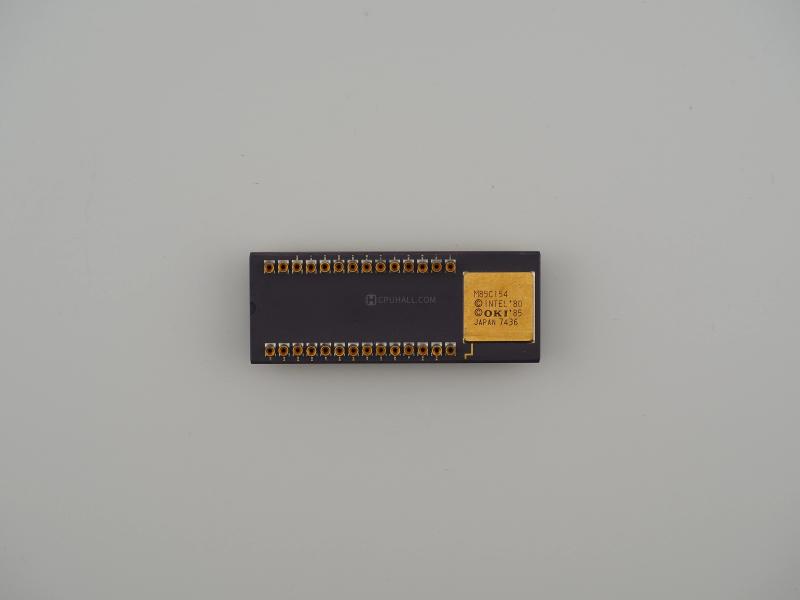

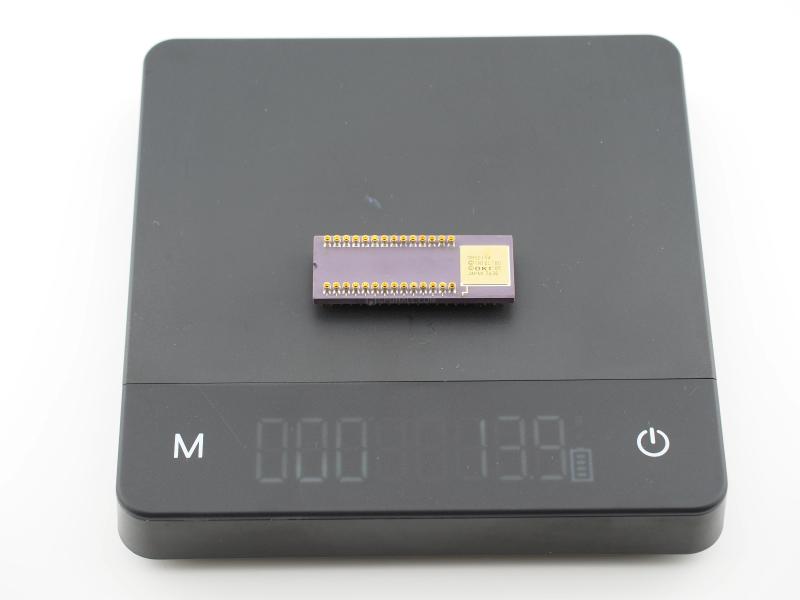
Coming in at exactly 13.9 grams on the scale, this is not your typical hollow plastic microcontroller. This artifact is a stunning piece of 1980s industrial engineering. We are looking at a classic "piggyback" package, and the visual details are spectacular.
The substrate is a gorgeous, deep purple ceramic, common to high-end Japanese fabrication of the era. Positioned perfectly on top is a brilliant gold cap, which protects the silicon die itself. The laser etching on the cap is crisp and reveals the following transcription:
M85C154
(C) INTEL '80
(C) OKI '85
JAPAN 7436
What absolutely steals the show are the pins. The standard 40-pin array on the bottom allows the chip to interface with a standard socket or board. However, flanking the gold cap on top is a secondary set of 28 heavily gold-plated, cylindrical receptacles. When looking closely at the macro shots of the side profile, the brazing technique used to attach these top receptacles to the ceramic body is meticulous. These tiny metal cups are designed to receive the pins of a separate memory chip, effectively allowing this microcontroller to carry its own brain on its back.
To understand why this bizarre two-story chip exists, we have to look at the realities of embedded hardware development in the mid-1980s. This chip belongs to the Intel MCS-51 architecture family, widely known as the 8051.
Most consumer-facing 8051 microcontrollers either had internal mask ROM (which was permanently baked at the factory) or internal EPROM that required a tiny quartz window to erase with ultraviolet light. Mask ROM was completely inflexible for prototyping. Windowed ceramic packages were expensive and slow to erase.
The elegant solution was the piggyback package. Engineers could plug a standard, cheap UV-EPROM directly into the top of this OKI M85C154. The microcontroller would fetch its instructions from the chip sitting right on top of it. If the code had a bug, the engineer simply popped the EPROM out of the gold receptacles, slotted in a freshly programmed EPROM, and rebooted the system. It was the 1980s equivalent of hot-swapping code. The "C" in the part number indicates this is a CMOS (Complementary Metal-Oxide-Semiconductor) variant. CMOS was a massive leap forward from the older NMOS technology, allowing this chip to run significantly cooler and draw a fraction of the power.
The 8051 architecture is the undisputed cockroach of the silicon world. I mean that as the highest possible compliment. Introduced by Intel in 1980, it was so flawlessly designed for embedded control that it is still being manufactured and used in modern appliances, automotive systems, and industrial controllers decades later.
There is a common myth that Intel manufactured all the great early microcontrollers themselves. The reality is that companies like IBM demanded a "second source" for critical components to ensure supply chain stability. Intel aggressively licensed the 8051 architecture to companies like AMD, Siemens, Philips, and OKI. OKI Electric Industry (based in Japan) took the design, optimized it for their cutting-edge CMOS fabrication lines, and produced some of the most reliable and beautiful 8051 clones on the market. This specific OKI artifact represents a brief golden era where development hardware was built with the same uncompromising, "heavy metal" material quality as military aerospace components.
Identifying the exact provenance of an artifact like this requires reading the subtle clues left by the manufacturer. The dual copyright dates on the gold cap are our primary map. The (C) INTEL '80 acknowledges the original creation of the MCS-51 instruction set. The (C) OKI '85 marks the year OKI finalized their specific CMOS mask for this variant.
The real mystery is the batch code 7436. Standard date code logic usually dictates a Year/Week format. If we assume the first digit is the year in the decade, "7" could mean 1987, and "43" would be the 43rd week, with the "6" possibly indicating a specific fab line or day. Alternatively, it could be a continuous OKI internal lot number. Given the 1985 copyright, a manufacturing date of late 1987 aligns perfectly with the peak market adoption of CMOS microcontrollers before surface-mount technology completely took over.