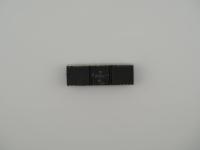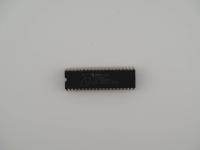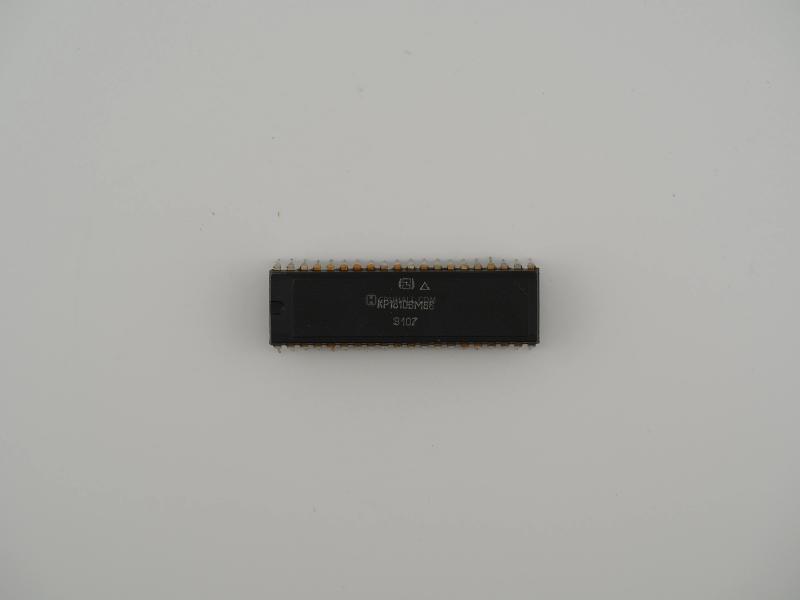

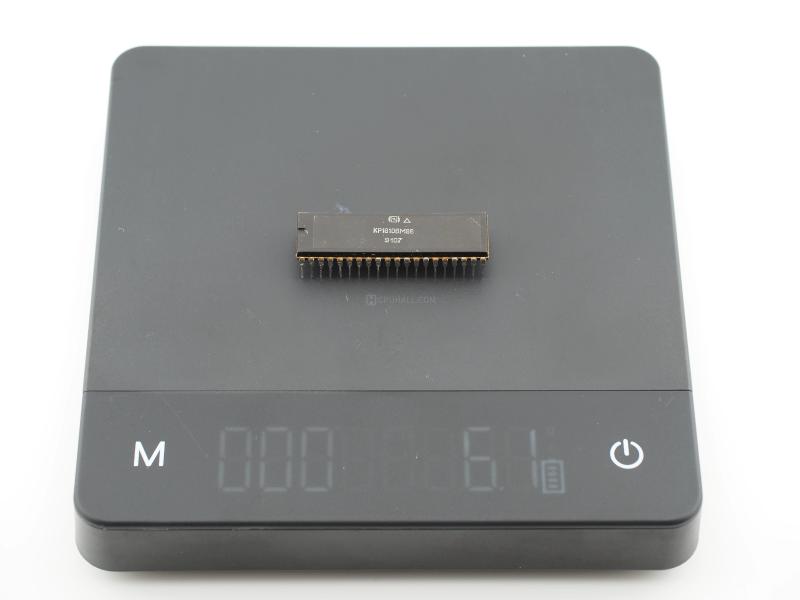
We are looking at a classic DIP-40 plastic package weighing in at precisely 6.1 grams and measuring exactly 52 millimeters in length. While Western chips from the same era often featured smooth epoxy, this specific unit has a uniquely matte, slightly rough surface on the top face designed to hold silkscreen ink.
Looking closely at the surface text under lighting, I can clearly read the stamped markings:
(Kvazar Logo) △
KP1810BM86
9107
Turning the chip over, the underside reveals the telltale signs of its manufacturing process. The dual injection mold indentations are prominent. The left depression features a painted or stamped 35, which was likely a batch or mold identifier used on the factory floor. The rough edges along the side seam reveal a bit of amber-colored flash, confirming this is a plastic PDIP package rather than a high-end ceramic slab. On the back, there is also a distinct patch of white adhesive residue on the right flank alongside a thin curved scratch or filament arcing across the black epoxy, adding a ton of character to its history. The 40 tinned pins are slightly oxidized but structurally perfect and ready to be seated in a socket.
Diving into the silicon, this is not just a standard processor. It is a meticulous and unauthorized hardware clone. Underneath that black epoxy beats a reverse-engineered heart functionally identical to the Intel 8086. This chip utilizes a 16-bit internal and external data bus, fabricated using an NMOS process.
To achieve this feat without the original schematics, Soviet engineers had to optically reverse-engineer roughly 29,000 transistors. They chemically stripped original Intel chips layer by layer, photographing the logic gates and tracing the microscopic pathways by hand. Because this was a 1:1 hardware clone at the mask level, the KP1810BM86 inherited every architectural quirk of its Western twin, including the notorious 1MB segmented memory limit. It ran perfectly at a 5 MHz base clock. Thermal output was minimal by today's standards, meaning this artifact could easily run bare without any heat sink by dissipating its thermal load directly through the plastic body and into the logic board traces.
During the height of the Cold War, Western high-tech exports to the Eastern Bloc were strictly throttled by the CoCom embargo. The Soviet Union's Ministry of Electronic Industry responded by simply copying what they could not legally buy. This x86 architecture became the computing foundation for legendary Eastern Bloc microcomputers like the Iskra-1030 and the ES PEVM.
There is a persistent myth in vintage hardware circles that Soviet clones were inherently flawed or significantly slower than their Western counterparts. The reality is far more nuanced. While manufacturing yields at Soviet plants were undeniably lower due to less refined chemical processes, a fully validated KP1810BM86 performed identically to a genuine Intel 8086. It executed the exact same instruction set flawlessly.
What I find incredibly poignant about this specific artifact is the date code: 9107. This chip was minted in the 7th week of 1991, meaning it rolled off the Ukrainian assembly line just months before the entire Soviet Union officially collapsed. It is quite literally end-of-an-era silicon.
Identifying this chip is straightforward if you know how to read Soviet GOST nomenclature. The prefix KP strictly dictates a commercial-grade plastic package. The 1810 designates the microcomputer processor family series, while BM86 translates to VM86, the direct identifier for the 8086 microprocessor clone.
The most crucial visual clue is the logo in the upper left corner. That square featuring a stylized internal pathway is the official mark of the Kvazar plant located in Kyiv, Ukrainian SSR. The triangle △ printed next to it is a state quality mark indicating the chip met specific operational and military testing tolerances. Based on the exact factory markings, the 9107 date code, and the 6.1g physical weight, I can authoritatively confirm this is a late-production Soviet clone manufactured in mid-February 1991.