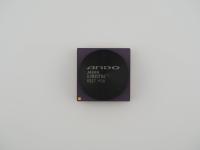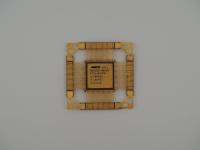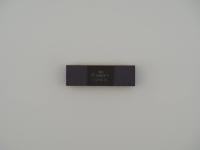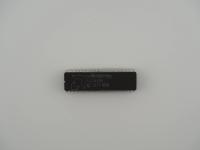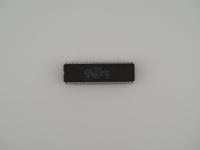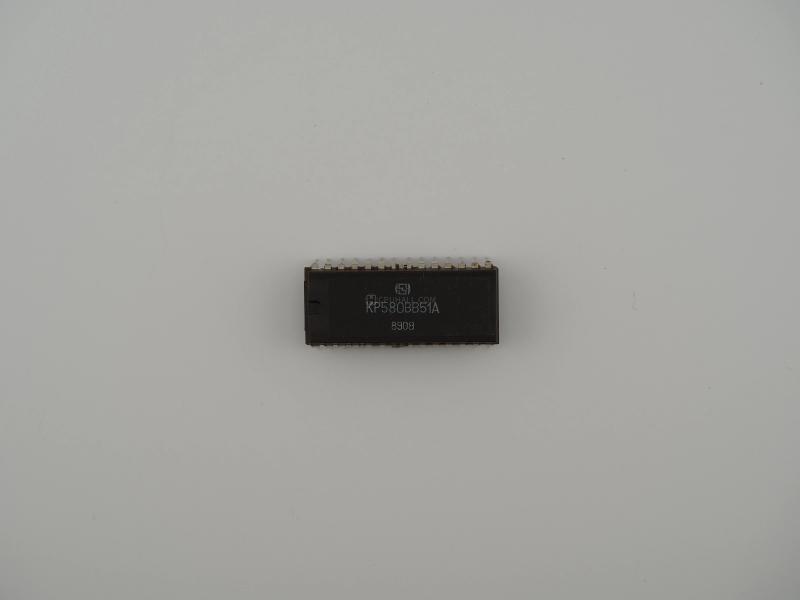

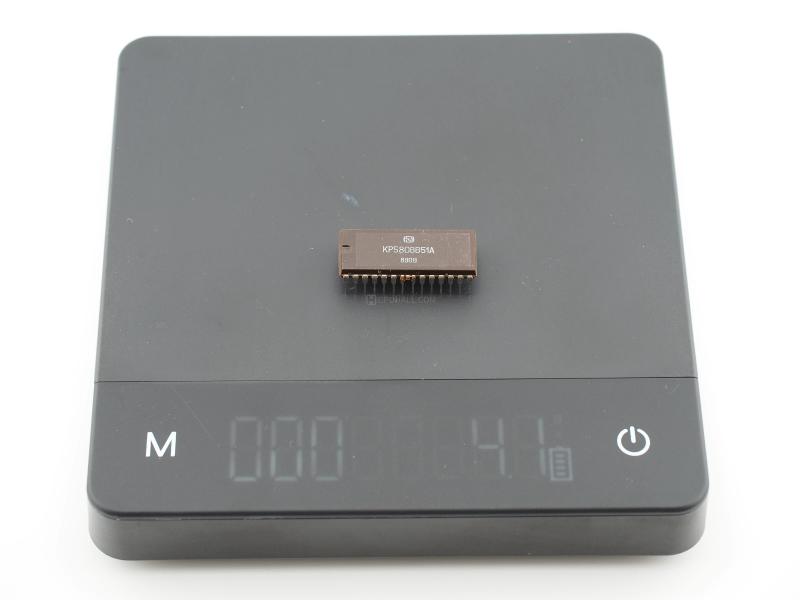
This artifact is housed in a standard 28-pin plastic dual in-line package (DIP-28). Measuring exactly 35mm across my ruler and weighing in at a mere 4.1 grams, it is a lightweight chip compared to the massive ceramic modules in my collection.
Looking closely at the top surface, the dark brown and black plastic resin provides a high-contrast background for the crisp, silver-white laser etching. Here is the exact surface text:
(Logo: “Rodon”)
KP580BB51A
8908
Flipping the chip over to inspect the belly, the brazing of the pins looks slightly oxidized but remarkably intact for its age. The bottom plastic features two distinct circular mold indentations flanking the center. Dead center on the underside, there is a faint, hand-stamped white ink mark reading OC or possibly QC, which almost certainly denotes a factory quality control pass. There is no gold here, no heavy ceramic substrate. It is raw, mass-produced functionalism.
To understand what we are looking at, we have to step away from the central processor itself and look at the lifeblood of a computer system: communication. This chip is not a CPU. It is a Universal Synchronous/Asynchronous Receiver/Transmitter, universally known as a USART.
Specifically, this is a Soviet clone of the Intel 8251A. In an 8080 or 8086 computer architecture, the CPU cannot efficiently talk to external serial devices like modems, terminals, or printers on its own. The USART acts as the essential middleman. It takes parallel data directly from the CPU data bus, packages it into a serial format, adds start and stop bits, and fires it down a single wire. Conversely, it receives incoming serial data, unpacks it, and hands it back to the CPU in parallel form.
The engineering of the КР580 series is a masterclass in aggressive reverse engineering. The fabrication node would likely be an older NMOS process, running warm but entirely manageable within this standard plastic package without the need for active cooling. The "A" suffix in the part number indicates an improved version of the original design, directly mirroring Intel's own update from the 8251 to the 8251A, which fixed several timing bugs and baud rate limitations.
The story behind this chip is deeply rooted in Cold War technological espionage. By the late 1970s and through the 1980s, the Soviet Union realized they were lagging critically behind the West in microcomputing. Rather than completely reinventing the wheel, the Soviet Ministry of Electronics Industry launched massive state-backed initiatives to decap, study, and perfectly clone Western silicon.
The K580 microprocessor series was born from this effort, serving as an unauthorized, highly accurate duplicate of the Intel 8080 family. While the West had moved on to the 80286 and 80386 by 1989, the Soviet bloc was still heavily reliant on these 8-bit systems.
This specific USART would have been a crucial component in legendary Soviet home and educational computers like the Radio-86RK, the Mikrosha, and the Vector-06C. There is a common myth that Soviet clones were inherently buggy or inferior. In reality, chips like this were ruthlessly tested and surprisingly reliable. They had to be, as they were deployed across the entire Eastern Bloc in environments ranging from harsh industrial control floors to high school computer labs.
Identifying Soviet silicon is a decoding game I absolutely love. The Cyrillic part number КР580ВВ51А tells us the entire life story of the chip once you know the cipher.
The prefix К stands for "Kommercheskaya" or commercial grade, confirming this was destined for civilian hardware rather than a missile guidance system. The Р denotes the plastic DIP package. The number 580 designates the specific Soviet microcomputer family cloning the Intel 8080. The letters ВВ stand for input/output peripheral devices. Finally, the 51 perfectly matches Intel's own 8251 numbering scheme.
The date code 8908 is particularly fascinating. It means this artifact rolled off the assembly line in the 8th week of 1989. This places its birth precisely during the twilight years of the Soviet Union, right as Perestroika was taking hold and only two years before the USSR officially dissolved. The logo points to a state-operated semiconductor fabrication plant “Rodon”, churning out these communication lifelines by the thousands. It is a fantastic piece of geopolitical computing history.