
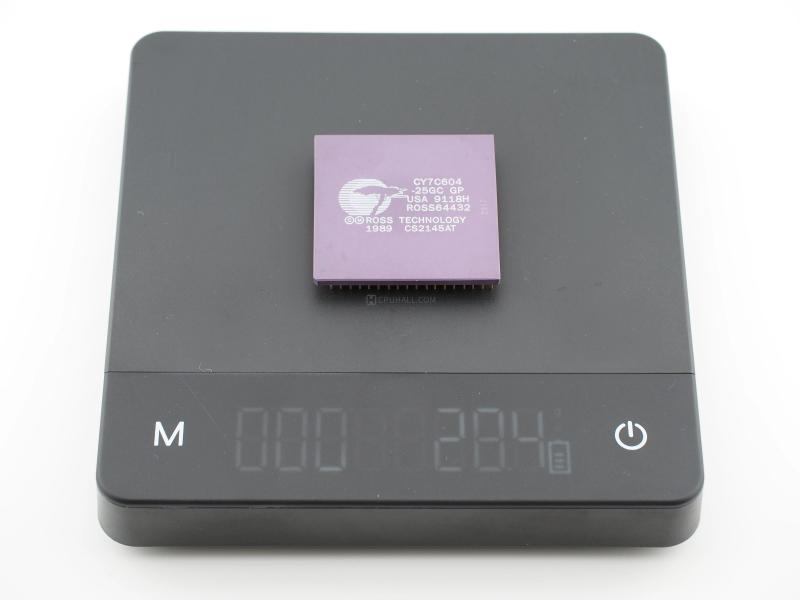
Sitting on the scale, this 35x35mm slab of silicon and ceramic weighs in at exactly 28.4 grams. That weight comes from the dense purple ceramic substrate and the heavily brazed gold pins covering the bottom. It is a stunning, tactile example of late 1980s IC packaging.
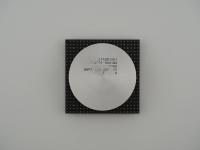
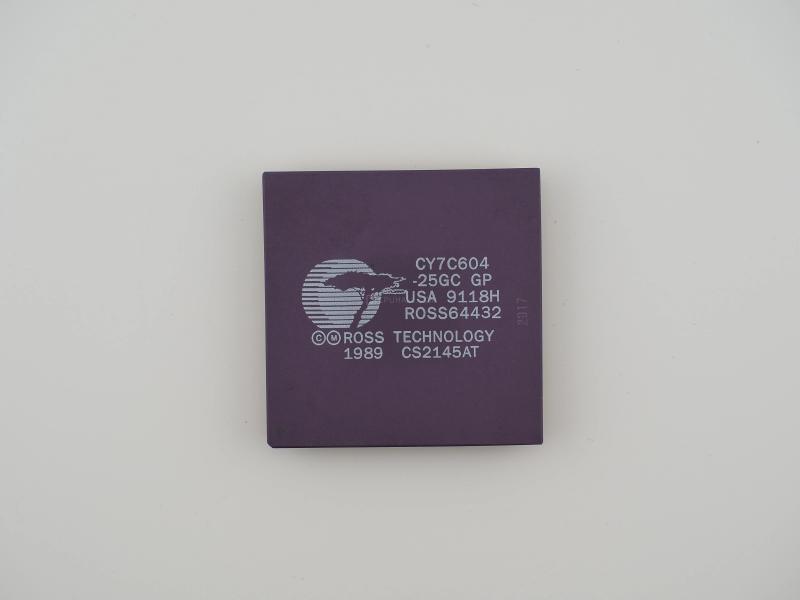
Flipping the artifact over reveals crisp white laser etching against the deep purple ceramic. We have a prominent tree logo belonging to Ross Technology. Here is the exact transcription of the surface text:
CY7C604
-25GC GP
USA 9118H
ROSS64432
© M ROSS TECHNOLOGY
1989 CS2145AT
The 9118H date code indicates this specific unit rolled off the assembly line in the 18th week of 1991 in the USA. The -25GC suffix tells us it is rated for 25 MHz and uses a Commercial grade Ceramic package. The pins themselves are perfectly arranged in a hollow grid, leaving the center exposed where the silicon die cavity is brazed shut.
While the CY7C601 was the primary Integer Unit for this early SPARC chipset, the CY7C604 we have here is the Cache Controller and Memory Management Unit. Back in the early RISC days, putting everything on a single die was physically impossible due to transistor budgets and yield limitations. You needed a multi chip module or a motherboard filled with discrete logic to make a complete processor.
This specific artifact acts as the traffic cop for memory operations. It manages a 64 Kbyte mixed instruction and data cache and supports both write through and copyback modes. Operating at 25 MHz, it had to be incredibly fast to ensure the SPARC integer unit was never starved for data. The dense pin grid array on the bottom provides the massive bandwidth required to interface with the main CPU, the external cache RAM chips (typically Cypress CY7C157 SRAMs), and the system bus.
The story of Ross Technology is a fantastic piece of Silicon Valley lore. Founded in 1988, Ross was set up as a subsidiary of Cypress Semiconductor specifically to build SPARC RISC microprocessors. Sun Microsystems was pushing SPARC as an open standard to dominate the high end server and workstation market, and they needed second sources and fast fab partners. Cypress was already known for ultra fast SRAMs and logic gates, so they saw an immediate opportunity.
This chipset, integrating the CY7C604, allowed system builders to replace dozens of discrete logic chips with a clean, five chip solution. It powered early Sun SPARCstations, machines that defined the Unix era of the early 90s. The funny thing about Ross Technology is how they were treated like a poker chip in corporate buyouts. Cypress eventually sold them to Fujitsu in 1993 once the margins on SPARC chips started to shrink and the architectural complexity demanded massive research and development budgets.
Identifying this artifact was incredibly straightforward thanks to the pristine surface printing. The CY7C604 part number immediately flags it as a Cypress Semiconductor product, while the prominent Ross Technology copyright and tree logo confirm its origin within their SPARC division.
I can state definitively that this is a production 25 MHz CMU and MMU chip. The GC designation in Cypress nomenclature strictly points to a ceramic pin grid array package for commercial temperature ranges. The visual evidence of the dense PGA layout and the 28.4g weight on the scale perfectly matches the physical profile of a high pin count ceramic module designed to sit on a Sun MBus module. It is a beautiful, complete piece of early RISC history.