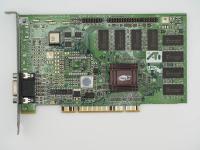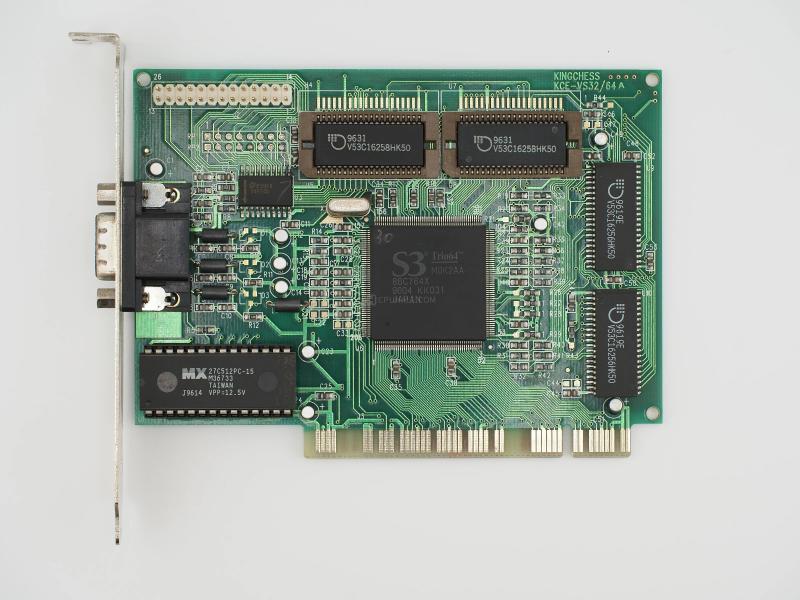

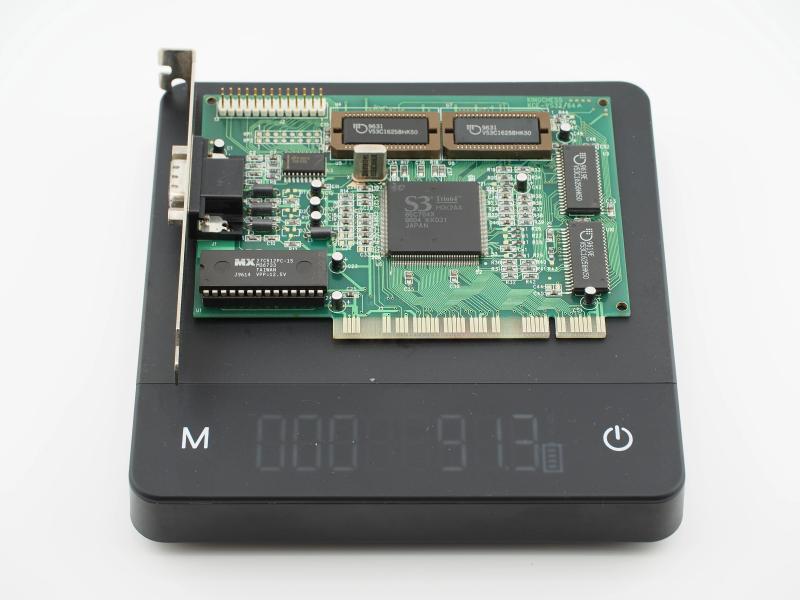
Holding this piece, I immediately noticed how incredibly light and compact these mid-90s accelerators were. Tipping the scales at a mere 91.3 grams and measuring roughly 130mm in length, it feels completely alien compared to the massive, power-hungry graphics bricks of the modern era. The PCB is a classic, vibrant 90s green, completely unshielded and laid bare for inspection.
Looking closely at the surface components under the studio lights, the micro-contrast reveals a wealth of manufacturing history scattered across the board. The main processor, the ROM, and the memory chips all tell a story of a late 1996 assembly.
Main GPU S3 Chip:
S3 Trio64 (TM)
MOK2AA
86C764X
9604 KK031
JAPAN

Macronix EPROM (BIOS):
MX 27C512PC-15
M36733
TAIWAN
J9614 VPP=12.5V

Mosel Vitelic Socketed RAM:
9631
V53C16258HK50

PCB Markings:
KINGCHESS KCE-VS32/64 A
P/N 600-3264-02 Rev 1.
The physical texture of the card is purely functional. The plastic QFP (Quad Flat Package) of the S3 chip sits centrally, flanked by the memory subsystem and the BIOS chip. The gold contacts on the PCI edge connector still look reasonably sharp, and the brazing on the through-hole components around the 15-pin VGA port is textbook mass-production wave soldering.
Diving into the technical weeds of this board is fascinating because it represents a major turning point in PC architecture. The S3 Trio64 (part number 86C764) was an engineering marvel of integration for its time. The "Trio" name was not just marketing fluff. It literally meant that S3 had integrated three previously separate discrete components into a single piece of silicon: the graphics core, the RAMDAC (Random Access Memory Digital-to-Analog Converter), and the clock generator. This monolithic integration drastically reduced board complexity, lowered manufacturing costs, and completely dominated the OEM market.
This specific unit features a 64-bit memory interface, a significant upgrade over the 32-bit interfaces common in earlier budget cards. Let us talk about the memory configuration, as it is a beautiful example of 90s expandability. We have 2MB of total video RAM here. There is 1MB soldered directly to the board on the right side using SOJ (Small Outline J-lead) packages. But the board also features two populated DIP sockets filled with Mosel Vitelic 50ns EDO (Extended Data Out) DRAM chips. EDO RAM was a massive deal in the mid-90s, offering noticeably better performance over standard Fast Page Mode RAM by allowing the memory controller to begin a new column address cycle while keeping the data output of the previous cycle active.
The 50ns access time on these chips was quite fast for 1996, giving the Trio64 plenty of memory bandwidth to push high-resolution 2D graphics at true color depths, something essential for the shiny new Windows 95 interface.
The S3 Trio64 is an absolute legend in the retro computing community. If you were playing Doom, Duke Nukem 3D, or Command & Conquer, there is a very high probability you were looking at pixels rendered by an S3 chip.
The lore surrounding S3 in this era is a tale of total market dominance followed by a rapid, brutal fall. In the 2D era, S3 was untouchable. Their drivers were rock solid, their DOS VESA compatibility was the gold standard, and their GUI acceleration made Windows fly. The myth often repeated is that S3 simply "forgot" to make 3D chips. The reality is more complicated. They tried with the ViRGE line (often jokingly referred to as the first "3D Decelerator"), but they simply could not pivot fast enough to compete with upstarts like 3dfx and their Voodoo graphics.
But looking at this Trio64, we are capturing S3 at the absolute peak of their power. This was the chip that every system builder defaulted to. It was cheap, it was fast, and it never crashed. It is the reliable heavy-metal workhorse of the Windows 95 revolution.
When I acquired this artifact, the exact OEM origin was slightly obscured, but the visual clues left on the PCB give us a very clear timeline.
The silkscreen "KINGCHESS KCE-VS32/64 A" points to a Taiwanese manufacturer. Kingchess was one of countless board partners in Taiwan churning out S3 reference designs to feed the insatiable global demand for PC clones in the 1990s.
Tracing the date codes across the silicon acts as a forensic timeline of assembly. The S3 GPU itself was manufactured in Japan in the 4th week of 1996. The Macronix BIOS chip was fabricated in Taiwan in the 14th week of 1996. Finally, the Mosel Vitelic socketed RAM chips carry a date code of 9631, placing their manufacture in the 31st week of 1996 (roughly August).
Based on this evidence, I can confidently state this specific card was assembled and shipped in the late summer or early fall of 1996. It represents the final, perfected iterations of the Trio64 line right before the industry completely pivoted to integrated 3D accelerators.