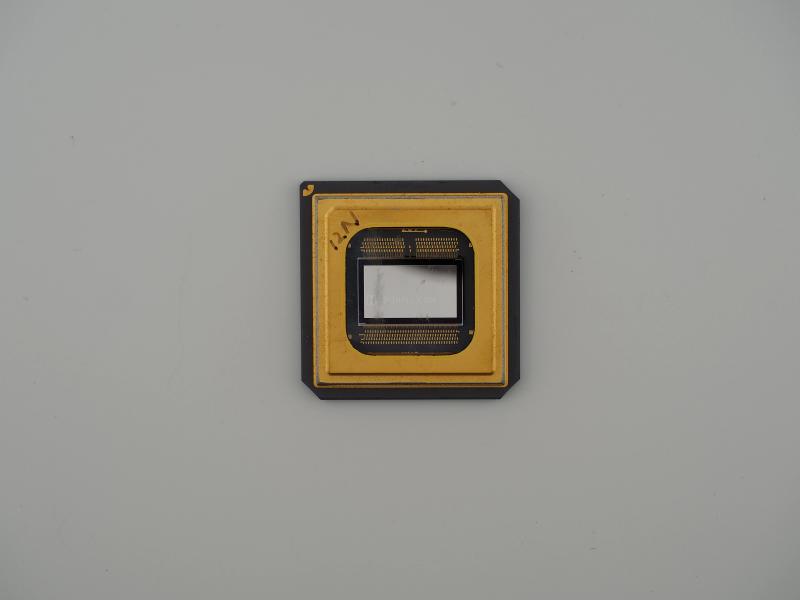

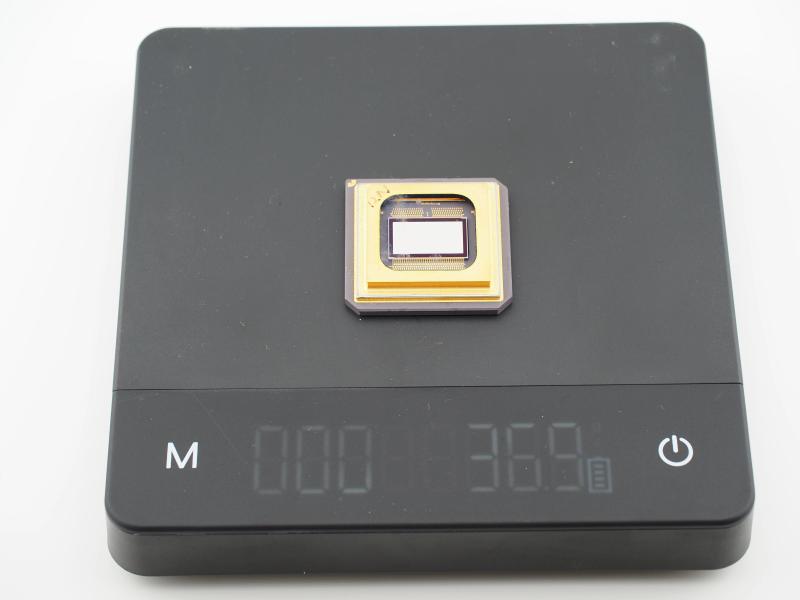
Holding this piece immediately conveys a sense of extreme precision and high manufacturing cost. Weighing in at 36.9 grams, this dense ceramic package is framed by a thick, heavy gold stiffener.
The undisputed star of this artifact is the highly reflective, mirror-like rectangular window sitting deep within the central cavity. The back of the package features a flawless array of 312 gold contact pads, accompanied by distinct laser etchings:
5081550
S1272-0343
[Data Matrix Barcode]
56Z3KZA 161204E
L0Z 161204
There is also a handwritten 12.1V scrawled in black marker on the front gold bezel, likely left by a technician during a repair or testing phase. The artifact has some light dust accumulation and surface wear, but the gold plating and the central optical window remain visually stunning.
This is an optical semiconductor—specifically, a Digital Micromirror Device (DMD). The technology behind it, known as Digital Light Processing (DLP), was pioneered by Texas Instruments.
That highly reflective rectangle in the center is not a flat piece of silicon; it is a micromechanical marvel. Behind that glass window sits an array of hundreds of thousands (or over a million) microscopic aluminum mirrors. Each individual mirror corresponds to a single pixel on a screen.
These micromirrors are mounted on tiny hinges over a static random access memory (SRAM) cell. By applying an electrical signal, each mirror can physically tilt either toward a light source (ON) or away from a light source (OFF) up to thousands of times per second. By coordinating the rapid toggling of these mirrors with a spinning color wheel and a bright projection lamp, the chip literally "paints" a high-definition image using reflected light.
The heavy gold frame and dense ceramic packaging are required to dissipate the massive amount of heat generated by the projection lamp continuously blasting intense light directly onto the mirror array.
Before flat-panel LCDs and OLEDs conquered the living room, there was a golden age of Rear-Projection Televisions (RPTVs) in the early-to-mid 2000s. If you wanted a massive 50-inch or 60-inch high-definition television without spending $10,000 on an early plasma display, you bought a DLP TV.
Brands like Samsung, Mitsubishi, RCA, and Toshiba built massive, deep television cabinets that housed a light engine powered by a chip exactly like this one. The picture quality was stunning for the time, offering incredibly deep blacks and fast motion response. However, they were mechanical devices. The spinning color wheels would whine, the high-intensity lamps would eventually burn out, and occasionally, individual microscopic mirrors on the DMD chip would get "stuck," resulting in permanent white or black dots on the TV screen.
The laser-etched markings on the rear ceramic provide a perfect forensic trail for this exact unit.
The part number S1272-0343 is a very well-documented Texas Instruments DLP chip. It was the optical heart of several highly popular rear-projection televisions from the mid-2000s, most notably:
Furthermore, the alphanumeric string ending in 161204 likely acts as a date code. This strongly points to a manufacturing date of late 2004 (possibly December 16, 2004, or the 12th week of 2004), which aligns perfectly with the absolute peak of the consumer DLP television market.
This artifact is a beautiful, tactile piece of home theater history—a literal million-mirror optical engine contained within a heavy gold and ceramic vault.