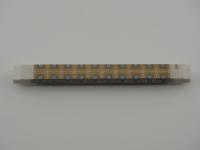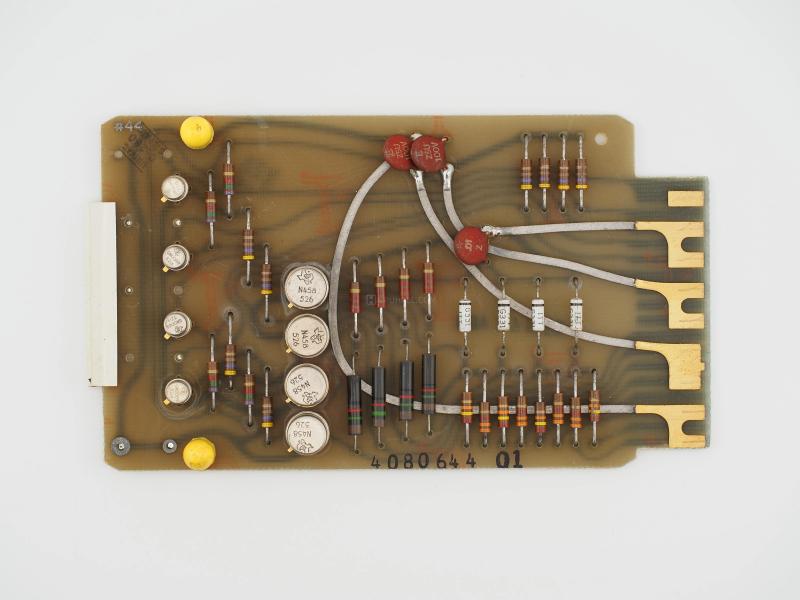

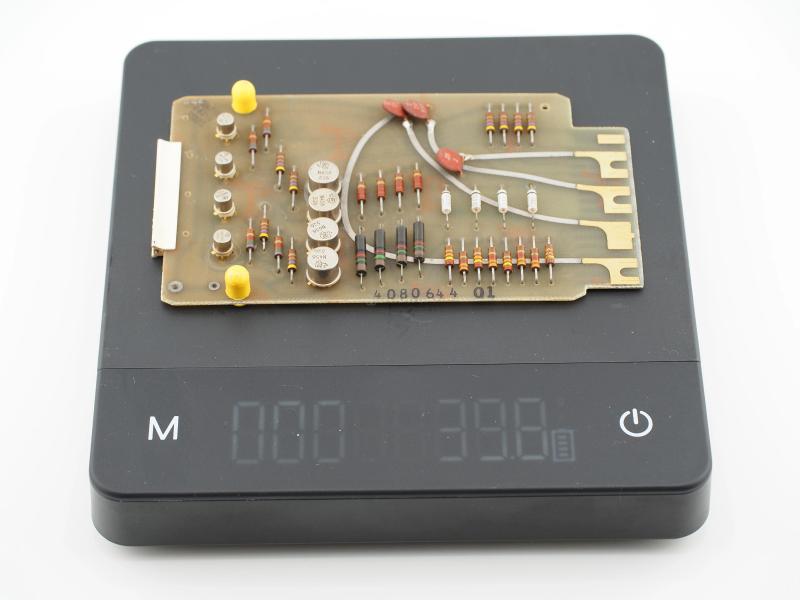
Holding this piece immediately transports me to an entirely different era of computing. Slipping it onto the scale reveals a surprisingly light 39.8 grams, but the historical weight is massive. The fiberglass substrate has aged to a deep, translucent amber.
Front Edge Code: 4080644 01
Large Transistors: TI Logo, N458, 526
Small Transistors: TI Logo, GM0089, 521A
Rear Trace Stamp: NOV 17 1965
Rear Print: UNIVAC, C-328, ST. PAUL
The top surface is populated with a gorgeous array of discrete components. We have axial resistors with perfectly preserved color bands, red ceramic disc capacitors marked 100V Z5U, and the absolute stars of the show: metal-can transistors. These cans bear the classic Texas Instruments map logo. The micro-contrast of the macro shots reveals slight oxidation on the metal cans, but the laser etchings are wonderfully legible. The date codes on these TI chips (526 and 521A) point perfectly to the middle of 1965. Flipping this artifact over is where the real magic happens. The hand-routed, flow-soldered traces are practically an art form, proudly stamped with "NOV 17 1965" and the origin "UNIVAC ST. PAUL".
This is what compute looked like before we packed millions of transistors into a sliver of silicon. What we are looking at is a discrete component logic gate board. This artifact relies on Diode-Transistor Logic (DTL) or early Resistor-Transistor Logic (RTL) to perform basic boolean operations.
Instead of a single microscopic die, the logic gates here are physically spread across the board. The Texas Instruments N458 and GM0089 transistors act as the active switching elements, while the surrounding carbon composition resistors and capacitors handle biasing and signal conditioning. The thermal challenges here were completely different from the massive IBM TCMs I usually handle. Instead of localized heat fluxes requiring water cooling, the heat was distributed across the entire card cage. The packaging complexity was entirely mechanical. Engineers had to figure out how to stack thousands of these PCB blades into massive backplanes, routing signals through those gold-plated proprietary edge connectors without succumbing to massive signal degradation.
The "ST. PAUL" stamp on the back is a massive historical clue. St. Paul, Minnesota, was the heart of Univac's Defense Systems division. This facility was born out of Engineering Research Associates (ERA), a pioneering computer company that was acquired by Remington Rand and eventually became Univac.
While commercial Univac mainframes were making waves in the business world, the St. Paul facility was building absolute tanks for the United States Navy and aerospace programs. Hardware from this specific era and facility powered systems like the Naval Tactical Data System (NTDS) and the CP-642B military computers. These machines tracked radar contacts, calculated firing solutions, and survived being bolted to the hull of active warships. A common myth is that computing in the 1960s was entirely fragile and required pristine, air-conditioned rooms. While true for commercial banking mainframes, the mil-spec gear coming out of St. Paul was ruggedized to an insane degree. They potted components, conformal-coated boards, and built chassis that could survive literal explosions.
The provenance of this specific unit is incredibly solid regarding its origin, but pinpointing the exact host machine requires some serious detective work. The explicit "UNIVAC" and date stamps leave zero doubt about who made it and when.
The part number 4080644 01 and the designation C-328 are standard Univac sub-assembly formats. Given the late 1965 date, this board sits right on the precipice of the transition from discrete transistors to early integrated circuits. Univac's 1218 and 1219 military computers heavily utilized exactly this style of fiberglass edge-connector card populated with discrete TI transistors. I strongly suspect this board is a logic module from a Univac 1219 (also known as the Navy CP-841), which was widely deployed in the mid-1960s for fire control and tactical data processing. Finding surviving documentation for these specific modular cards is notoriously difficult because much of the St. Paul output was heavily classified at the time of manufacture. I will need to track down a declassified NTDS maintenance manual to fully map out what specific boolean gate this card represents.