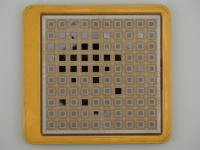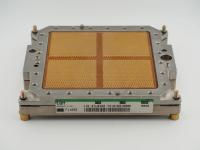

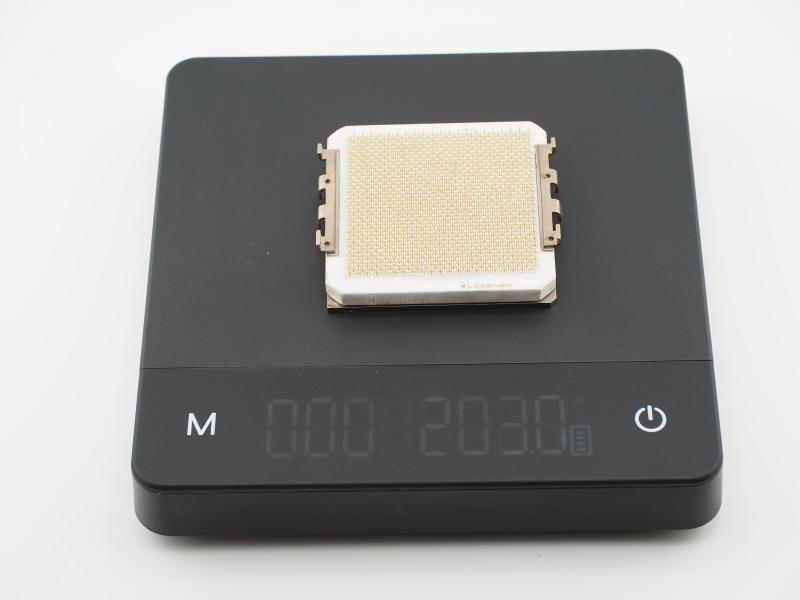
Holding this artifact, the sheer mass and industrial hostility of 1980s mainframe hardware are immediately apparent. It is a solid, heavy square of white ceramic capped with a thick, brushed aluminum plate. This isn't delicate desktop silicon; it is a brutalist slab of enterprise engineering.
Looking closely at the top plate, the metal tells a story of intense thermal stress. Right in the dead center, there is aggressive scuffing, scratching, and oxidized thermal paste residue. This marks the exact contact patch where a massive, multi-pin aluminum heat sink was ruthlessly clamped down to keep the logic underneath from burning itself alive. On the left and right edges, you can see the distinct, heavy-duty metal side rails with slotted tabs, permanently affixed to the module.
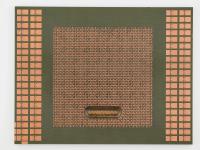
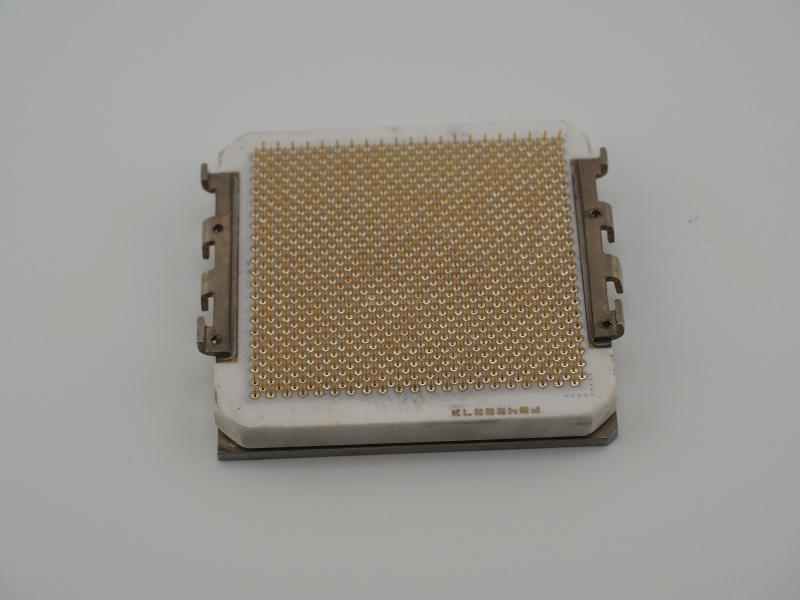
Flipping it over reveals an impossibly dense sea of pins. Looking through a macro lens at the bottom edge, the pins show an authentic, slightly dull patina. They have aged exactly how you'd expect vintage 1980s gold plating to age, with minor oxidation near the brazed joints on the stark white ceramic.
Ceramic Edge Stamping: P8422273
Diving into the technical weeds, this module represents a massive leap in packaging density. While IBM's flagship 308X series mainframes relied on monstrous, water-cooled Thermal Conduction Modules (TCMs), the 4381 required something that could survive in a standard, air-cooled data center.
IBM's solution was this high-density Multi-Chip Module (MCM). Built on a rigid 64 millimeter square ceramic substrate, IBM managed to pack up to 36 individual logic chips into this single package. To feed power to these bipolar logic arrays and handle the data bus, the bottom of the ceramic is studded with exactly 882 I/O pins.
The thermal engineering required to keep this alive was staggering. Each of the 36 chips inside could dissipate up to 2.9 watts under heavy load, turning this 64mm square into a nearly 100-watt space heater. To manage this, IBM used a targeted impingement cooling system, blasting high-velocity jets of air directly onto the heat sinks attached to these caps.
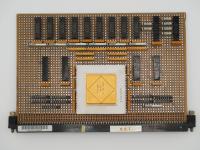
Furthermore, you couldn't just shove 882 pins into a standard socket without bending them into oblivion. IBM engineered a unique Zero Insertion Force (ZIF) connection array for the logic board. Those slotted metal tabs on the sides of the module were engaged by a mechanical actuator on the motherboard; when triggered, the actuator used the tabs to perfectly guide and lock the MCM into the board to form a solid electrical connection.
Announced in September 1983, the IBM 4381 was a legendary mid-range workhorse. It was strategically positioned between the entry-level 4341 and the massive 3083, supporting everything from DOS/VSE to the advanced XA operating systems.
The lore of the 4381 lies in its accessibility and longevity. Prior to this, achieving true high-end mainframe performance meant installing dedicated plumbing to water-cool your processor complex. The 4381 proved you could achieve blistering enterprise speeds, operating with an internal processor cycle time of just 68 nanoseconds (roughly 14.7 MHz) using clever ceramic packaging and brute-force air cooling.
A common myth among vintage collectors is that all IBM MCMs from this era are identical under the hood. In reality, these modules were highly specialized Field Replaceable Units (FRUs); depending on where this specific module was socketed on the board, it could be functioning as the Instruction Processing Unit (IPU), the channel controller, or the storage logic.
The 64mm x 64mm dimensions perfectly matched IBM's internal documentation for the 4381 MCMs. The forensic clues lie in the hardware's extreme proprietary nature. The exact layout of the 882-pin array, combined with those highly specific metal actuator tabs on the sides, are unmistakable signatures of the 4381's zero-insertion-force board design. Furthermore, flipping the module to read the gold-stamped P8422273 confirms the standard IBM 7-digit part numbering convention (P standing for Part).
While the permanent, hermetically sealed aluminum cap prevents us from seeing the exact internal layout of the 36 dies, its physical footprint and unmistakable ZIF mounting hardware solidify its identity as the beating heart of a mid-1980s IBM System/370 workhorse.