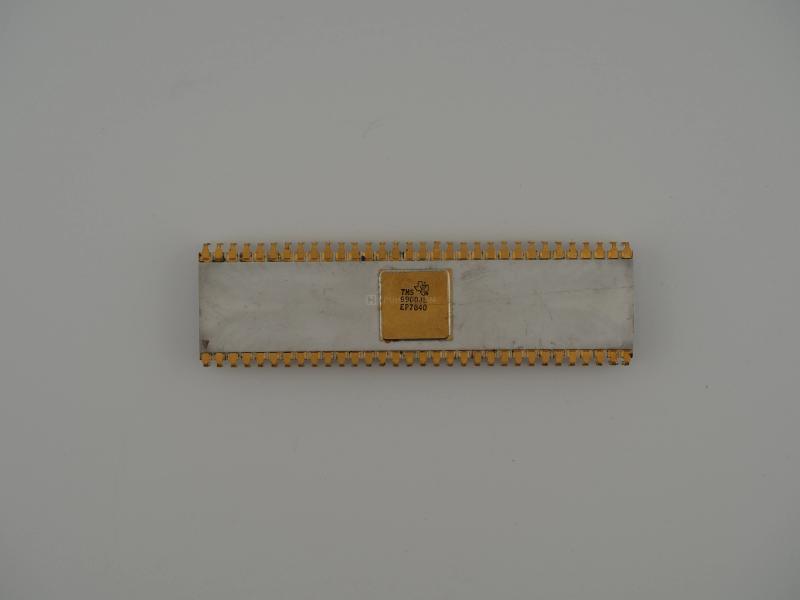

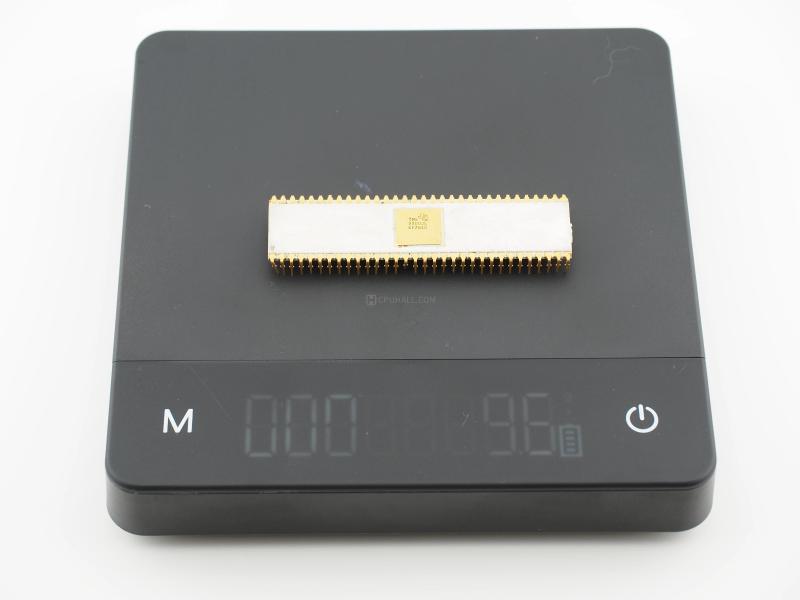
It is a massive slab of white ceramic weighing in at exactly 9.6 grams on the scale. The sheer size of this 64-pin package is imposing and demands attention. The top features a beautifully brazed gold cap with the classic Texas Instruments map logo sharply etched into the metal. The gold lid reveals the following markings:
TMS
9900JL
EP7840
Flipping the heavy ceramic body over reveals a stark white underside stamped with black ink:
M9900E/09445
SINGAPORE
B
The gold pins are beautifully preserved and contrast perfectly against the bright white substrate. This specific unit was clearly handled with immense care over the decades. The tactile feel of the cold ceramic paired with the heavy weight makes it feel less like a consumer electronics component and more like a piece of aerospace hardware.
Let us talk about the brutalist engineering decisions of the late 1970s. Why does this chip need 64 pins when the competing Intel 8088 got away with 40? Texas Instruments flatly refused to multiplex the address and data buses. They ran a full 16-bit data bus and a 15-bit address bus out to the physical pins simultaneously. This required a colossal footprint for the era but allowed for theoretical data throughput that was unmatched at the time.
The architecture itself is deeply fascinating. The TMS9900 features absolutely no general-purpose on-chip registers. Instead it uses a unique "workspace pointer" architecture. All user registers are held externally in main RAM. This design made hardware interrupt handling and context switching incredibly fast because the CPU only had to change a single pointer in memory rather than save and load a dozen internal register states. The fatal flaw was that it meant the processor could only ever execute as fast as the system memory allowed. If you paired it with slow RAM, the entire pipeline choked.
The lore surrounding the TMS9900 is the stuff of computing tragedy. This was one of the very first true single-chip 16-bit microprocessors on the market. It famously powered the legendary TI-99/4A home computer.
Historical rumors strongly suggest that IBM seriously considered the TMS9900 for the original IBM PC project. The TI-990 instruction set was far more elegant and mathematically powerful than the Intel 8086 family. But the massive 64-pin package made motherboards incredibly expensive to route and manufacture. Furthermore the lack of cheap 16-bit support peripherals forced IBM to look at the compromised 8-bit bus of the Intel 8088. Texas Instruments had a massive head start in the 16-bit microprocessor race and lost the entire PC revolution simply because they refused to compromise on their bus width.
Tracing the exact origin of this piece is straightforward thanks to the clear manufacturing codes physically present on the chip. The EP7840 etching dates this silicon exactly to the 40th week of 1978.
The JL suffix in the part number designates the premium white ceramic and gold package. This was an expensive format typically reserved for early production runs, industrial applications, or military contracts before cheaper plastic packaging became the global norm. The bold SINGAPORE print on the back confirms the final assembly and testing location for this specific batch. The large B stamp likely designates a specific testing bin or fabrication line at that facility. It is a flawless physical example of late 1970s semiconductor optimism and a crown jewel for early 16-bit computing history.