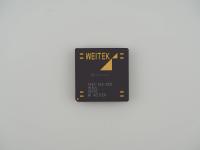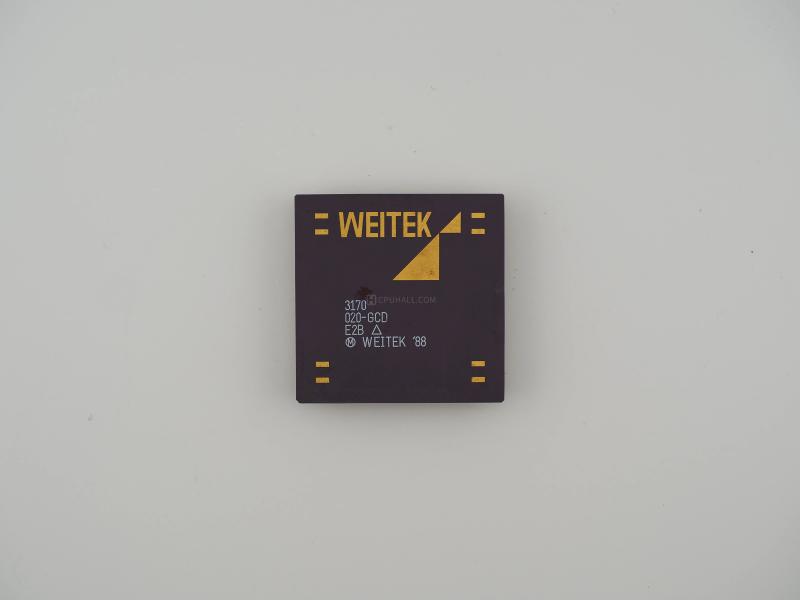

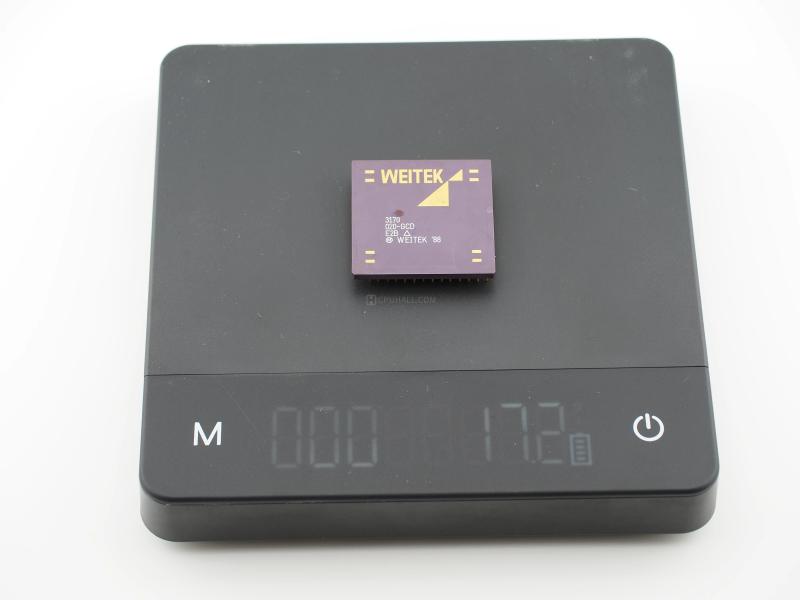
Handling this artifact is a distinctly premium experience. When I drop this piece onto the scale, it registers a solid 17.2 grams. This weight is entirely thanks to the incredibly dense purple ceramic package and the massive gold brazed cap on the underside. The deep plum hue of the ceramic substrate is a hallmark of high-end late 1980s fabrication and it contrasts beautifully with the gold-plated pins and top silkscreen.
Looking at the top surface under macro lighting, I can easily read:
= WEITEK [Triangle Logo] =
3170
020-GCD
E2B Δ
(M) WEITEK '88
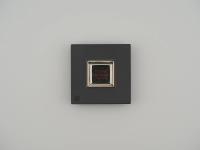
Flipping the chip over reveals a gorgeous, edge-to-edge gold heat spreader nestled within the pin grid. This is not just for show. High-speed math coprocessors ran incredibly hot, and this massive thermal interface was completely necessary. The laser etchings on the gold cap provide further manufacturing details:
3170-E2B
9047A
USA
The pins are perfectly straight and retain a brilliant gold luster, indicating this unit was either stored impeccably or saw very little mechanical wear in its socket. The contrast between the cold purple ceramic and the bright gold elements makes this one of the most visually striking pieces in my collection.
To understand the WTL3170, we have to look at the architectural landscape of the time. This is not a standalone processor. It is a dedicated hardware Floating Point Unit engineered specifically to interface with early SPARC microprocessors, most notably the Cypress CY7C601.
The 020 in the part number indicates this specific unit is binned for 20 MHz operation. While 20 MHz sounds pedestrian today, pushing complex floating-point mathematics at that frequency in 1988 required serious silicon real estate. The SPARC integer unit would encounter a floating-point instruction and immediately hand it off to this Weitek chip over a dedicated coprocessor bus. The WTL3170 would then execute single-precision or double-precision IEEE 754 math operations drastically faster than the host CPU could ever emulate them in software.
The packaging itself is a testament to the thermal demands of the era. The large gold cap on the bottom is designed to interface directly with a heatsink or to dissipate heat efficiently into the ambient airflow of a workstation chassis. The 143-pin CPGA layout provides enough bandwidth for the dedicated memory and instruction buses required to keep the FPU fed with data without bottlenecking the main SPARC processor.
Weitek is a legendary name among vintage hardware enthusiasts. Before Intel integrated the FPU directly into the die with the 80486DX, and before Motorola did the same with the 68040, dedicated math coprocessors were big business. If you were doing CAD work, scientific modeling, or high-end financial calculations, your computer was essentially useless without one of these expensive add-on chips.
While Weitek is most famous for their x86 coprocessors like the 1167 and 3167, their RISC partnerships were equally vital. Sun Microsystems leaned heavily on the WTL3170 for their legendary SPARCstation 1. The SPARCstation 1 was a pizza-box workstation that revolutionized the industry, and its raw mathematical superiority was entirely dependent on this exact Weitek silicon.
The tragic lore of Weitek is that their business model was doomed from the start. They built incredibly fast and expensive coprocessors to fix a temporary problem. The moment Moore's Law allowed CPU manufacturers to bake floating-point logic directly onto the main processor die, Weitek's core market vanished overnight. They pivoted to graphics accelerators later in the 1990s but eventually faded away, leaving these beautiful ceramic chips as the only physical remnants of their brief absolute dominance in computer mathematics.
The visual clues on this chip leave absolutely zero ambiguity about its identity and timeline. The front copyright date of 1988 denotes the year the architecture was finalized and the mask was created. However, the exact birthdate of this specific physical artifact is etched onto the gold cap.
The 9047A marking is a standard industry date code. This tells me definitively that this specific unit rolled off the assembly line in the USA during the 47th week of 1990. This perfectly aligns with the peak production years of the Sun SPARCstation 1 and SPARCstation IPC systems. It is highly probable that this chip lived its working life inside a high-end Sun workstation in an engineering firm or university computer lab before being salvaged and finding a home in my archive. The E2B marking is a silicon stepping code, indicating a refined mask revision that likely ironed out errata from the initial 1988 release.