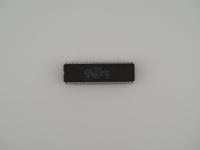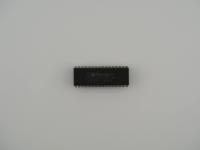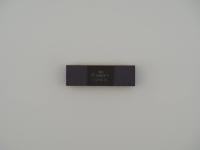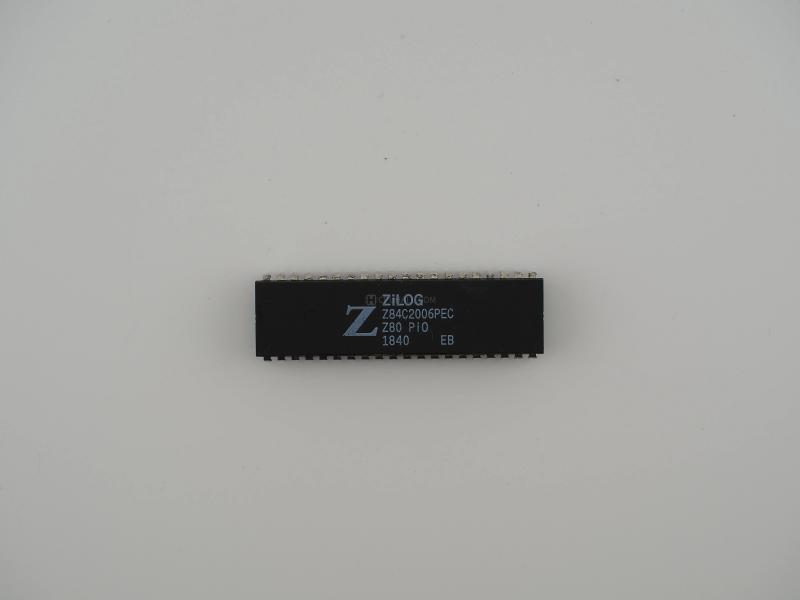

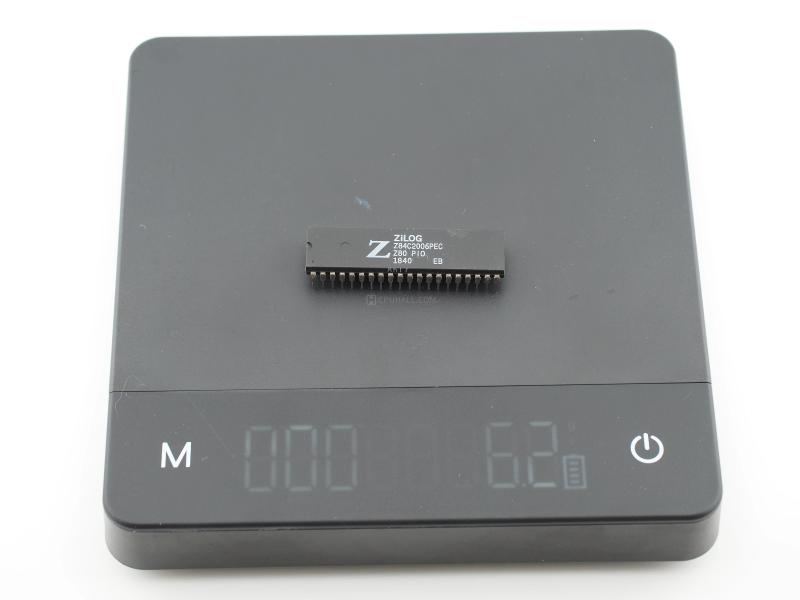
This is the workhorse of the computing revolution. Weighing in at exactly 6.2 grams, the artifact is housed in a standard, matte black plastic dual in-line package with forty tin-plated pins.
Looking closely at the top surface under macro lighting, the laser-etched typography is incredibly crisp against the dark plastic substrate. The markings read:
ZiLOG
Z84C2006PEC
Z80 PIO
1840      EB
The stylized "Z" logo is a hallmark of Zilog's branding. Flipping the chip over reveals a completely unadorned bottom surface, save for the circular mold injection marks typical of high-volume plastic resin encapsulation. The pins are remarkably straight and free of oxidation, hinting at careful storage or very recent manufacturing.
To understand the Z84C2006PEC, we have to dive into the architecture of system peripherals. This is not a central processing unit. Instead, it is a Parallel Input/Output controller designed specifically for the Z80 microcomputer ecosystem.
The original Z80 chips were built on power-hungry NMOS logic. The C in this part number indicates that this is a later CMOS fabrication. This transition to Complementary Metal-Oxide-Semiconductor logic drastically reduced power consumption and allowed the chip to operate entirely cool to the touch.
This specific silicon provides two independent 8-bit bidirectional peripheral interface ports. Its real engineering genius lies in its interrupt handling. Zilog designed their peripherals to use a proprietary daisy-chain interrupt structure. When an external device needed attention, the PIO could automatically place a programmable vector onto the data bus, allowing the main Z80 CPU to instantly jump to the correct service routine without wasting clock cycles polling devices. The 06 in the part number denotes a certified maximum clock speed of 6 MHz, which was plenty fast for interfacing with printers, industrial relays, or custom control panels.
While the Z80 CPU gets all the glory for powering early home computers and arcade machines like Pac-Man, the system was actually a family of carefully orchestrated chips. The PIO was the crucial bridge between the digital brain and the physical world.
There is a running joke among vintage hardware engineers that you can build literally anything with a Z80 and a handful of PIO chips. From traffic light controllers to the complex automated test equipment of the 1980s, this silicon was omnipresent. The most fascinating aspect of this specific architecture is its sheer refusal to die. While Intel abandoned their early 8-bit architectures, Zilog kept the Z80 line alive for decades to serve the deeply embedded industrial market. Engineers loved it because the instruction set was completely understood and incredibly reliable.
I am completely confident in the identification of this artifact. The surface nomenclature leaves zero room for ambiguity. By breaking down the Z84C2006PEC string, we get a perfect map of its capabilities.
The Z84C20 base designates it as a CMOS Z80 PIO. The 06 confirms the 6 MHz speed grade. The suffix P indicates the Plastic DIP packaging, while the E usually points to an extended industrial temperature operating range. The final C signifies RoHS compliance, meaning it was manufactured without lead.
The most striking detail is the date code 1840. In standard semiconductor YYWW format, this points to the 40th week of 2018. It is absolutely wild to hold a chip in my hand that belongs to a computing family introduced in 1976, yet was freshly minted off a fabrication line in the 21st century. It serves as a physical testament to the enduring brilliance of Federico Faggin and the original Zilog engineering team.