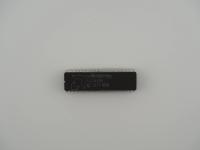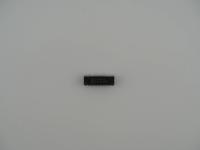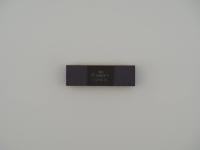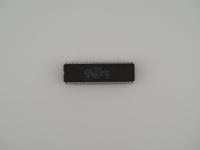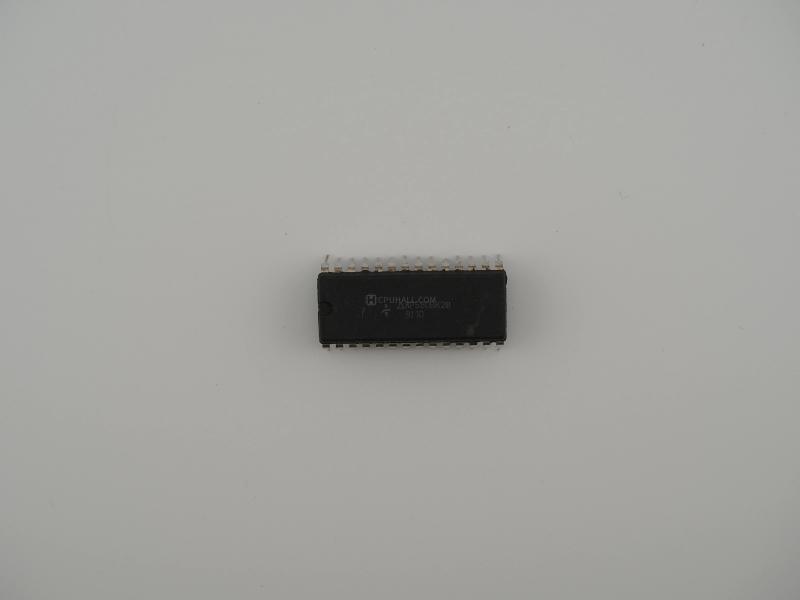

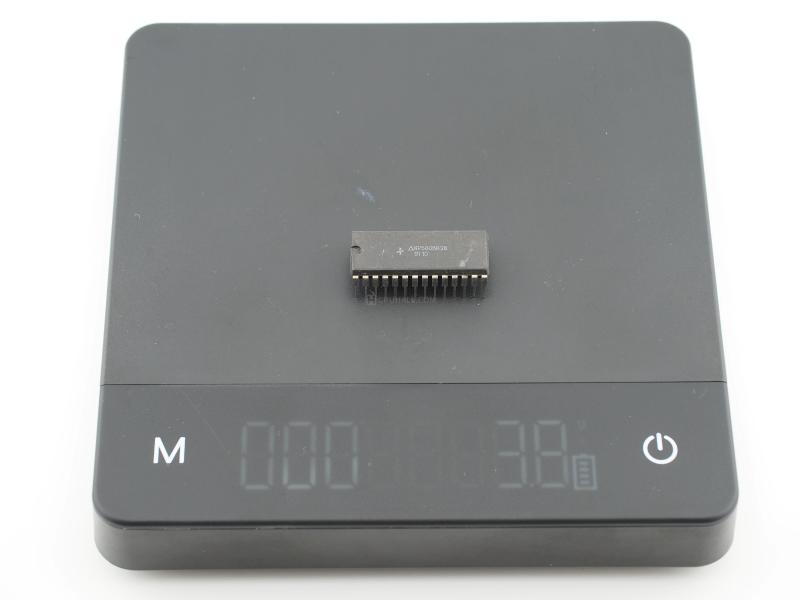
This is a mass-produced chunk of Soviet pragmatism. When I throw it on the scale, it registers a modest 3.8 grams. Laying it against the ruler shows a standard length of roughly 34 millimeters, confirming its classic 28-pin dual in-line package footprint.
Looking closely at the top of the black plastic epoxy, we can see the laser-etched markings shining faintly against the matte surface. The text reads:
(Logo) ΔKP580BK28
       91 10
The pins are standard tin-plated copper, showing mild oxidation but remarkably straight considering the age. The texture of the plastic package is slightly porous, lacking the smooth sheen you often find on contemporary NEC or Texas Instruments chips. The printing itself is a bit chalky. This artifact tells a distinct visual story of Cold War manufacturing priorities where function entirely eclipsed form.
To understand this chip, we have to look at the architecture it supports. The KR580VK28 is a direct, unauthorized clone of the Intel 8228. In the late 1970s, microprocessors were not the neat, single-chip solutions we know today. The Intel 8080 was notoriously weird about its pinout and bus management. Because it was crammed into a 40-pin package, Intel had to multiplex the status signals onto the main data bus during the SYNC cycle.
This is where our little chip comes in. The VK28 acts as the system controller and bus driver. It sits right next to the main processor, catches that multiplexed status word, latches it, and generates the clean control signals the rest of the motherboard desperately needs (like Memory Read, Memory Write, I/O Read, and I/O Write). It also provides a crucial bidirectional data bus buffer to ensure the fragile 8080 does not get fried by electrical noise from the peripherals.
Fabricated using an older NMOS process, this chip is designed to interface directly with the high-voltage madness of early 8080 systems, which required a completely absurd mix of +5V, -5V, and +12V power rails.
The history of the K580 series is essentially the history of Soviet computing espionage and reverse engineering. The Iron Curtain restricted the import of advanced Western microelectronics. The Soviet Ministry of Electronic Industry responded by simply taking Western chips apart, photographing the silicon dies through microscopes, and painstakingly copying the logic gates to build their own masks.
What makes this specific unit so fascinating is the date code. 1991, week 10. This little piece of reverse-engineered 1974 Intel technology was stamped out in a Soviet factory right as the USSR itself was collapsing. By 1991, the West was marveling at the Intel 486. Meanwhile, Soviet factories were still churning out 8080 support chips for domestic industrial control systems, embedded hardware, and hobbyist computers like the legendary Radio-86RK. The sheer technological inertia of the Soviet state is perfectly crystallized in this 3.8-gram plastic rectangle.
Identifying Soviet ICs requires reading Cyrillic and understanding the state nomenclature system. The markings on this chip break down beautifully once you know the cipher.
The prefix K denotes a commercial grade part, intended for civilian or standard industrial use. The P (which is the Cyrillic 'П') stands for "plastmassovy", meaning a plastic package rather than military-grade ceramic. The 580 designates the microchip family, which was the official Soviet designation for the Intel 8080 ecosystem. Finally, the VK28 (Cyrillic 'ВК28') identifies the specific function, translating to the system controller.
The small triangle symbol preceding the part number is a common Soviet factory mark, often indicating a specific quality assurance test or a specialized production run for export. The abstract, half-bird looking logo to the left is the manufacturer mark. Based on my research into Soviet semiconductor plants, this specific icon points to the Gamma plant located in Zaporozhye, Ukraine.