
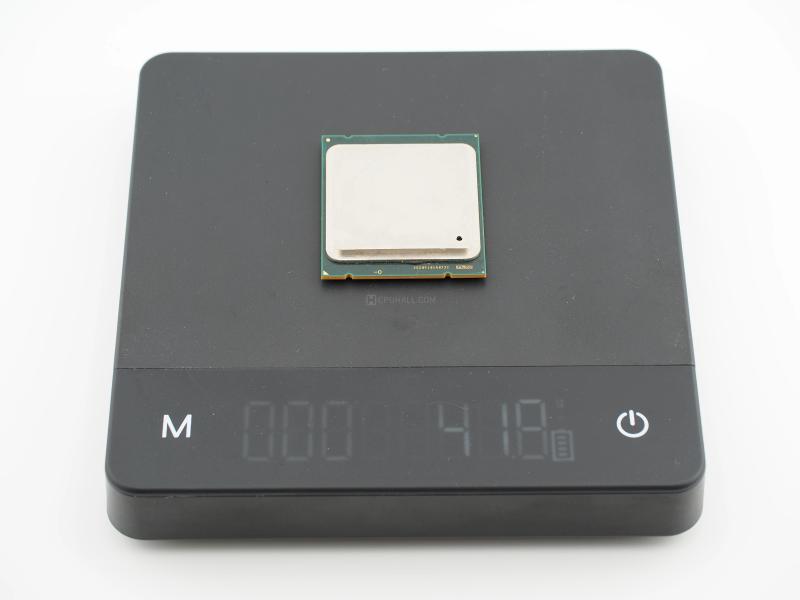
Tipping the scale at exactly 41.8 grams, this is a substantial block of copper and silicon. The LGA-2011 package is famously massive compared to its mainstream desktop counterparts of the era, and the integrated heat spreader reflects that bulk. The manufacturing facility in Costa Rica turned out some incredibly reliable silicon during this era.
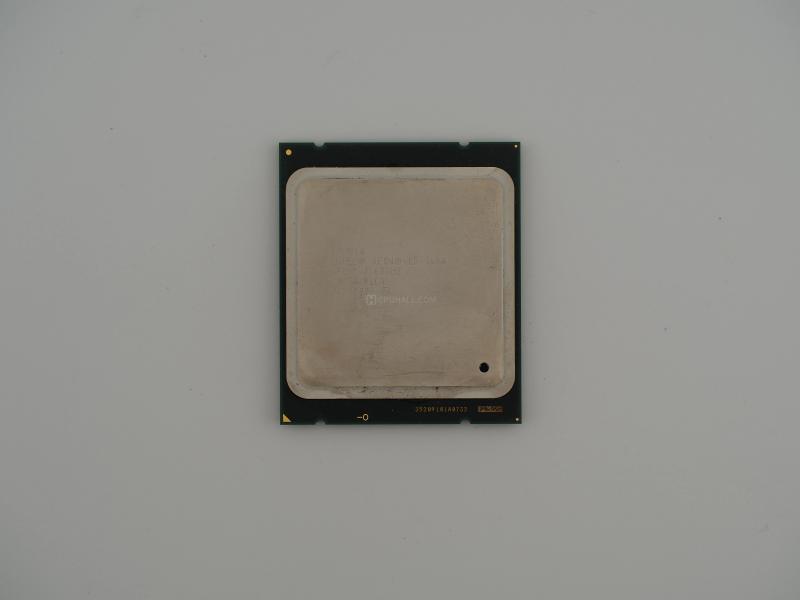
Here is the exact surface text transcription:
i (M) (C) 10
INTEL (R) XEON (R) E5-1620
SR0LC 3.60GHZ
COSTA RICA
3221C003 (e4)
Flipping this artifact over reveals the sprawling 2011-pad grid array. But what truly makes this specific unit fascinating is a tiny blue and white paper sticker placed dead center among the surface mounted capacitors. The sticker reads 撕毁无效 2025 11 12. This translates to "Void if torn," with a warranty expiration date of November 12, 2025. This tells an incredible story about the modern lifecycle of server hardware, which I will dig into later. The gold plating on the pads looks reasonably clean, showing only minor insertion marks from whatever socket it was previously clamped into.
This chunk of silicon represents the Sandy Bridge-EP microarchitecture, fabricated on Intel's highly mature 32nm process node. While the consumer Sandy Bridge chips were revolutionary in their own right, the "EP" (Efficient Performance) line designed for the LGA-2011 socket took things to an entirely different level.
The Xeon E5-1620 is a quad-core processor with hyper-threading enabled, giving it eight logical threads. Running at a base clock of 3.60 GHz with a turbo boost up to 3.80 GHz, it was remarkably fast for single-threaded workloads in 2012. It packs 10MB of Intel Smart Cache.
The real engineering marvel of this platform, however, is the I/O. This chip features an integrated quad-channel DDR3 memory controller, capable of delivering massive memory bandwidth that dual-channel consumer chips could only dream of. Furthermore, it supports 40 PCIe 3.0 lanes directly from the CPU. This made the LGA-2011 platform an absolute powerhouse for workstations requiring multiple high-end GPUs or RAID controller cards.
All of this capability comes at a thermal cost. The TDP (Thermal Design Power) is rated at a hefty 130 watts. It requires a serious cooling solution to keep the massive die operating within optimal thermal parameters, which explains the physical bulk of the heat spreader.
The Sandy Bridge architecture is universally recognized as one of Intel's greatest triumphs. It provided a massive leap in IPC (Instructions Per Clock) over the previous Nehalem and Westmere generations. The Xeon E5-1600 series was specifically targeted at single-socket workstations, competing directly with high-end desktop parts but offering enterprise-grade reliability and ECC memory support. You would typically find this exact chip powering heavy duty engineering rigs like the HP Z420 or the Dell Precision T3600.
But the true lore of this specific unit lies in its second life. Remember that Chinese warranty sticker on the back?
Around 2018, data centers and enterprise environments began mass-decommissioning their Sandy Bridge-EP servers and workstations. Millions of these capable Xeons flooded the secondhand market, driving prices down to literal pocket change. In response, resourceful overseas manufacturers began engineering entirely new, unbranded "X79" motherboards. They salvaged desktop chipsets (like H61 or B75) and adapted them to the massive LGA-2011 socket, creating incredibly cheap Frankenstein kits that paired high-end server CPUs with budget server RAM.
This specific unit was clearly swept up in that grey-market renaissance. The fact that a chip minted in 2012 carries an active warranty sticker valid until late 2025 is hilarious and awesome. It highlights the absolute durability of Intel's 32nm silicon and the relentless ingenuity of the aftermarket PC building community.
Identifying this processor requires no guesswork. The S-Spec SR0LC uniquely and definitively identifies it as the OEM/Tray version of the Intel Xeon E5-1620.
Decoding the FPO (Finished Process Order) batch code 3221C003 gives us the exact manufacturing timeline.
3 represents the location (Costa Rica).2 represents the year (2012).21 represents the week of that year.C003 are internal lot tracking digits.Therefore, this specific processor rolled off the Costa Rican assembly line in the 21st week of 2012. It likely served a full five-to-seven year life cycle in an enterprise workstation before being ripped out, tossed into a bin with thousands of identical chips, shipped across the world, tested by a secondhand hardware vendor, slapped with a warranty sticker, and sold once again to a budget PC builder. It is a fantastic piece of functional history.