
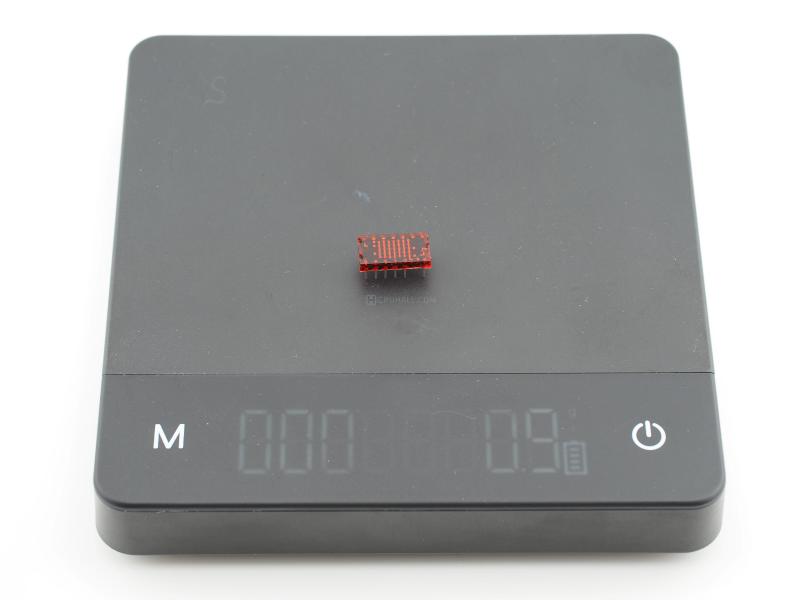
Tipping the scales at a mere 0.9 grams and measuring exactly 10 millimeters across the long edge, this artifact is incredibly diminutive. This is not a complex logic engine crunching floating point math. Instead, it is the raw vocal cord of a vintage machine.
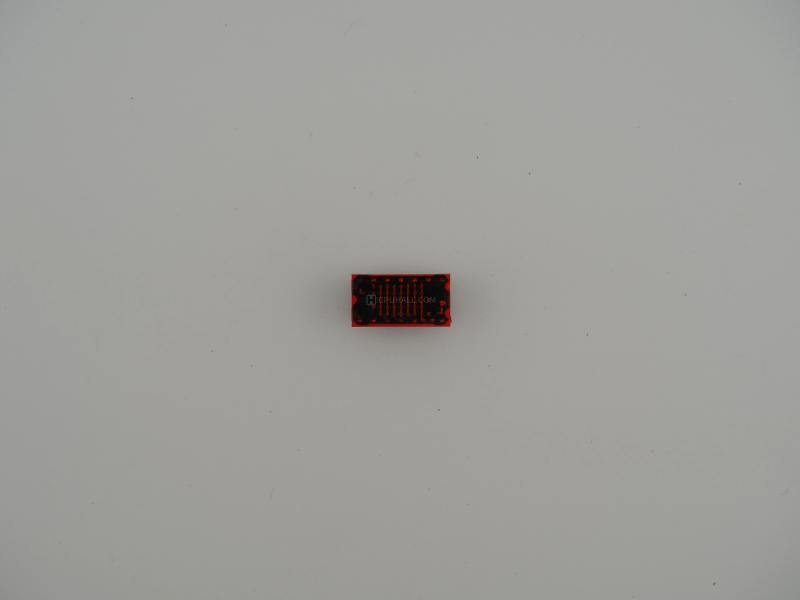
Visually, this component is a masterpiece of early optoelectronic packaging. The top face gives us a direct, unobstructed view through the translucent ruby red epoxy resin. We can clearly see the 5x7 grid of individual light emitting diode dies, complete with the microscopic gold wire bonds routing back to the lead frame. It looks like a tiny insect trapped in futuristic amber. Flipping it over, the black backing is sealed securely, with rigid, widely spaced pins indicating a standard breadboard friendly pitch.
The surface text requires some careful lighting to fully decode, but the white screen printing and the overlapping red factory stamps tell a distinct story:
[White Silkscreen]
L T P 3 0 5 R
418THAILAND

[Red Factory Overstamp]
K66A (Vertical, Left)
B345 (Horizontal, Right, Partial)
Diving into the technical weeds, the LTP-305R is a masterclass in minimalist electronic engineering. What we are looking at is a 5x7 alphanumeric dot matrix display. Inside that red resin block sits 35 individual Gallium Arsenide Phosphide (GaAsP) LED dies.
If you count the pins, you will notice there are only 14 of them forming the DIP-14 package. How do you drive 35 individual lights with only 14 pins? The answer is multiplexing. The internal wiring is arranged in a row and column matrix. To light up a specific pixel, the host hardware must rapidly scan through the columns, applying power to the specific rows needed for that slice of the character, and then move to the next column faster than the human eye can process. It relies entirely on persistence of vision.
There is no onboard logic here. No character ROM. No shift registers. This is an entirely "dumb" display. It requires the host CPU or a dedicated driver IC to constantly babysit it, blasting the matrix with precise timing just to keep a static number visible on the screen. It is raw hardware integration at its finest, demanding cycle accurate respect from whatever processor is driving it.
While the massive ceramic multi chip modules and gold plated microprocessors of the 1980s get all the glory, chips like the LTP-305R did the actual talking. Before high resolution LCDs became cheap and ubiquitous, if a piece of hardware needed to communicate a complex status code, an alphanumeric character, or a simple reading, it used these matrices.
You would find banks of these slotted into high end Hewlett Packard logic analyzers, aerospace diagnostic panels, and premium pocket calculators. They run hot, they consume a relatively massive amount of current compared to modern liquid crystals, and they have an undeniable, aggressive red glow that instantly screams "Cold War technology."
Today, there is a massive cult following for these specific micro displays. The modern maker community hunts down vintage New Old Stock tubes of LTP-305 displays to build cyberpunk wearables, miniature retro clocks, and bespoke readouts. The aesthetic of the visible die matrix is simply something that modern diffused LEDs cannot replicate.
I am highly confident in the identification of this artifact. The LTP prefix is the historical standard nomenclature for Lite-On Optoelectronics, one of the most prolific manufacturers of LED indicators during the late 20th century. The 305 indicates the specific 0.3-inch character height 5x7 matrix series, and the R designates the standard Red emitting color.
The 418THAILAND stamp confirms the manufacturing origin. Lite-On, like many semiconductor companies, heavily utilized Thai fabrication and assembly plants for optoelectronics throughout the 1980s and 1990s. The red overstamp is a classic factory quality control mark. The B345 likely translates to a date code of the 45th week of 1983, perfectly aligning with the visual style, pin brazing techniques, and material choices of the era. This tiny block of red resin is a perfect, functional snapshot of early 80s interface design.