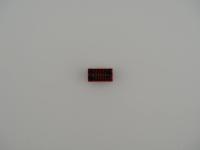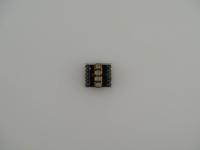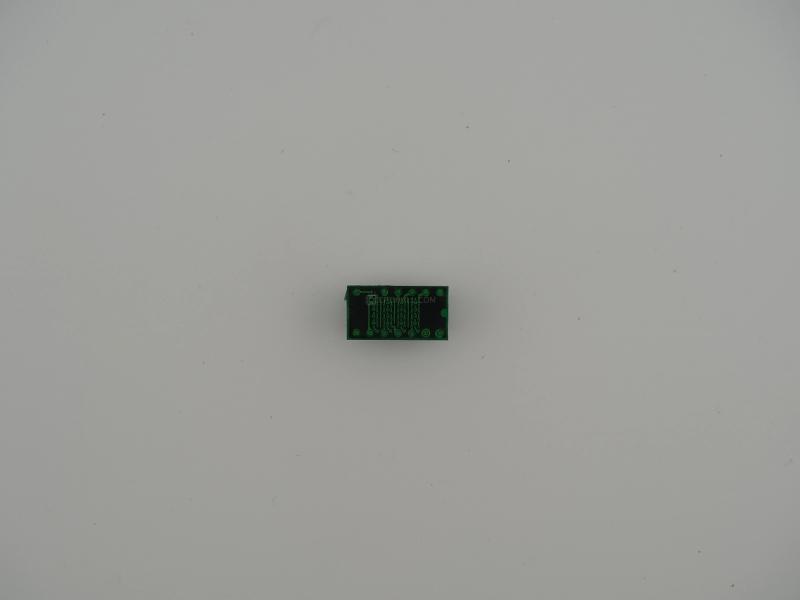

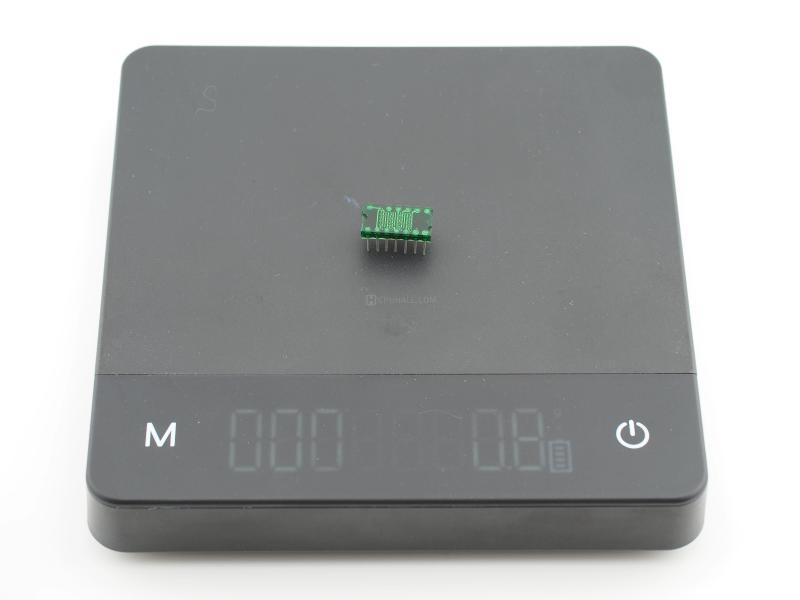
Holding this piece, I am immediately struck by how jewel-like it is. Clocking in at barely 0.8 grams on the scale, this artifact is a beautiful departure from the heavy ceramic and gold-plated behemoths that usually dominate my collection. What we are looking at is an incredibly tiny 0.3-inch 5x7 dot matrix LED display encased in a deep, transparent green optical resin.
Transcribed Markings:Bottom Face: MTAN2135-AG
When you flip the DIP-10 package over to its top face (the side with the orientation notch), you can look directly through that green lens. Right in the center, surrounded by delicate routing traces, is a microscopic 5x7 grid of light emitting diodes. The physical traits are pristine. The texture of the resin is smooth but features small circular standoffs perfectly aligned with the pins below, designed to seat the lens flush against a chassis window or a control panel bezel. The substrate itself is a standard green FR4 fiberglass, repurposed into a dual in-line package with ten rigid, straight-cut pins soldered directly to the perimeter pads.
Diving into the optoelectronics of this module reveals some fascinating architectural quirks. Standard 5x7 dot matrix displays contain 35 individual light emitting diodes. To drive them using a standard row and column multiplexing scheme, you mathematically need 12 pins (specifically 5 columns and 7 rows).
The fact that Marktech engineered this into a strict 10-pin footprint is brilliant. It implies that there is either a highly specific, proprietary multiplexing matrix at play, or there is a microscopic CMOS driver die wire-bonded directly under that resin alongside the LEDs handling the decoding internally. Peering through the green resin, you can clearly see the intricate trace routing carrying signals from the ten perimeter through-hole pins toward the central die area. The green FR4 fiberglass substrate acts as both the structural base and the PCB, allowing for an incredibly lightweight package. Thermally, this unit runs cold, drawing only minimal milliamperes to illuminate the tiny junctions.
Marktech Optoelectronics has been a major player in high-reliability specialized lighting since the mid 1980s. While modern electronics use OLEDs or high-density LCDs for complex readouts, there was an era where military, aerospace, and high-end industrial equipment required alphanumeric displays that could survive extreme conditions.
These micro dot matrix units were the heavy metal solution to a very specific problem. A standard 7-segment display is useless if you need to output full alphabetical characters or complex system symbols. By shrinking a full 5x7 matrix down to a 0.3-inch package, engineers could pack dynamic text readouts into the tightest control panels, rack mounts, and embedded testing equipment. Because they are solid-state and encased entirely in rigid optical epoxy, they are virtually immune to the intense vibrations and pressure shifts that would shatter a standard hollow-cavity glass display. Hardware preservationists and vintage synth enthusiasts often hunt for these exact modules to restore obscure 1980s studio gear.
The crude silver stamping on the bottom reads MTAN2135-AG, though the final character is easily mistaken for a 6 due to the low resolution of the ink stamp bleeding into the fiberglass weave.
The prefix MT clearly stands for Marktech, while AN historically denotes their Alphanumeric display line. Finding these modules intact and unmounted is quite rare today. Most were permanently soldered into expensive industrial machinery that was eventually scrapped and recycled for heavier metals. Having this specific unit resting loose in the museum provides a rare, naked view of how component manufacturers solved complex interface and space limitation problems before the era of cheap, ubiquitous liquid crystal screens. It is a fantastic piece of vintage optoelectronics that perfectly captures the industrial design ethos of its time.