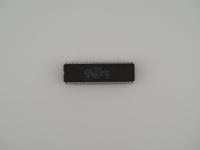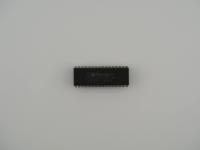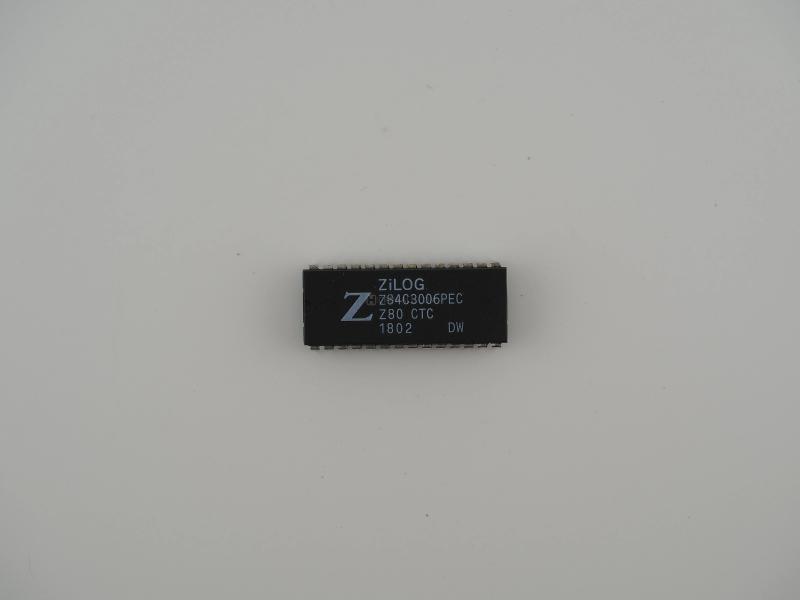

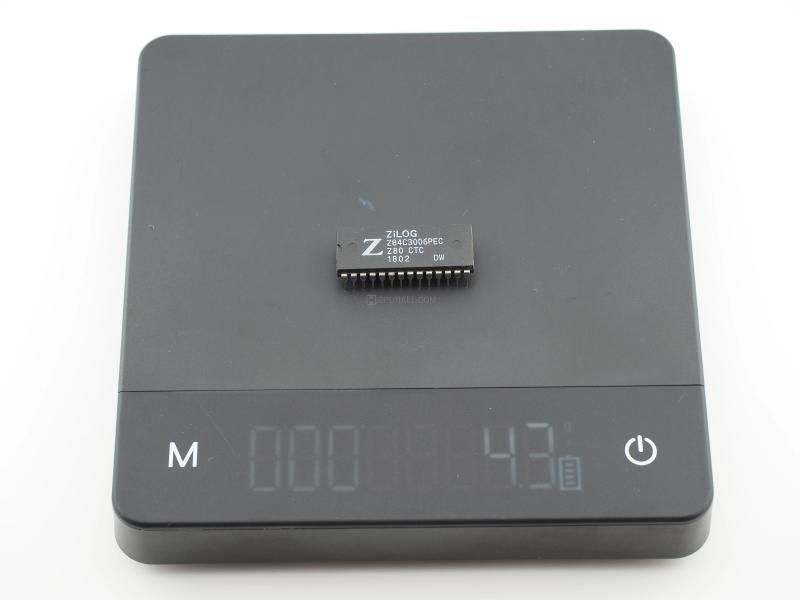
Unlike the battered, heavily oxidized chips pulled from 1980s arcade cabinets, this specific unit looks like it just rolled off the assembly line. The package is a standard black plastic Dual In-line Package (PDIP) with 28 pins. Weighing in at exactly 4.3 grams on the scale, it possesses that classic, utilitarian feel of vintage computing hardware, but the surface details tell a different story.
The laser etching is incredibly sharp and high-contrast, a hallmark of modern semiconductor marking rather than the white stamped ink typical of the original 1970s runs. Here is the exact transcription of the surface text:
(Large Z Logo) ZiLOG
               Z84C3006PEC
               Z80 CTC
               1802     DW
The pins are straight, unbent, and show a dull silver finish rather than the bright gold or heavy tin plating seen on older military or ceramic parts. It is a humble, plastic workhorse, but its pristine condition makes it a fascinating specimen for the collection.
To understand the Z80 Counter/Timer Circuit (CTC), we have to look at the genius of the Zilog Z80 ecosystem. This is not a central processing unit. Instead, it is a dedicated peripheral chip designed to take a massive load off the main CPU.
The CTC features four independent, programmable channels. Each of these channels can be configured to act as either a counter (counting external events) or a timer (generating interrupts at specific intervals). In the early days of microcomputing, making the CPU pause its execution to manually count clock cycles for timing operations was a massive waste of processing power. The CTC solved this by handling the timing autonomously and tapping the CPU on the shoulder via an interrupt only when a specific task was complete.
What makes the Z80 family so legendary is its daisy-chained interrupt structure. You could wire multiple peripheral chips like this CTC, the Parallel Input/Output (PIO), and the Serial Input/Output (SIO) together. If two devices demanded the CPU's attention simultaneously, the hardware daisy chain automatically resolved the priority without requiring complex software polling.
This particular artifact is a CMOS variant. The original 1970s chips were built using NMOS technology, which ran famously hot and consumed a fair amount of power. The shift to CMOS (Complementary Metal-Oxide-Semiconductor) allowed these chips to run much cooler and draw significantly less current, which became vital as the Z80 architecture shifted from desktop computers into deeply embedded industrial controllers and portable devices.
The legacy of the Z80 is absolute heavy metal. It was the brains behind the ZX Spectrum, the Master System, early arcade cabinets like Pac-Man, and countless synthesizers. But the CPU alone did not conquer the world. It was the complete, elegant chipset provided by Zilog that made engineers fall in love. You did not need a messy board full of generic logic gates to make a computer. You just dropped a Z80 CPU next to a Z80 CTC and a Z80 PIO, and you had a complete, sophisticated system.
There is a funny irony with chips like this. Because it is housed in standard black plastic, it lacks the visual "wow" factor of a massive IBM thermal conduction module or a gold-capped Soviet clone. Visitors to the museum often gloss over these little black rectangles. Yet, without chips exactly like this one orchestrating the timing of audio chips, video generation, and memory refreshes, the 8-bit revolution simply would not have happened the way it did.
Identifying this chip is straightforward, but the date code provides a brilliant twist.
The part number Z84C3006PEC breaks down perfectly according to Zilog's standard nomenclature. The Z84C30 designates it as the CMOS version of the Z80 CTC. The 06 indicates its speed grade, specifically rating this part for a maximum clockspeed of 6 MHz. The P confirms the plastic DIP package, and the EC typically relates to the environmental and temperature compliance standards for the run.
But the real magic is the batch code: 1802. In semiconductor manufacturing, this format universally points to the manufacturing date. This chip was fabricated in the second week of 2018.
Let that sink in. The Z80 architecture was introduced in 1976, and the original CTC followed shortly after. Over forty years later, the demand for this exact logic structure in legacy industrial systems, embedded controllers, and hobbyist projects was still strong enough to justify silicon foundries pressing brand new batches. Holding this chip is like holding a living fossil, a piece of 1970s engineering immortalized in 21st-century silicon. It seems crazy, but Zilog (which was later acquired by Littelfuse) continued to manufacture the Z80 microprocessor family and its peripheral chips well into the 21st century. In fact, Zilog only just announced the official "End of Life" (EOL) for the standalone Z80 CPU in April 2024.