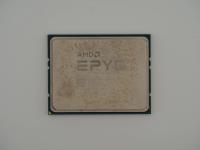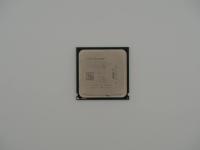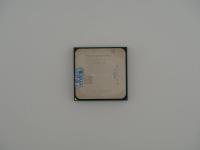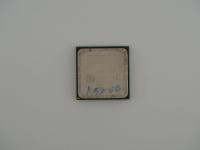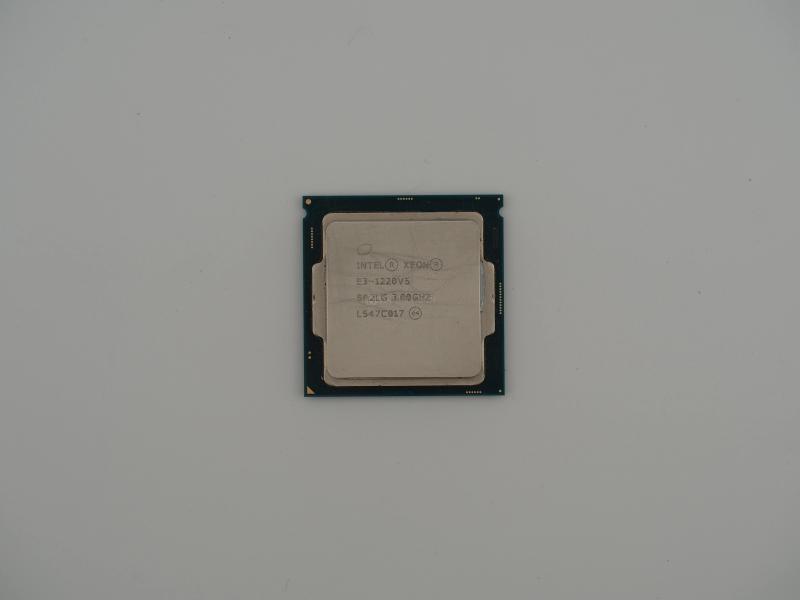

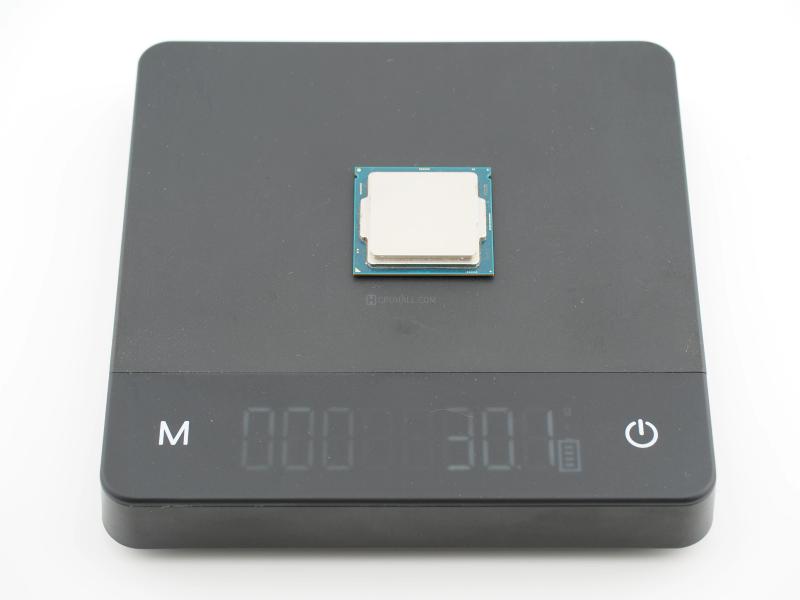
I placed this specific unit on my digital scale, and it clocked in at exactly 30.1 grams. That weight is almost entirely the nickel-plated copper Integrated Heat Spreader (IHS), designed to wick thermal energy away from the silicon die beneath it. Holding this piece, I immediately noticed the slight clouding and micro-abrasions on the surface of the heat spreader. This tells me it spent years pressed hard against a server heatsink, doing exactly what it was engineered to do.
INTEL (R) XEON (R)
E3-1220V5
SR2LG 3.00GHZ
L547C017 (e4)
Flipping the artifact over to view the underside reveals the vast grid of gold-plated contact pads. Sitting next to my bench ruler, it measures exactly 37.5 millimeters squared. This is the LGA-1151 package, and the dense cluster of microscopic surface-mount capacitors in the center is a dead giveaway of the 14-nanometer Skylake generation.
Let us look closely at what Intel packed inside this fiberglass envelope. The Xeon E3-1220 v5 is a quad-core processor built on the 14nm fabrication node. Notice that I did not say quad-core with hyperthreading. The 1220 tier was notoriously stripped down; it offered four physical cores and exactly four threads.
It carries a base clock of 3.00 GHz and can boost up to 3.50 GHz under load, backed by a healthy 8MB of Intel Smart Cache. Operating at an 80W TDP, it was an incredibly efficient chip for single-socket tower servers or small rackmount network appliances.
From an architectural standpoint, the Skylake design was a massive leap. It introduced dual memory controllers capable of supporting either DDR4 or DDR3L ECC memory. However, the engineering here is less about the physical silicon and more about the artificial boundaries programmed into the microcode.
If there is a reason to keep this otherwise mundane piece of server silicon in a museum, it is purely historical. For years leading up to 2015, the PC hardware community had a brilliant loophole. Enthusiasts would buy Xeon E3 processors from the Sandy Bridge, Ivy Bridge, and Haswell generations and drop them into cheap consumer desktop motherboards. You essentially got Core i7 performance for the price of a Core i5, minus the integrated graphics.
When this chip, the Skylake-based v5, hit the market, Intel finally slammed the door shut. They hardcoded a block into the microcode and the platform controller hub. If you wanted to run an E3-1200 v5 series processor, you absolutely had to use a motherboard equipped with the expensive enterprise C232 or C236 chipsets. You could not drop this 30.1-gram block into a standard Z170 gaming board.
The enthusiast community was furious. This exact processor lineage went from being a coveted secret weapon to an ignored enterprise-only commodity overnight. When I look at this chip, I see the literal embodiment of corporate market segmentation.
The physical evidence here is irrefutable. The SR2LG S-Spec stamped directly onto the IHS is Intel's unique identifier for the production stepping of the Xeon E3-1220 v5.
Furthermore, the batch number L547C017 allows us to precisely date the birth of this artifact. The "L" points to Intel's massive fabrication and assembly facilities in Malaysia. The "5" indicates the year 2015, and "47" tells us it was manufactured in the 47th week of that year. This places its origin perfectly in the mid-November launch window of the Skylake enterprise lineup. The (e4) marking on the bottom right of the IHS text is a standard environmental indicator, assuring us that the internal packaging and solder are compliant with RoHS lead-free directives.
There are no mysteries here, just cold, hard, meticulously documented manufacturing data from the world's most rigid semiconductor company.