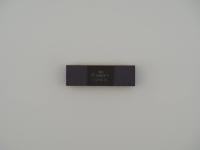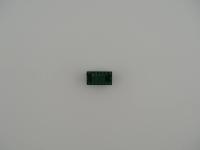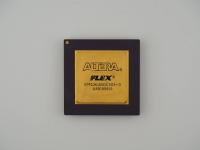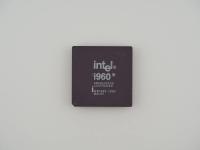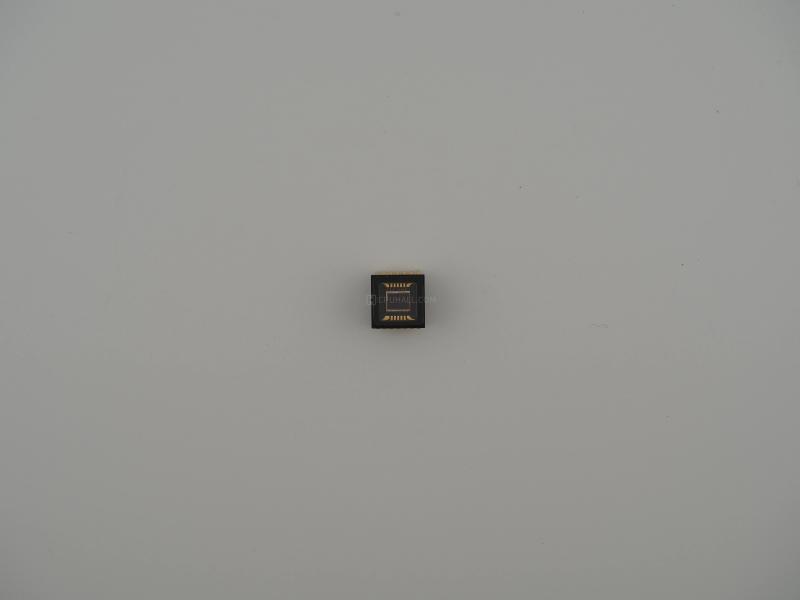

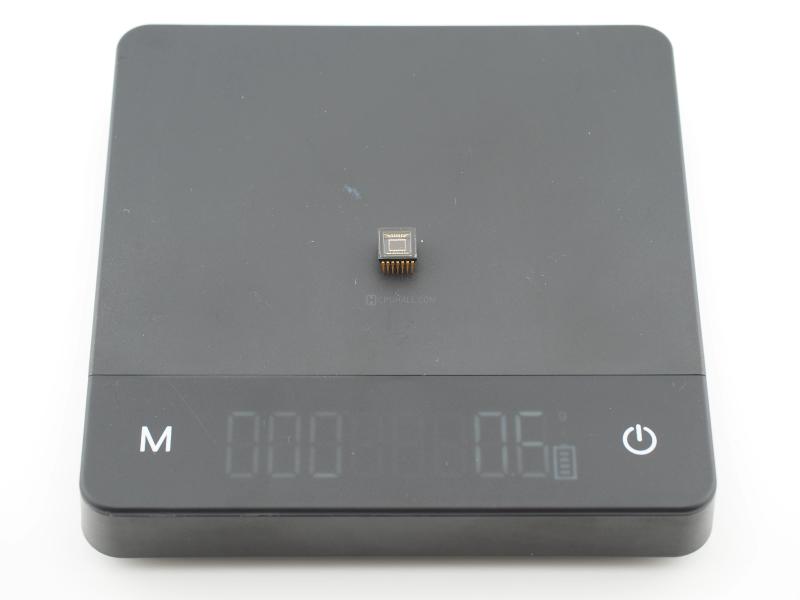
When I first placed this chip on the scale, it registered a mere 0.6 grams. It is a remarkably tiny piece of silicon history.
JAPAN
SHARP
RJ2451
CAOPB
09485SA
Holding this unit, the first thing that strikes you is the pristine glass window. Unlike standard microprocessors sealed away in solid ceramic or epoxy, this chip is designed to look back at you. The package is a classic 14-pin Ceramic Dual In-line Package (CDIP-14), coated in a deep matte black. Flipping it over, the heavy gold plating on the pins catches the light perfectly. The laser etching on the back is incredibly crisp, with the white pin-1 indicator dot resting just above the Sharp logo. Peering through the top glass under macro magnification, the silicon die itself is clearly visible, surrounded by microscopic gold wire bonds bridging the die to the lead frame.
This is a Charge-Coupled Device, or CCD. Before modern CMOS sensors took over every smartphone on the planet, CCDs were the absolute king of digital imaging. The engineering here is fundamentally different from a traditional CPU. Instead of processing logic gates, the silicon under that glass window is a massive array of photosensitive capacitors.
When photons pass through the glass lid and strike the exposed die, they generate an electrical charge. The "coupled" part of the name refers to how this data is read out. The chip shifts the charge from one capacitor to its neighbor across the entire array, moving the data row by row down to a single output amplifier. It is a beautifully synchronized analog bucket brigade. The packaging itself is an engineering marvel. Sealing a delicate silicon die behind a flawless, optically clear glass window without introducing dust or condensation during manufacturing requires incredibly stringent cleanroom conditions. The black ceramic body is deliberately chosen to prevent stray light from penetrating the sides of the package and corrupting the sensor data.
Sharp was an absolute powerhouse in the optical component market throughout the 1990s and 2000s. While giants like Sony often grabbed the headlines for their consumer camera sensors, Sharp was quietly dominating the embedded space. You would find these RJ-series sensors in everything from high-end CCTV security systems to camcorders and industrial inspection equipment.
There is a lingering myth in the hardware community that CCDs are inherently "slower" or "worse" than modern CMOS sensors. That is only half the story. While it is true that modern CMOS sensors are cheaper to produce and easier to integrate with on-chip digital logic, purists still argue that vintage CCDs offer a unique color rendition and a global shutter aesthetic that is hard to replicate. The analog nature of the charge transfer gives images captured by these sensors a distinct, almost film-like quality that digital noise reduction algorithms have mostly scrubbed from modern photography.
Identifying this piece was straightforward thanks to Sharp's logical naming conventions. The RJ prefix is the dead giveaway for Sharp's CCD area sensor lineup. Based on the physical footprint and pinout, this is a 1/4-inch type or similar small-format image sensor.
The date code 09485SA is highly informative. In standard semiconductor dating, the 0948 points to the 48th week of 2009. This places the chip right at the sunset of the CCD era, just before CMOS sensors completely cannibalized the market. Finding one in this pristine, unmounted condition is a treat. It lacks the solder residue or bent pins you usually see on salvaged components, suggesting this was likely New Old Stock (NOS) pulled from an industrial repair bin or an aborted manufacturing run. While it might not carry the sheer compute prestige of an IBM TCM or a Cray logic board in my collection, it earns its place through sheer material beauty and its representation of the analog-to-digital visual revolution.