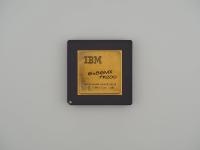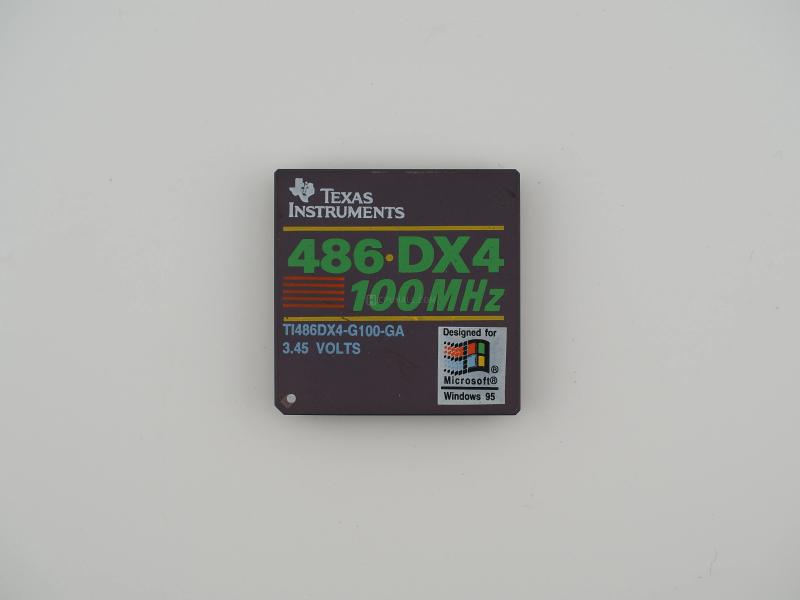

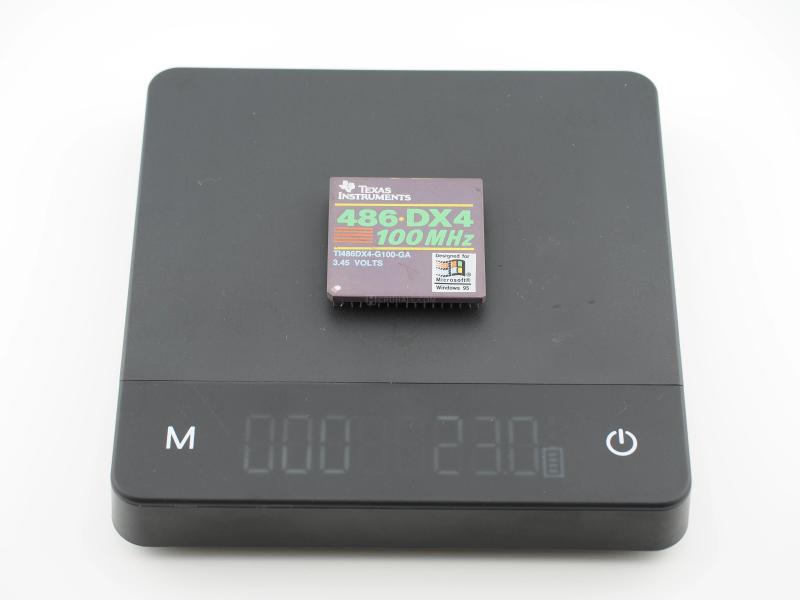
Unlike the sterile branding of modern processors, this artifact with its distinct color palette screams 1995. Weighing in at exactly 23.0 grams on my scale, it features a heavy, dark purple tinted ceramic substrate that feels incredibly dense.
The top face is dominated by the striking green and orange silk-screened text. I can clearly read the primary branding alongside a deeply nostalgic sticker:
TEXAS INSTRUMENTS
486-DX4 100MHz
TI486DX4-G100-GA
3.45 VOLTS
Designed for Microsoft Windows 95
Flipping this specific unit over reveals a standard 168-pin grid array. The gold pins show some slight oxidation and minor debris from decades of storage, but they remain remarkably straight. The central square heat spreader or cap on the underside contains faint but legible laser etchings. Under the macro lens, I can extract the following fab codes:
TAIWAN
CA1-61C41LT
4085977-0001
The text TAIWAN is actually printed twice on the bottom, once in the center cap and once vertically along the ceramic edge. The physical contrast between the matte ceramic, the reflective gold pins, and that colorful Windows 95 badge gives this chip a fantastic, distinct aesthetic.
Diving into the technical specifications, this is not an Intel processor. During the peak of the 486 era, Cyrix designed their own x86 compatible processors. However, Cyrix was a fabless company and needed manufacturing partners. Texas Instruments was one of their primary foundries. This TI486DX4-G100-GA is essentially a Cyrix Cx486DX4 core manufactured and branded by Texas Instruments.
The engineering here represents the absolute twilight of the 486 architecture. Running at 100 MHz, it utilized a clock multiplier (typically 3x on a 33 MHz front-side bus). Notice the 3.45 VOLTS marking. This is crucial. Early 486 motherboards supplied 5 volts to the socket. Pushing a chip to 100 MHz on a 5V rail would have generated an unmanageable amount of heat for a simple ceramic package without a massive active cooler. By dropping the core voltage to 3.45V, TI and Cyrix kept thermal output in check, allowing this chip to run comfortably with standard low-profile aluminum heatsinks.
Under the hood, these chips typically featured an 8KB write-back L1 cache, which made them incredibly snappy for integer operations and general desktop tasks, even if their floating-point units lagged slightly behind genuine Intel silicon.
This chip is a primary witness to the great CPU Clone Wars. The relationship between Cyrix and Texas Instruments was mutually beneficial until it wasn't. Because TI was manufacturing these chips, they negotiated the right to sell a portion of the yield under their own name. This led to fierce competition in the budget PC market, where TI was effectively undercutting the very company whose chips they were fabbing.
The inclusion of the "Designed for Microsoft Windows 95" logo is a brilliant piece of historical marketing. When Windows 95 launched, Microsoft heavily implied that users needed a Pentium processor for a good experience. The reality was that a fast 486 like this 100 MHz variant could run Windows 95 perfectly well. System integrators slapped these TI chips into budget motherboards, stuck the Win95 badge on the box, and sold them by the millions to consumers upgrading from their aging 386 machines.
There is no mystery regarding the identity of this artifact. The surface markings are explicit and perfectly align with known databooks from Texas Instruments. The TI486DX4-G100-GA part number explicitly denotes the 100 MHz clock speed and the 168-pin PGA package.
The bottom lot codes, specifically CA1-61C41LT, trace back to TI's Taiwanese fabrication facilities from that era. While not as rare as a supercomputer multi-chip module or a prototype stepping, this processor represents a crucial era of democratized computing. It is a flawless example of alternative silicon fighting for dominance in a market Intel was desperately trying to monopolize.