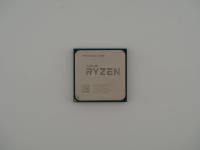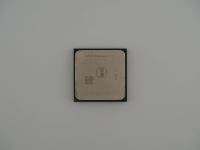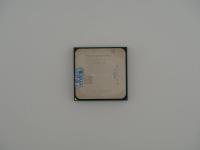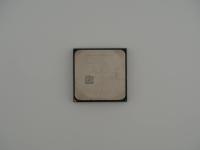

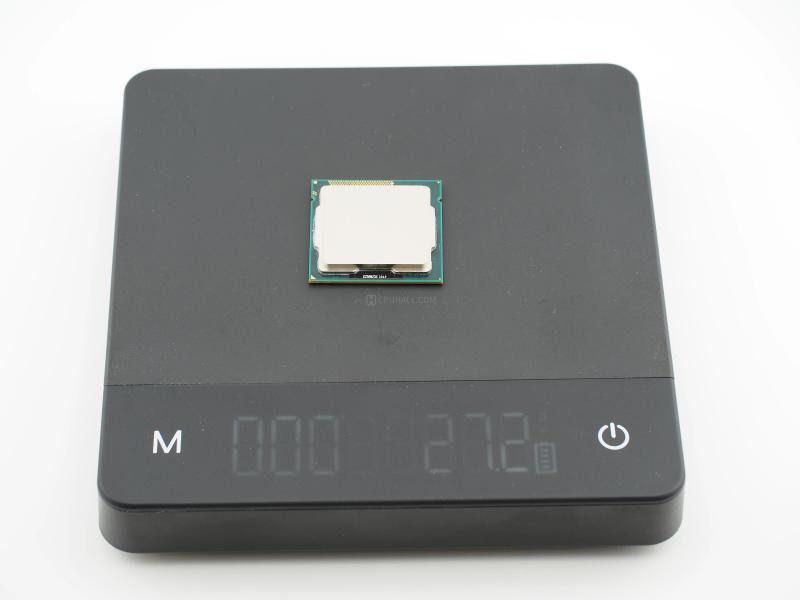
Dropping this artifact onto my digital scale, it reads exactly 27.2 grams. It is a dense, familiar weight. The green fiberglass substrate is completely intact, and flipping it over to inspect the gold-plated contact pads reveals an absolutely flawless LGA-1155 array. There is no carbon scoring around the central capacitor layout and no bent corners on the PCB.
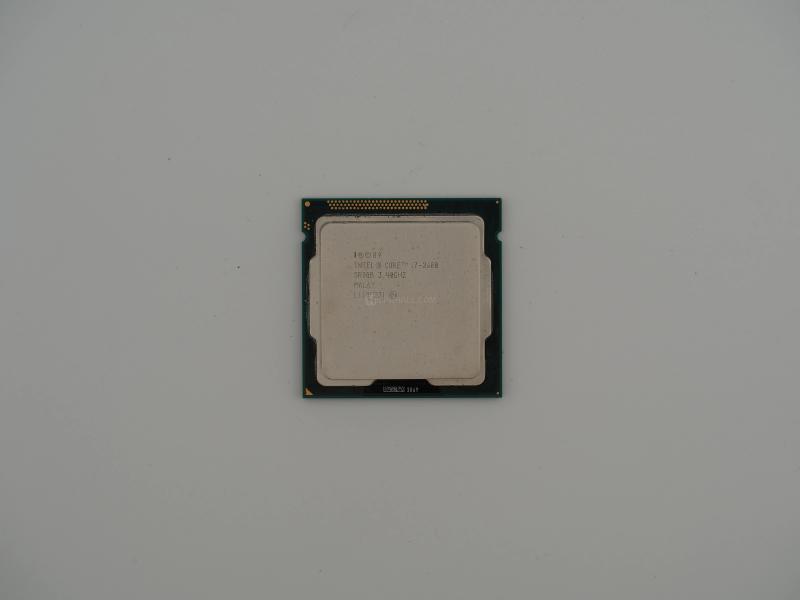
The laser etching on the nickel-plated copper is faint in certain lighting but perfectly legible under macro focus.
i (M) (C) 09
INTEL (R) CORE (TM) i7-2600
SR00B 3.40GHZ
MALAY
L119C231 (e4)
The aesthetics here are purely functional. Unlike the heavy ceramic and gold behemoths of the 1980s, this is modern high-volume manufacturing. Yet, there is a distinct beauty in its brutal efficiency.
We have to talk about what makes this piece of silicon tick. The Core i7-2600 is the beating heart of Intel's legendary Sandy Bridge microarchitecture, built on their cutting-edge 32-nanometer High-K Metal Gate process. This chip packs roughly 995 million transistors into a surprisingly compact 216 mm² die.
One of the most radical engineering achievements of this chip was the Ring Bus architecture. Prior to Sandy Bridge, connecting the processor cores, L3 cache, and the integrated GPU was a messy, high-latency affair. Intel wrapped all of these components around a unified, high-speed ring interconnect. This drastically reduced memory latency and allowed for massive bandwidth sharing.
Furthermore, this artifact includes the introduction of Advanced Vector Extensions (AVX). This 256-bit instruction set doubled the floating-point performance over the previous generation, making this chip a monster for rendering, scientific calculations, and multimedia encoding. Speaking of encoding, this generation also introduced Quick Sync Video, dedicating physical silicon space to hardware video encoding. It operated with a base clock of 3.4 GHz and could turbo up to 3.8 GHz under a very manageable 95W Thermal Design Power constraint.
Crucially, Intel used highly conductive fluxless solder to attach the silicon die directly to the metal heat spreader on this model. This thermal decision meant these chips ran incredibly cool under heavy loads.
Sandy Bridge is not just a processor architecture. It is an industry legend.
When Intel dropped this architecture in early 2011, it completely annihilated the competition and fundamentally shifted consumer expectations. The performance jump from the first-generation Nehalem architecture to Sandy Bridge was so violent and absolute that it essentially stagnated the CPU market for the next six years.
There is a hilarious irony to this chip. Intel built it too well. Consumers who bought a Core i7-2600 (or its unlocked sibling, the 2600K) realized they had absolutely no reason to upgrade for nearly a decade. Intel's subsequent architectures like Ivy Bridge, Haswell, and Skylake offered only meager single-digit percentage improvements in instructions per clock. While the 2600K gets all the glory in overclocking forums, the locked Core i7-2600 in my collection was the bedrock of millions of high-end workstations and premium pre-built gaming rigs.
Hardware enthusiasts still speak of Sandy Bridge with a deep, nostalgic reverence. It marks the last era where a single generation brought a truly mind-bending leap in raw performance before the dark ages of incremental four-core refreshes set in.
Reading the micro-contrast etching on the IHS tells us exactly where and when this specific processor was born.
The batch code L119C231 is our primary forensic key. The "L" indicates it was fabricated and packaged at Intel's massive facility in Malaysia. The "1" points to the year 2011, and "19" tells us it rolled off the assembly line during the 19th week of that year. This makes it a mid-2011 production unit.
The S-Spec code SR00B confirms this is the standard D2 stepping of the chip. This stepping was incredibly stable, featuring hardware virtualization support (VT-x and VT-d) and Intel Trusted Execution Technology. Everything about the surface text, the exact placement of the 1155 contact pads, and the surface mounted components on the rear confirms this is a genuine, retail-ready Sandy Bridge powerhouse. It is a fantastic, pristine representation of an era-defining architecture.